
By Joseph Siemandel, Joint Force Headquarters – Washington National Guard
The life of Lenny Wilkens was defined by service, leadership, and excellence—values that came full circle on Dec. 6, when the Washington Army National Guard rendered final honors to one of basketball’s most enduring figures and a former Army officer.
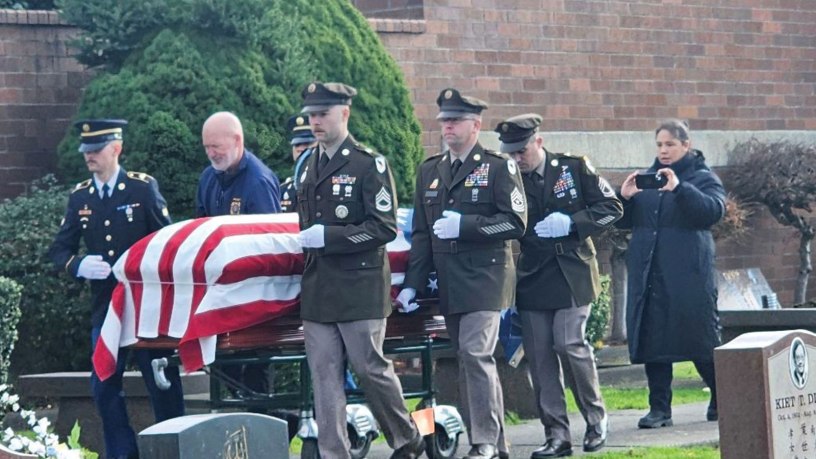
Wilkens, who died Nov. 9, 2025, at the age of 88, was laid to rest during a small family funeral at Sunset Hills Memorial Park in Bellevue, Washington. At the family’s request, an Honor Guard from the Washington Army National Guard supported the ceremony, serving as pallbearers, presenting the U.S. flag to the family, and assisting with additional honors. The quiet precision of the soldiers’ movements reflected the respect owed to a man whose life bridged military service and sporting greatness.
“Not a lot of people knew that Coach Wilkens was in the Army,” said Jim Ocon, a family friend of the Wilkens family. “So many people came up to me afterward and had no idea that the legendary coach had served in the Army.”
Wilkens’ life followed a steady progression of service and leadership that bridged military duty and basketball excellence. After entering the NBA in 1960 with the St. Louis Hawks, he was commissioned as a U.S. Army second lieutenant and served from 1961 to 1962 at Fort Lee, Virginia.
During that time, he balanced the responsibilities of military leadership with professional athletics, playing for the Hawks on weekends. On post, Wilkens served first as a company executive officer and later as a company commander, developing the discipline, organization, and leadership skills that would define his future success. Before and during his military service, Wilkens was already establishing himself as an elite basketball talent. A two-time All-American at Providence College, he transitioned to the NBA in 1960 and spent eight seasons with the St. Louis Hawks. In 1968, he placed second in most valuable player voting, cementing his reputation as one of the league’s premier point guards.
From 1968 to 1972, Wilkens made his first stop in Seattle, playing for the newly established Supersonics, earning All-Star honors in three seasons. During his second year with the franchise, he took on the dual role of player and head coach. He later continued his playing career with the Cleveland Cavaliers and the Portland Trail Blazers, where he again served as a player-coach before transitioning fully into coaching.
After a season off from coaching, he again became coach of the Supersonics in 1977. Wilkens became a legend in Seattle sports lure, guiding the team to its only NBA championship in 1979. He later coached the Cleveland Cavaliers, Atlanta Hawks, Toronto Raptors, and New York Knicks. In 1994, he was named NBA Coach of the Year, and in 1995 he became the NBA’s all-time leader in coaching victories with 939 wins over 22 seasons.
Across that timeline, Wilkens’ influence extended beyond the NBA. He served as an assistant coach for the 1992 U.S. Olympic “Dream Team” and as head coach of the U.S. men’s basketball team in 1996, leading both squads to Olympic gold medals. In 2010 he was recruited by South Korea to help prepare their Basketball team for the Asian Games.
In 2016, Wilkens was inducted into the inaugural class of the U.S. Army’s Reserve Officers’ Training Corps Hall of Fame. The Hall of Fame honors graduates of the Army Reserve Officers’ Training Corps who have distinguished themselves in military or civilian pursuits. It provides a prestigious and tangible means of recognizing and honoring Army ROTC Alumni who have made lasting, significant contributions to the Nation, the Army and the history and traditions of the Army ROTC Program.
During a 1999 interview with the Basketball Hall of Fame, Wilkens credited the Army—and especially his senior noncommissioned officers—with shaping his leadership philosophy. He spoke often of the discipline, teamwork, and organizational skills the military instilled in him, lessons that would later define his approach on the court and the sideline. Those principles became hallmarks of his coaching career and helped earn him the respect of generations of players.
As soldiers of the Washington Army National Guard folded the flag and presented it to Wilkens’ family, the moment symbolized a life devoted to teamwork, discipline, and service.
“As someone who has lived in the Pacific Northwest for most of his life and remembers when the Seattle Supersonics won the NBA title in 1979, it was an honor and privilege to attend and be a part of Lenny Wilkens’ Military Funeral Honors,” said Stephen Mester, coordinator for the Washington State Funeral Honors. “I say this both as a fan of the Sonics and a fellow veteran of the U.S. Army.”
Whether leading soldiers, players, or coaches, Lenny Wilkens embodied the quiet professionalism shared by both the military and the game he loved. In honoring him at his final rest, the Guard paid tribute not only to a basketball legend, but to a fellow soldier whose leadership left a lasting mark on generations.
 That PAO Guy