
By That PAO Guy
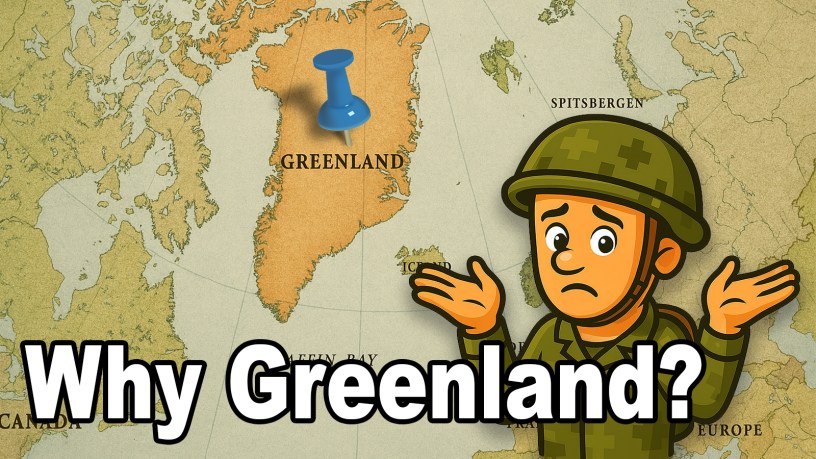
Unless you’ve been living under a rock for the past several months, you already know that the country of Greenland is a hot topic in today’s news cycle. President Donald Trump has gone on record multiple times suggesting that the United States NEEDS to acquire Greenland one way or another. He’s even gone so far as to be open to the idea of using military force to acquire the island from our NATO allies in Denmark.
For the sake or remaining apolitical, I’m not going to get into the politics of this, but I do want to take you on a little historical journey about the United States’ long history with Greenland.
Early American Expansion
Although Greenland is in the news now, the US’s desire to acquire the Danish territory is not something new. As a matter of fact, The U-S first tried to buy Greenland from Denmark as far back as 1858. Then-Secretary of State William Seward was on a mission to expand the United States. It was in that year that he negotiated with Russia to purchase the land we now know as Alaska for just $7.2 million. That’s about two-cents per square mile.
After that deal, his sights became focused on purchasing Greenland from Denmark. He wanted this particular island because after commissioning a survey in 1857, he believed Greenland was ripe with abundant resources the United States wanted. Unfortunately for Seward, his bid to acquire Greenland was halted, thanks to the infamous court of public opinion.
People saw his acquisition of Alaska as a colossal waste of money. They called the deal, “Seward’s folly”, “Seward’s Ice Box”, and, my personal favorite, “Andrew Johnson’s Polar Bear Garden.” People at the time didn’t see the value of Alaska. It wasn’t until the Yukon Gold Rush in 1896 that people first began seeing Alaska as a valuable asset.
So, with all the public outcry, Seward’s bid for Greenland came to an abrupt end. But America’s interest in Greenland wasn’t so easy to die.
Trouble in Europe
The next time the United States saw an opportunity to acquire the land came in 1910. But before we get to that, we need to better understand what was going on in Denmark and Europe during this period of time.
You see, in 1864, Denmark lost a piece of its territory called the Schleswig-Holstein region. Schleswig, an area of land at the southern tip of Denmark, had been under Danish rule since the 12th Century and it bordered Holstein, which was a part of the Holy Roman Empire. Although they were technically part of two different countries or empires, the entire region was under the control and rule of the Danes. That was until more and more Germans began settling in southern Schleswig, bringing up questions about who was the rightful ruler of the region. This resulted in the Schleswig wars.
The first Schleswig War resulted in a victory for the Danes, however, after the second war in 1864, the Prussian military was victorious and the territory was absorbed into Prussia.
But what do Prussians have to do with Greenland? Well, Denmark didn’t like the fact they lost that land. Knowing this, Ambassador Maurice Egan, the U.S. ambassador to Denmark, penned a trade deal he thought would benefit both the U.S., Denmark, and Germany.
This three-way deal would go something like this. Denmark would give Greenland to the United States in exchange for a cluster of islands in the Phillipines; Denmark would then exchange those islands with Germany for the Schleswig-Holstein region, because Germany was looking to expand its influence in the East.
Obviously, this deal never happened. In fact, the U.S. government refused to even suggest it to either Denmark or Germany. However, some believe this deal laid the groundwork for the U.S. to purchase the Virgin Islands from Denmark in 1917.
Post World War II
Arguably, the closest the United States ever came to acquiring Greenland came in the aftermath of World War II.
The set up for this deal started back in 1941. Denmark had declared itself neutral at the onset of the war, but after it was invaded and occupied by Germany, many of the Allies feared it would invade Greenland next, giving Germany a foothold in North America. So, the U.S. signed the “Defense of Greenland” treaty with the Danish ambassador in the U.S. that gave Greenland’s defense rights to the United States for the duration of the war.
It also gave the U.S. military the right to build any military facilities they needed, particularly to land, refuel, and rearm their aircraft. During the war, the U.S. utilized these bases to refit more than 10,000 planes throughout the course of the conflict. Following the war, the U.S. saw how strategically valuable Greenland was and offered to buy the island from Denmark for $100 million in gold.
Denmark refused, with the Danish Prime Minister saying “We owe much to America, I do not feel we owe them the whole island of Greenland.”
But the story doesn’t end there. After World War II, a new threat emerged: the Soviet Union. And in 1949, after several Eastern European countries fell to Soviet-backed revolutions, The U.S., Denmark, and ten other nations formed the North Atlantic Treaty Organization, or NATO. This is a defensive alliance designed to prevent Soviet and Russian aggression.
Then, after the Soviets successfully tested their first nuclear bomb, tensions rose and the U.S. and Denmark worked on creating a new defense treaty for Greenland because there was a real threat of Soviet bombers flying over the arctic to attack NATO countries.
In 1951, the Defense of Greenland agreement granted the United States the right to expand their presence on Greenland beyond the previous levels outlined during World War II. Through this treaty, the U.S. built Thule Air Force Base which housed 10,000 troops at its peak and was capable of rapid response to any Soviet nuclear threats. Although the Soviet Union has since collapsed, the U.S. still maintains this base, but it transferred it to the Space Force in 2020.
Today’s geo-political tensions
And that brings us to today. With renewed tensions in the world, particularly with Russia and China, it’s the administration’s belief that the United States should have control of Greenland in order to maintain the security of the country. This is due in part because despite what some people may say on the internet, we live on a globe and the shortest path between Russia and the U.S. is over the arctic.
Despite this fact, it doesn’t seem like Denmark or Greenland are open to the idea of the island becoming a territory of the United States. So, it begs the question: are we witnessing history repeat itself, or will there be a different outcome this time around? We’ll just have to wait and see.
 That PAO Guy