
By Timothy Koster, Connecticut National Guard Public Affairs Office
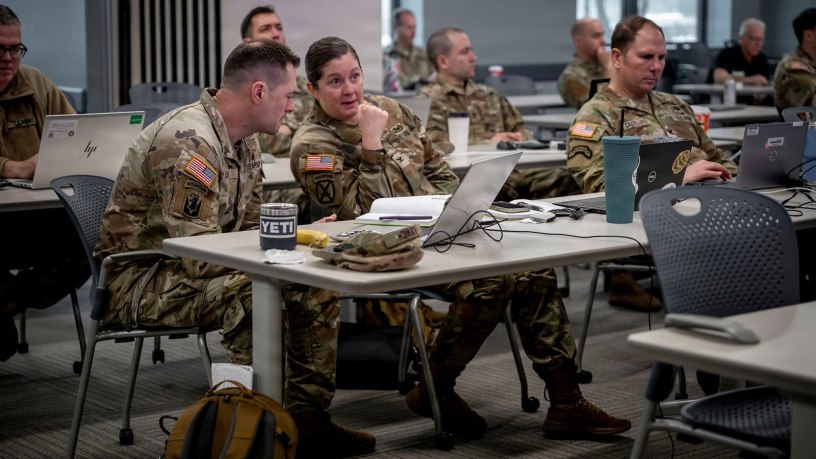
CAMP NETT, Conn. — Members of the Connecticut National Guard’s Joint Force Headquarters joint staff completed a five-day Joint Task Force Staff Training Course at Camp Nett, strengthening their ability to plan and coordinate National Guard support during domestic emergency operations as a major winter storm threatened parts of the region.
The course provided baseline training for joint staff members responsible for organizing personnel, logistics and resources when the Connecticut National Guard is called upon to support state and civil authorities during natural disasters, public health emergencies and other governor-declared events. The timing of the training coincided with forecasted winter weather, giving participants an opportunity to apply planning concepts in a realistic emergency-response scenario.
“The joint staff has a high level of turnover,” said Maj. Lee Lukas, a domestic operations officer in the Connecticut National Guard’s Joint Operations Center. “It’s like a revolving door, with new staff rotating in every couple of years. The JSTC is an introductory course that helps lay the groundwork for a good team.”
This baseline training is critical for the joint staff to be successful in its mission because the work is highly specialized and not something the Army typically teaches, according to Lukas.
When the state faces an emergency, whether it is a natural disaster, such as the Hawthorne Brush Fire that burned more than 127 acres of woodlands several years ago; a pandemic, such as COVID-19; or another declared emergency in which the governor calls upon the National Guard to assist, it is the joint staff’s job to provide logistical support and manpower for the mission.
It is an important mission with real-world consequences, which makes the training all the more important.
Over the three days of the course, students taught by instructors from Western Hemisphere Command learned the nuances associated with operating a joint staff during an emergency. This included coordinating with other civil authorities, such as the Department of Emergency Services and Public Protection and the Division of Emergency Management and Homeland Security.
The course culminated with a practical exercise in which the team responded to a simulated winter storm emergency.
“In the practical exercise, we used the military decision-making process to create a common operational picture for the adjutant general for a winter storm response,” Lukas said. “With that, he can better advise the governor on how the National Guard can help during the emergency.”
New England is no stranger to winter storms, but with a major storm forecast to affect much of the country, the training coincided with heightened winter weather awareness.
While the training will be beneficial in the near term, Lukas is working to make it a biennial requirement to ensure future joint staffs remain proficient and ready to support the state when called upon.
The training also serves as a prerequisite for additional courses designed to prepare the organization for emergencies and operations beyond routine support missions.
One example is the Joint Planner’s Course, which trains students in strategic planning for large-scale events, such as Hurricane Katrina, should a similar disaster occur in Connecticut.
Another is the Joint Reception, Staging, Onward Movement and Integration course, which teaches students how to ensure forces are effectively received, prepared and deployed during emergencies, particularly during large-scale events that require support through the Emergency Management Assistance Compact. An EMAC is a formal request for additional equipment or personnel from other states when local resources are insufficient.
With the potential for future disasters always present, the Connecticut National Guard continues to take a proactive approach to readiness to ensure it is prepared to support the state when needed.
 That PAO Guy