
By Cynthia Stephenson, U.S. Army Recruiting Harrisburg Battalion
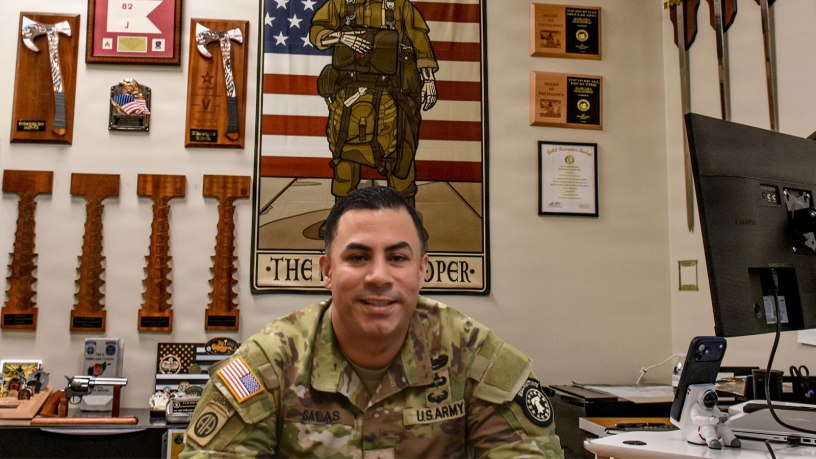
NEW CUMBERLAND, Pa- For Staff Sgt. Hector Salas, recruiting success isn’t about chasing numbers, it’s about earning trust.
In an environment saturated with content, particularly among Gen Z, Salas understands a fundamental truth: people don’t trust institutions until they trust the humans inside them. His approach helped make him one of the nation’s top Army’s recruiters and a model for modern recruiting in a crowded social media space.
“Gen Z is overwhelmed,” Salas explained. “They see a ton of content, ads and sales tactics. What they want now is real connection”.
The Human Behind the Uniform
Salas uses Instagram not as a sales funnel, but as a transparency tool. His content reflects daily life as a Soldier, a recruiter, a person allowing prospects to see that Army service does not erase individuality, family life, or personal identity.
“When prospects see my page,” Salas said, “they can tell I’m a Soldier, not a salesman.”
This organic presence helps establish rapport long before a formal conversation begins. Social media, he emphasizes, is not a replacement for recruiting fundamentals, but it opens the door.
“Social media is the steppingstone,” Salas said. “It gathers insight, opens dialogue, and sets the conditions for trust.”
Relationships Over Volume
Early in his recruiting career, Salas believed success came down to volume, more calls, more leads, more enlistments. Experience corrected that assumption.
“I realized it’s not a numbers game,” he said. “It’s a people game.”
Today, Salas prioritizes consistent engagement and personal follow-through. He speaks with each Future Soldier at least twice a week, even after they take the oath, reinforcing his commitment to them beyond the contract.
That consistency pays dividends. Salas now receives so many referrals from current and former Future Soldiers that he rarely needs to prospect. Those referrals span multiple states, driven by reputation rather than advertising.
The Power of Reviews
Salas draws a direct parallel between recruiting and everyday consumer behavior to explain the value of digital credibility.
“If you were going to try a new restaurant, what’s the first thing you’d do?” Salas asked.
The answer: Google.
Reviews form the foundation of his digital strategy.
“That’s exactly what applicants are doing with recruiters,” he explained.
Salas actively asks applicants and Future Soldiers to leave Google reviews and removes any barriers by sending direct links, making the process quick and simple. These reviews serve as applicant testimonials, building credibility and trust before a prospect ever walks through the station doors.
“My Google reviews are applicant reviews,” Salas continues, “they build credibility before I ever meet someone.” He noted that many recruiters underestimate the value of online reviews and limit their networking to their immediate geographic area, missing opportunities in an information environment driven by visibility and reputation.
“People shouldn’t be afraid to ask for reviews,” Salas said. “We all rely on them every day.”
According to Salas, waiting for the “perfect” applicant without proactively building trust online is a losing strategy. “If you’re waiting for a unicorn to fall into your lap,” he said, “you will fail.”
Getting to the Real “Why”
While digital presence may open the door, Salas believes trust is built through intentional, meaningful conversation.
“One of the biggest mistakes recruiters make is stopping at surface-level answers,” Salas explains.
Salas believes every prospect cites benefits as their reason for joining, but that response rarely tells the full story. “Benefits matter,” Salas explained, “but they’re often a default answer when recruiters don’t ask better questions.”
Salas deems it is the recruiter’s responsibility to uncover the true motivation behind a prospect’s interest in service. Identifying that deeper “why” allows recruiters to address concerns honestly and demonstrate genuine investment in the individual.
“If you don’t know the real reason someone wants to join,” Salas states bluntly, “you haven’t done your job.” Understanding a prospect’s motivation strengthens the recruiter–prospect relationship, reinforces trust, and leads to long-term engagement. That trust, Salas said, is what ultimately drives referrals and sustains recruiting success.
“When people feel understood,” he said, “they tell others.”
Building Networks from Day One
Salas’s commitment to relationships doesn’t stop at accession. One of his most distinctive practices is placing newly sworn-in Future Soldiers into group chats, encouraging them to connect with one another.
“They learn each other’s names, their MOS (Military Occupational Specialty), and where people are from,” Salas said. “The Army is a large force, but the world is small. Networking starts on day one.”
This approach reinforces camaraderie early and mirrors the professional networking Soldiers will rely on throughout their careers.
Trust-driven Recruiting
For Salas, recruiting success is the byproduct, not the goal.
By prioritizing transparency, asking better questions, leveraging digital tools, and treating people like people, he has built a recruiting ecosystem driven by trust rather than transactions.
“When you’re real,” Salas said, “people notice. And when people trust you, they tell others.” In a recruiting landscape defined by competition for attention, Staff Sgt. Hector Salas proves that relationships, not reach, win the mission.
 That PAO Guy