
By Matthew Wheaton, Joint Munitions Command
ROCK ISLAND ARSENAL, Ill. — The destruction of the U.S. chemical weapons stockpile represents one of the most significant achievements in the history of arms control.
Stored at multiple locations across the country, the U.S. once possessed more than 30,000 tons of chemical warfare agents. The successful elimination of the stockpile marks the first time an entire class of declared weapons of mass destruction has been destroyed under international supervision, reinforcing U.S. commitment to global security and the strength of the Chemical Weapons Convention – an international treaty that bans the development, production, stockpiling, and use of chemical weapons.
Beginning in 1990, the Department of War undertook the complex task of destroying its chemical weapons in a manner that protected workers, safeguarded surrounding communities, and met strict environmental standards.
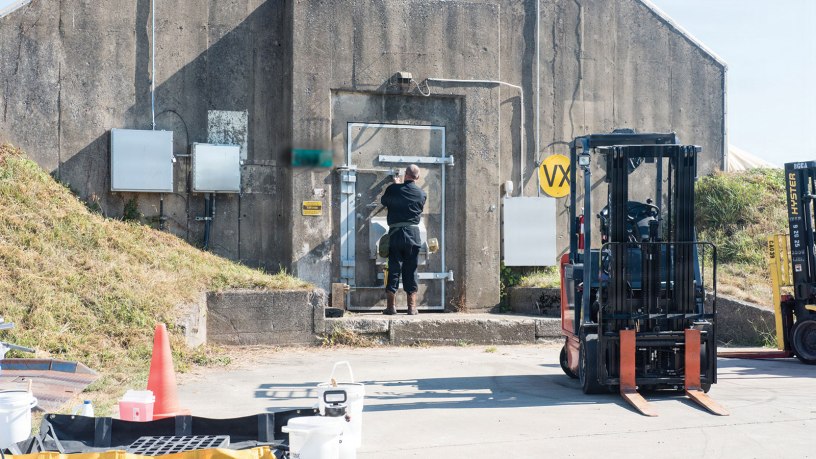
Destruction of the Pueblo Chemical Depot, Colorado, stockpile was completed at Pueblo Chemical Agent‑Destruction Pilot Plant in June 2023. One month later, the final munition in the stockpile stored by Blue Grass Chemical Activity at Blue Grass Army Depot, Kentucky, was destroyed inside the BGCA‑Destruction Pilot Plant.
The successful elimination of the stockpile set the conditions for a major transition. On Dec. 10, 2025, the Department of the Army approved termination of BGCA’s surety status. The termination for the BGCA-Destruction Pilot Plant was approved on Dec. 1, 2025, paving the path for surety experts to support the Army in other ways. Both organizations are located on BGAD.
“This is more than the end of a mission,” said Kelso Horne, CMA’s director. “It is the culmination of decades of disciplined work by people who never lost sight of the responsibility they carried.”
At PCD, the workforce safely stored hundreds of thousands of projectiles, which contained mustard agent, until they were transferred for neutralization followed by biotreatment, an environmentally responsible approach that relied on living organisms to break down chemical byproducts.
“Every person who touched this mission understood the weight,” said Col. Rodney McCutcheon, PCD’s 40th and final commander. “We knew the nation trusted us, and we honored that trust every single day.”
The stockpile stored by BGCA included diverse nerve agents and munitions with complex designs that required first of its kind engineering solutions and evolving storage monitoring efforts and careful munition movement. Neutralization and static detonation chambers were used to safely eliminate more than 100,000 rockets and projectiles containing nerve and blister agents.
“The success at BGCA shows what is possible when the Army and the community stand shoulder to shoulder,” said Lt. Col. David Dellerman, BGCA’s commander. “This mission was bigger than any one organization, and we succeeded because we worked as one team. The global significance of this accomplishment cannot be overstated.”
Although BGCA and PCD have completed their chemical destruction missions, CMA’s mission is far from over. Support to the treaty continues, as the CMA Recovered Chemical Materiel Directorate provides centralized management and direction to the DOW for the assessment and destruction of items that are not part of the declared, stored U.S. chemical weapons stockpile but still contain chemical warfare materiel and are recovered across the country, primarily on active military installations and Formerly Used Defense Sites.
“Our responsibility extends beyond the elimination of weapons. It includes stewardship, accountability, and the preservation of lessons learned for future generations,” Dellerman said.
 That PAO Guy