
By William Costello, U.S. Army Human Resources Command
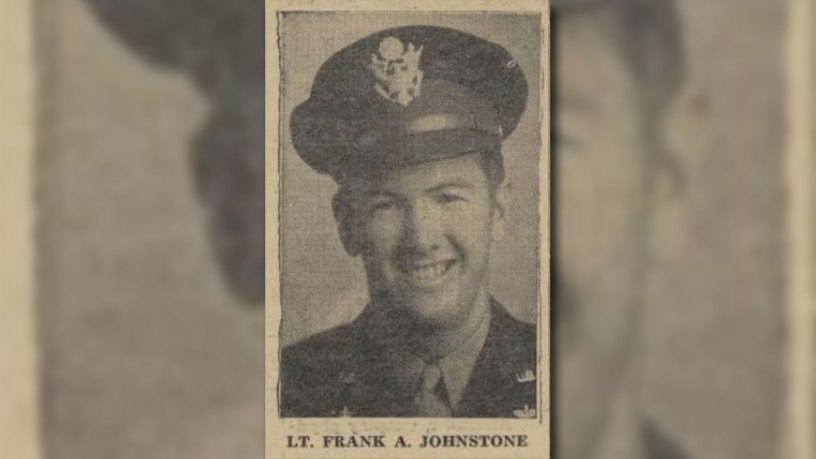
FORT KNOX, Ky. – The remains of U.S. Army Air Forces 2nd Lt. Frank A. Johnstone, 20, of Beaumont, Texas, killed during World War II, will be interred Feb. 26, in Forest Lawn Funeral Home and Memorial Park in his hometown. Graveside services will precede the interment.
Johnstone was assigned to the 721st Bombardment Squadron, 450th Bombardment Group, 15th Air Force. On Feb. 25, 1945, he served as a navigator aboard a B-24J on a bombardment mission to Linz, Austria. During the mission, his aircraft was shot down by enemy fire and crashed near Groβraming, Austria. Nine of the twelve crewmembers bailed out of the aircraft while the remaining three, including Johnstone, went down with the plane. His remains were not recovered after the war.
The Defense POW/MIA Accounting Agency accounted for Johnstone on Feb. 6, 2025.
For more information on DPAA’s efforts to locate and identify Johnstone, please visit the DPAA website.
U.S. Army Human Resources Command’s Past Conflict Repatriations Branch plays a vital role in the process of identifying, locating and contacting subsequent generation family members of Soldiers missing or killed in action during WWII and the Korean War to positively identify previously undiscovered or unknown remains.
Media interested in covering and/or obtaining more information about the funeral and interment should contact Forest Lawn Funeral Home, 409-892-5912.
Press Release | July 11, 2025
WASHINGTON –
The Defense POW/MIA Accounting Agency announced today that Army Air Forces 2nd Lt. Frank A. Johnstone, 20, of Beaumont, Texas, killed during World War II, was accounted for Feb. 6, 2025.
Johnstone’s family recently received their full briefing on his identification, therefore, additional details on his identification can be shared.
In the winter of 1945, Johnstone was assigned to the 721st Bombardment Squadron, 450th Bombardment Group, 15th Air Force. On Feb. 25, he served as a navigator aboard a B-24J on a bombardment mission to Linz, Austria. During the mission, his aircraft was shot down by enemy fire and crashed near Groβraming, Austria. Nine of the twelve crewmembers bailed out of the aircraft while the remaining three, including Johnstone, went down with the plane. His remains were not recovered after the war.
Following the end of the war, the American Graves Registration Command was tasked with investigating and recovering missing American personnel in Europe. During their area investigations, teams of AGRC investigators interviewed local residents and officials for information about missing American servicemen, including reported burials that could be associated with American losses or downed aircraft.
In June 1950, AGRC investigators visited the area of Großraming where they discovered that the remains of nine airmen from three different American aircraft crashes were reportedly buried in the Großraming cemetery by a local gravedigger. However, in the summer of 1946, the 535th Quartermaster Graves Registration Company has already visited Großraming and recovered the nine sets of remains and transferred them to St. Avold Cemetery in France. The 1950 investigation found a discrepancy in that it only had evidence for seven sets of remains being recovered. At the end of the investigation, all but two of the nine sets were identified, with the final two being designated Unknowns X-6568 and X-6404 St. Avold.
In August 2013, an investigation team from one of DPAA’s predecessor organizations traveled to Groβraming to investigate the loss of Johnstone’s B-24. They found enough to correlate the site with the aircraft. In July and August 2017, DPAA partner teams from the University of Maryland and University of Vienna began excavation on the crash site and returned the following year to continue excavation in June and July 2018. The team recovered aircraft wreckage, pieces of material evidence, and possible human remains which were all accessioned into the DPAA laboratory for scientific analysis. In addition, DPAA partner Geoscope Services Ltd. continued excavation of the site in April and May 2023 and July and August 2024, finding additional evidence which was also accessioned into the DPAA lab.
To identify Johnstone’s remains, scientists from DPAA used dental and anthropological analysis, as well as material and circumstantial evidence. Additionally, scientists from the Armed Forces Medical Examiner System used mitochondrial DNA analysis.
Johnstone’s name is recorded on the Tablets of the Missing at Epinal American Cemetery, an American Battle Monuments Commission site in Dinoze, France, along with the others still missing from World War II. A rosette will be placed next to his name to indicate he has been accounted for.
Johnstone will be buried on a date yet to be determined.
For family and funeral information, contact the Army Casualty Office at (800) 892-2490.
DPAA is grateful to the Austrian government for their assistance in this mission.
For additional information on the Defense Department’s mission to account for Americans who went missing while serving their country, visit the DPAA website at www.dpaa.mil or on social media at www.facebook.com/dodpaa, https://www.linkedin.com/company/dodpaa, https://www.instagram.com/dodpaa/, or https://x.com/dodpaa.
Read Johnstone’s initial ID announcement here: Johnstone.
 That PAO Guy