
By Petty Officer 1st Class Abigayle Lutz
KODIAK, Alaska (Feb. 27, 2026) – U.S. Navy expeditionary medical teams trained in the harsh Alaskan environment as part of ARCTIC EDGE 2026 (AE 26), a large-scale joint and multinational exercise running from February 23 to March 13.
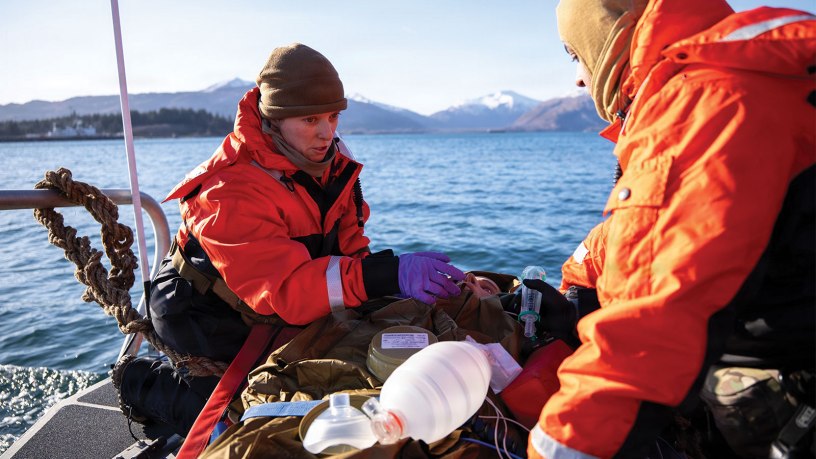
At Coast Guard Air Station Kodiak, the U.S. Navy’s Expeditionary Resuscitation Surgical System (ERSS) Team 3 and En-Route Care System (ERCS) Team 52 tested and evaluated critical life-saving medical equipment through realistic joint training scenarios alongside the U.S. Coast Guard, U.S. Army, and U.S. Air Force, as well as interagency partners. Mission sets included ship-to-shore patient transfers, mass casualty drills, and ship-to-ship patient transfers.
The exercise provided a crucial, real-world opportunity to validate that the specialized systems used by ERSS and ERCS teams can function reliably in sub-zero temperatures and that their personnel can deliver advanced medical care far from any hospital.
The ERSS team set up a fully functional trauma receiving area and operating room within a hangar bay on the base, demonstrating their ability to create a sophisticated medical facility in an austere environment.
“We bridge that gap where you may have medical providers far forward where they can do some skills, but you need somebody that can actually stop that bleed, and that’s where we come in,” said Cmdr. Michelle Miller, an emergency medicine nurse assigned to ERSS Team 3. “You can put us in a hangar bay, you can put us out in a tent in the field, and we come in and we just adapt to that space to be able to provide that capability to the unit commanders.”
ERCS Team 52 focused on en route care, practicing critical care transport aboard helicopters and small boats, a key capability in the Arctic where limited infrastructure and vast distances can complicate medical evacuations.
For Sailors like Hospital Corpsman 1st Class Daniel Rodriguez, this exercise provides a unique opportunity to apply his medical knowledge and experience in a military-specific context.
“As a Navy Reserve Sailor participating in Arctic Edge 2026, I get the chance to apply medical skills from my civilian experience in an expeditionary setting,” said Rodriguez, assigned to ERCS Team 52. “Practicing en route care in a helicopter and on a small boat here in Kodiak is the kind of realistic training that builds confidence and ensures we’re ready for anything.”
The lessons learned during AE 26 will directly influence the future of expeditionary medicine. PMS 408, at Naval Sea Systems Command (NAVSEA), the Navy’s Program Office for Expeditionary Missions, is responsible for the development and acquisition of this life-saving equipment and will use the data and feedback gathered to inform future medical technology modernization, tactics, techniques, and operational procedures.
“Our fundamental responsibility at PMS 408 is to put the best possible life-saving tools into the hands of our medical teams, and an exercise like Arctic Edge provides real-world feedback of these medical technologies,” said U.S. Navy Cmdr. Joshua Swift, Expeditionary Medical Products Director. “Rigorous testing of Navy medical equipment in different environments enables our office and Navy Medicine to meet operational and medical requirements in realistic conditions, reducing risk to the warfighter and ensuring dependable, mission-ready capabilities when deployed.”
The ERSS and ERCS teams are part of the U.S. Navy’s expeditionary medical capabilities, with ERSS providing forward-deployed damage-control resuscitation and surgical intervention in austere environments, and ERCS delivering critical care transport and continuous patient stabilization during evacuation from the point of injury to higher levels of care.
AE 26 is led by North American Aerospace Defense Command (NORAD) and U.S. Northern Command (USNORTHCOM) and involves approximately 1,200 personnel. Participants include forces from the U.S. Army, Marine Corps, Air Force, and Coast Guard, alongside international partners from Canada and the Kingdom of Denmark. The exercise, which spans various locations in Alaska and Greenland, is designed to improve readiness and enhance interoperability in the Arctic.
 That PAO Guy