
By Joseph Siemandel, Joint Force Headquarters – Washington National Guard
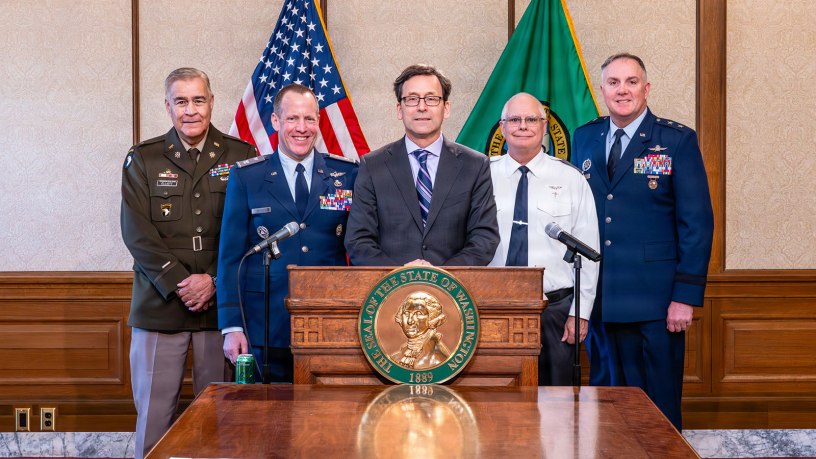
From searching for lost hikers to mapping wildfire damage from thousands of feet above the ground, volunteers with the Civil Air Patrol (CAP) have long been part of Washington’s emergency response network. Now, a new law signed March 14, 2026, by Gov. Bob Ferguson formally brings the Washington wing of the CAP into the state’s Military Department as a dedicated division, giving Washington officials faster access to aircraft, aerial mapping, and trained volunteers when disasters strike.
Senate Bill 6046, sponsored by Keith Wagoner of the 39th District, transitions the CAP from an informal partner into a formal state asset. By creating a dedicated division, the state aims to establish a unified chain of command, enabling the Military Department to rapidly deploy volunteer pilots and ground crews during critical missions.
“The Civil Air Patrol does such a great job with young people, teaching them leadership and about opportunities that they might not learn about otherwise,” Wagoner said.
The Washington State Senate passed legislation in a unanimous vote before sending it to the House of Representatives, where it passed 88-4.
Moving the CAP into the Washington Military Department will accelerate emergency response capabilities across the state. The measure also supports the organization’s broader mission of youth development through its cadet program, which provides aerospace education and character development for future leaders.
Leadership within the Washington National Guard voiced strong support for the bill.
“This bill simply places the Washington wing of the Civil Air Patrol under the Washington Military Department,” said Paul Sellars, assistant adjutant general for the Washington Military Department and commanding general of the Washington Army National Guard, during testimony to the House Technology, Economic Development, & Veterans Committee on Feb. 20, 2026, in Olympia. “It allows us easier access to this critical resource both before and during disasters – things like aerial mapping or cyber missions.”
Sellars explained the legislation would allow the Washington wing of CAP to operate in two capacities: continuing its current federal role or serving in a state active-duty status under the National Guard’s Joint Operations Center.
The bill’s language mirrored legislation previously adopted in Kansas and is supported by the Civil Air Patrol’s national headquarters as well as the U.S. Air Force. The measure would not result in additional costs to the state.
“This does not in any way affect the existing federal charter or corporate charter of the Civil Air Patrol,” Sellars said. “The proposed legislation preserves CAP’s ability to execute both Title 10 and Title 36 missions, while streamlining support timelines for state, local, and tribal governments.”
The organizational change would impact CAP units statewide, including active squadrons in the Tri-Cities and Walla Walla regions.
“This relationship enables better coordination before, during, and after disasters,” said Robert Ezelle, director of Washington Emergency Management. “During recent flooding, coordination for aerial surveys of affected communities would have been improved. Incorporating the Civil Air Patrol into the Washington Military Department provides tangible benefits to communities at a time of limited federal and state funding.”
 That PAO Guy