
By Sgt. 1st Class Cory Grogan, Oregon Military Department Joint Forces Headquarters
As communities recognize Women’s Military History Month and Women’s History Month in March, Oregon Employer Support of the Guard & Reserve (ESGR) is recognizing three Oregon National Guard service members setting an example as women leaders both in uniform and through nonprofit organizations supporting veterans.
Women’s Military History Week will be observed March 16–20 as part of the national monthlong recognition of women’s contributions that include service in the armed forces.
The work also reflects part of the mission of Oregon ESGR, which supports service members and the employers and organizations to include nonprofit groups that help sustain the Guard and Reserve community.
Leanne Babcock, a volunteer with Oregon ESGR, serves as the organization’s Employer Outreach Director while also serving in the Oregon Air National Guard as the Director of Logistics. She is also involved in nonprofit leadership supporting veterans through the [Dauntless Veteran Foundation](https://dauntlessvf.org/) as their volunteer Executive Director. Dauntless Veteran Foundation’s mission is to help Veterans translate their talents from the field to the farm. Their Agriculture Grant is open to all Veterans and dependents who are starting or growing their venture in agriculture.
Babcock said Oregon is home to several drilling service members who also lead nonprofit organizations supporting veterans, particularly women veterans.
“It’s pretty incredible that the Oregon Military Department has drilling service members in leadership positions who are also nonprofit leaders serving the veteran community,” Babcock said. “They’re actively serving in the Guard and Reserve while building programs that connect and support veterans.”
One of those leaders is Chief Master Sgt. Amy Almond-Schmid, 142nd Medical Group chief with the Oregon Air National Guard and executive director of the Returning Veterans Project. For more than 20 years the nonprofit’s Volunteer Provider model has served Oregon and SW Washington.
Almond-Schmid said women leaders often bring a broader perspective to both military and nonprofit leadership.
“One strength women bring is a whole-person perspective,” Almond-Schmid said. “Women leaders often take a holistic view, considering family systems, community factors and the long-term well-being of their fellow Airmen, Soldiers, teams and civilian counterparts. It is not at the expense of mission goals, but alongside them.”
In February 2025, Oregon ESGR presented a Patriot Award to the organization’s board in recognition of its support of service members and their civilian employment responsibilities.
Babcock said Almond-Schmid’s dual role reflects how Guard members often balance military service with community leadership.
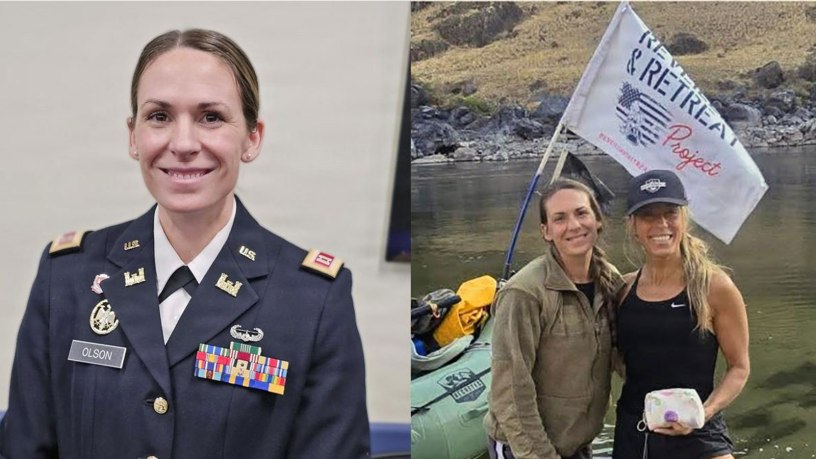
Army National Guard Capt. Dakota Olson-Harris is another leader that stands out for her work as co-founder of the Reveille and Retreat Project. Olson-Harris is the commander of the Oregon National Guard’s 115th Mobile Public Affairs Detachment and is preparing to mobilize with her Guard unit while continuing to support the nonprofit’s mission.
The Reveille and Retreat Project was recently named a top-three finalist for the Melissa Washington Small Business Award. The organization also helped co-host the 2025 Oregon Department of Veterans’ Affairs Women Veterans Conference and organizes retreats that bring together women veterans with Department of Veterans Affairs and medical professionals to focus on health and wellness.
The nonprofit also participates in nationwide simulcasts focused on women veterans’ health and is working to expand retreat opportunities across Oregon.
Babcock said events like these often provide one of the few opportunities for women veterans to gather and build community.
“For many women veterans, this is the only opportunity to gather in this type of community,” she said. “The visibility and exposure are powerful, especially for those of us in the Guard and Reserve.”
Olson-Harris, who lives in Eugene, said women bring a leadership style that strengthens both military units and veteran support organizations.
“Women bring a high level of emotional intelligence to leadership, which enables empathetic advocacy while still maintaining an operational mindset,” Olson-Harris said. “People want to feel like they belong and like they’re part of a community or family, not just filling a position.”
She said that leadership approach carries across her roles serving in the Guard, leading a nonprofit and providing counseling to veterans.
Despite progress, these leaders say women in the military and veteran community still face unique challenges.
Almond-Schmid said the relatively small number of women in the force can affect mentorship opportunities and visibility.
“Because women make up a smaller percentage of the military and veteran population, there are naturally fewer of us,” she said. “While serving, there are fewer women in senior leadership positions, and after service there are fewer of us within the veteran community.”
That can make it harder to find shared experiences and established pathways for advancement, she said.
“It can be hard to envision yourself rising to the upper echelons of our force when the landscape doesn’t reflect you being there,” Almond-Schmid said. “When women take off the uniform, it’s often not obvious they served.”
Olson-Harris said many women veterans also do not always identify themselves as veterans.
“In my experience, many women veterans don’t readily identify as veterans,” Olson-Harris said. “Sometimes they undervalue their service, or they’ve experienced trauma and prefer not to talk about it.”
Women veterans also face gaps in timely and specialized health care related to their military experience, along with challenges such as housing stability and access to child care, she said.
Those needs helped inspire the creation of the Reveille and Retreat Project.
“We saw a gap in support for women who have served or are currently serving in the military,” Olson-Harris said.
“Our goal was to create a healing space with no barriers to access and a community where women are seen, heard, validated and genuinely celebrated.”
Almond-Schmid said partnerships with organizations like ESGR help strengthen support networks for service members and veterans.
“ESGR provides education, advocacy and resources that help ensure military service is understood, respected and protected in the workplace,” she said. “For veteran-focused nonprofits, ESGR partnerships create opportunities to collaborate, share resources and expand support networks for service members and their families.”
As Women’s History Month and Women’s Military History Month continues, leaders say visibility remains critical for recognizing women’s contributions to military service and to the veteran community.
“Women who have served deserve to be seen, heard and celebrated,” Olson-Harris said. “Many continue to serve as pillars for their families, their communities and as advocates for other women.”
All three women and their nonprofit organizations are also part of the planning team for the Pacific Northwest Women Veterans Engage events scheduled for May 29–30 in Bend and Forest Grove.
Women Veterans Engage is an annual nationwide live simulcast event that brings women veterans together in local communities across the United States and beyond. The two-day event provides an opportunity for women veterans to connect, engage and build professional and personal networks.
More information about the event is available through the Women Veterans Alliance website.
 That PAO Guy