
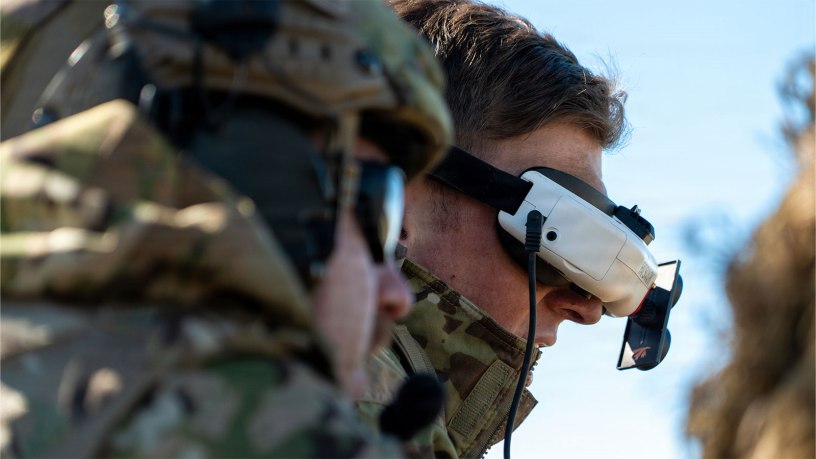
By Capt. Andrew Lightsey IV, 101st Combat Aviation Brigade
FORT CAMPBELL, Ky. – The 101st Airborne Division (Air Assault) tested their ability to integrate unmanned aircraft systems (UAS) to support ground forces during a live-fire exercise on March 12.
“We are no strangers to innovation here on Fort Campbell,” said Brig. Gen. Travis McIntosh, deputy commanding general of operations for the 101 ABN DIV (AA). “Drones are reshaping the geometry of the battlefield in real time and we must adjust. Distance and sanctuary no longer provide the protection they once did, and mass and speed of decision-making will increasingly be enabled by autonomy and AI. This event tested and proved these assumptions for us.”
Advancing Secretary of War Pete Hegseth’s directive for drone dominance, the Division utilized UAS operators from its 1st Mobile Brigade Combat Team, 2nd Mobile Brigade Combat Team, and 101st Combat Aviation Brigade, to fly multiple UAS, alongside 5th Special Forces Group (Airborne). The sortie, that consisted of an MQ-1C Gray Eagle, C100 small UAS, and Attritable Battlefield Enabler 1.01 (ABE) systems, provided aerial clearance for 5th Special Forces Group Soldiers during the exercise.
“Drones are a great tool for over the hill reconnaissance,” said Spc. Basil Holland, an infantryman and C100 small UAS operator assigned to the 1st Battalion, 502nd Infantry Regiment. “They have a lot of ability to identify short and medium range targets and get eyes on whatever you need. It’s proven to be super useful.”
Representatives from the U.S. Army Reserve Command (USARC) also attended the event. They were interested in learning how the 101st incorporates emerging technologies.
“We wanted to get a clear understanding of how the big Army is integrating UAS,” said Mr. Sammy Stevens, a counter UAS lead planner for USARC. “We want to try and replicate their efforts with the Reserve. During counterinsurgency operations everyone was used to looking down, to identify improvised explosive devices, now we have to look up in the air.”
Partnering with USARC highlights the Division’s commitment to improving lethality for the entire Army.
“The 101st has been very gracious in supporting us,” said Master Sgt. Bryan Pettaway, USARC senior enlisted advisor for operations and logistics. “By showing us what has worked, and what hasn’t, they have helped us avoid those same mistakes.”
The exercise validated the Division’s ability to operate UAS in a kinetic, multi-domain setting. This successful pairing of systems and Soldiers ensures the 101st Airborne Division (Air Assault) remains at the forefront of Army transformation efforts.
“Today’s demonstration was a direct answer to the Secretary of War’s directive,” said Chief Warrant Officer 2 Page Frazier, the exercise coordinator and member of the 101st Robotics and Autonomous Integration Directorate (RAID). “We did some unorthodox things and always made first contact with a machine. Before we sent a sapper to breach, we sent an ABE. Before we sent a tech to lase for laser guided munitions, we sent a Gray Eagle. Before we sent cavalry troops or light infantrymen to gather ground reconnaissance, we sent a UAS for medium-range reconnaissance and I don’t think any other exercise has done that. We leveraged modern technology to set conditions for a safe employment of a ground force.”
“I am superbly proud of the teamwork, from both the operational and institutional sides of the Army, as well as the conventional and Special Forces on Fort Campbell,” said McIntosh. “This exercise demonstrates one of the many ways we will dominate in tomorrow’s fight.”
For more information on the 101st Airborne Division (Air Assault)’s UAS modernization efforts, contact the Public Affairs office.
 That PAO Guy