
By Warren Marlow
From Matthew Brady to Ernie Pyle to Andy Rooney, documenting the military’s accomplishments has been a valuable undertaking. But it was only this year, on Jan. 15, that public affairs became its own Army branch. This move from a functional area to a fundamental branch reflected the key role that public affairs plays in the Army’s overall mission and success.
The move to a branch also meant that public affairs Soldiers and civilians can apply for a direct commission to become a public affairs officer. In this role, they will prep subject matter experts for interviews, maintain working relationships with the media, and help ensure the unit’s mission is conveyed to internal and external audiences.
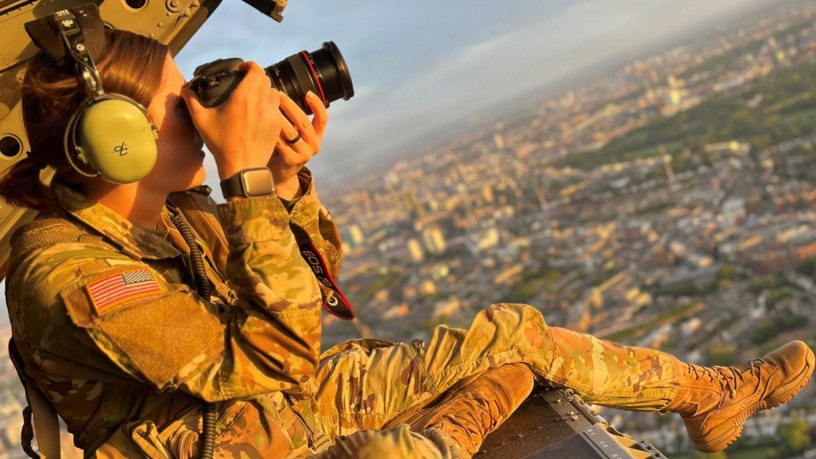
Among the first public affairs Soldiers to tread this path is 2nd Lt. Caitlin Wilkins, who before this week was Sgt. Caitlin Wilkins, a public affairs observer controller/trainer with the 120th Infantry Brigade.
“The direct commission program allows civilians and Soldiers with specific skill sets and education to apply for a direct commission,” Wilkins explained. “This speeds up the commissioning timeline significantly compared to a Reserved Officer Training Corps or Officer Candidate School program.”
This streamlining helps not just the Soldier, but the branch and the Army, as Soldiers can immediately transition to being an officer while keeping their experience and staying in their field. The direct route results in the applicant being commissioned at a rank commiserate with their education, experience, and skill set, as well as the Army’s need.
Wilkins has served in the Army for six years and holds a bachelor’s in public relations and a master’s in integrated marketing. This experience and education made her a strong officer candidate but Wilkins had been reluctant to leave a job that she loved.
“I had thought about commissioning but I never wanted to leave public affairs. I really enjoy the career field,” she said. “So when I found out that I could commission and stay in public affairs, it was a really easy choice. I love the Soldiers within PAO. We have a really creative group of people that do a good job of telling the Army’s story and showing what it’s like day to day.”
It took three months to go from packet submission to getting word that she had been accepted for a direct commission.
“The program works a lot differently than OCS,” Wilkins explained. “I was expecting to have to go to the direct commission course and then pin, but how it works is, you get your promotion orders, you do your oath, you pin the rank, and they submit you for a class date. It was a much faster process than I was expecting. I have friends that have gone the OCS route and it’s taken them over a year just to get to the schoolhouse.”
Wilkins and other Soldiers accepted into the public affairs direct commissioning program attend a six-week course at Fort Benning, Georgia, as well as a qualifying course at Fort Meade, Maryland.
“It’s a fantastic program. It gives people a lot of opportunities to stay in their career field,” Wilkins said. “It’s a huge benefit. We get to keep a lot of talented public affairs Soldiers and I feel fortunate to have been selected in the first cohort. “
Applicants must be a U.S. citizen, meet height and weight standards, pass a commissioning physical, have an undergraduate degree, have applicable experience and education and a secret clearance. More information, visit the Direct Commission Program website.
 That PAO Guy