
By Prim Hibbard, XVIII Airborne Corps Public Affairs
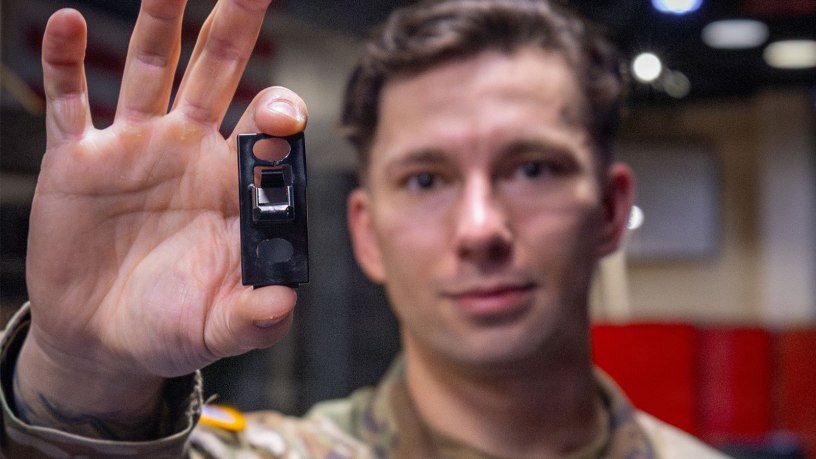
FORT BRAGG, N.C. — An 82nd Airborne Division paratrooper created a 3D-printed washing machine part, roughly the size of a large paperclip, that could save the Army thousands of dollars and fix a widespread quality of life issue for Soldiers living in the barracks.
Sgt. Aidan Hanson, a barracks manager assigned to Headquarters and Headquarters Battery, Division Artillery, 82nd Airborne Division, grew tired of seeing a “broken” sign taped to dozens of washing machines in the barracks where he and his peers live.
“We were getting to a point where almost all of our washers within the DIVARTY barracks were unserviceable and couldn’t be used because the latch was broken,” Hanson said.
After learning the Directorate of Public Works was unable to procure the part because it’s no longer in production, Hanson took the initiative to see if he could replicate one with a 3D printer.
A DPW representative said that they welcome any solution that reduces downtime on appliances and improves the quality of life for service members.
Hanson’s company commander, Capt. Frederick Crudale, HHB, 3rd Battalion, 319th Airborne Field Artillery Regiment, 82nd Airborne Division Artillery, agreed.
“For Sgt. Hanson to figure this out and take it upon himself and do something positive for the units and Soldiers, it’s really been an added value to those living in the barracks.”
Working alongside the 82nd Division engineering team, Hanson developed multiple prototypes at the Airborne Innovation Lab, testing for durability and cost efficiency before moving into production. The resulting 3D-printed piece is far superior in structure and can be produced in hours.
“The manufacturer charged $10.54 for the part,” Hanson said. “It cost us about 80 cents or less to make at the innovation lab.”
Using data from the Army Maintenance Activity, a system that tracks maintenance issues across Army installations, Hanson identified more than 200 broken washing machines reporting the same issue across Fort Bragg. If applied across the four divisions under XVIII Airborne Corps, Hanson estimates it could save the Army approximately $70,000.
“I think the Innovation lab is a really good idea,” Hanson said. “Not just for us coming up with our own products to save the military money, but also to solve problems happening in the barracks for Soldiers.”
Hanson hopes to inspire more Soldiers across the Army to leverage 3D printing to find solutions to common problems impacting Soldiers. Small solutions, sometimes the size of a large paperclip, can have an insurmountable impact on Soldiers’ quality of life across the Army.
 That PAO Guy