
By Daniel Linehan, Naval Postgraduate School
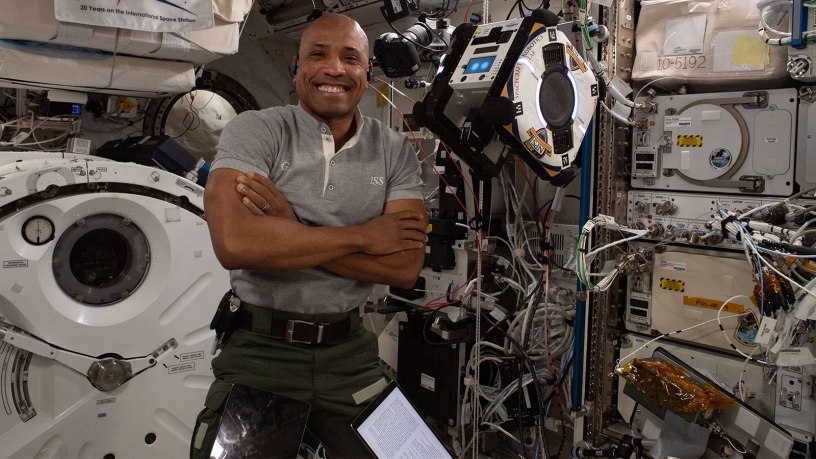
Two Naval Postgraduate School (NPS) alumni will lead the historic Artemis II mission on a 10-day space flight around the Moon — mission commander retired U.S. Navy Capt. Reid Wiseman and spacecraft pilot U.S. Navy Capt. Victor Glover. The target launch window opens on April 1, 2026, the first of seven possible launch days in April. Artemis II will be the first crewed lunar fly-by in more than 50 years.
Americans first orbited the Moon during the Apollo 8 mission in 1968, which was piloted by James Lovell, also a U.S. Navy captain, naval aviator, and test pilot, in preparation for the Apollo 11 lunar landing. Now, 58 years later, this modern mission will similarly take the four-person crew around the Moon to test their modern spacecraft at a maximum distance of nearly 250,000 miles away from Earth. The Artemis II mission “will carry astronauts farther from Earth and closer to the Moon than any human has been in over half a century,” according to NASA’s website.
“U.S. Navy Capt. Gene Cernan was the last astronaut to set foot on the Moon. He commanded the Apollo 17 mission in 1972 and was also an NPS alumnus. So, it’s exciting to see us headed back,” said retired U.S. Navy Vice Adm. Ann Rondeau, NPS president. “Since NASA’s inception, NPS and our Navy have had a very strong history in space, from educating future astronauts to record-setting efforts and cutting-edge research. We continue to break boundaries today.”
Both naval aviators and test pilots, Wiseman and Glover received NPS certificates in Space Systems Fundamentals. And Glover also earned a Master of Science in Systems Engineering from NPS. These programs and others are offered by NPS’ Space Systems Academic Group (SSAG).
Jim Newman, former SSAG chair and NPS provost, flew aboard four Space Shuttle missions as a mission specialist to the International Space Station (ISS) and made six spacewalks. He understands the magnitude of returning to the Moon and believes extensive education is fundamental to preparing astronauts for the out-of-this-world challenges faced during spaceflight.
“It’s very exciting for NPS alumni to be so involved in NASA’s return to the Moon,” said Newman. “Not only on this upcoming Artemis II spaceflight but on others as well, continuing a long tradition of exceptional service and contribution to our country.”
Having a graduate degree is a requirement for becoming a NASA astronaut. Back in 2013 after Glover’s selection, he reflected on the importance of having an advanced education that integrated real-world problems and solutions.
“I was a test pilot, working in the systems engineering field, actually doing test and evaluation under the umbrella of weapons systems acquisition,” Glover said of his Navy duties back while concurrently studying for his master’s from NPS. “My work product bolstered my school product, and, likewise, my school product improved my work quality.”
Two mission specialists make up the remaining Artemis II crew. Researcher Christina Koch specializes in space science instrument development and remote scientific field engineering, and Canadian Space Agency’s Jeremy Hansen is a Royal Canadian Air Force colonel and fighter pilot with NASA and European Space Agency mission operations experience.
Wiseman, Glover, and Koch have each previously completed one spaceflight mission. For Hansen, it will be his first trip into space.
The astronauts will blast off aboard the crew capsule of an Orion spacecraft that’s mounted atop a NASA Space Launch System (SLS) super heavy-lift rocket. Like the Space Shuttle, SLS uses liquid oxygen and liquid hydrogen propellants for its main engines and has two solid rocket boosters at opposite sides.
After liftoff from Kennedy Space Center’s Launch Complex 39B, Orion will orbit Earth twice as it conducts thorough tests that ensure the spacecraft is ready to safely trek across the vacuum of space to the Moon and back. While still in Earth’s orbit, CubeSats from international space agencies are planned for deployment. Though none are from NPS this time around, the institution has a long history of developing CubeSats—and other types of satellites—and putting them into space.
Interest in NPS’ CubeSats helped draw former director of the science directorate at NASA’s Ames Research Center Michael Hesse to his new position of Vice Provost of Research and Innovation at NPS. Hesse is a physicist, specializing in space science and space weather.
“Particularly as someone who has worked at NASA for so many years, it’s wonderful to see this mission lead by two NPS alumni,” said Hesse. “For a school that has educated so many astronauts and so many others who are involved in the science, technology, and applications of space programs across the globe, it’s a tremendous honor to have this connection as humankind finally returns to the Moon.”
Blasts from rocket thrusters will break Orion free of Earth’s orbit and put the spacecraft on trajectories to the Moon, around it, and back to Earth. The roundtrip mission will cover approximately 500,000 miles. During this time, astronauts will test equipment and procedures required for future long duration and Moon landing missions and use the Deep Space Network to stay in communication with Earth.
The Artemis space program started exploration spaceflights in 2022 with Artemis 1, which was a successful uncrewed mission that orbited the Moon. Future Artemis missions will be Moon landings with astronauts and lunar surface exploration.
NPS’ tradition of graduating astronauts stretches back to Project Mercury, which was NASA’s very first human spaceflight program. U.S. Navy Cmdr. Scott Carpenter was one of the Mercury Seven and, in 1962, the second American to orbit Earth. And a decade later, Cernan’s Apollo 17 made the last lunar landing.
Including Carpenter, Cernan, Wiseman, and Glover, NPS has 44 NASA astronaut alumni. And this figure doesn’t even include its non-alumni astronauts, such as current NPS student U.S. Army CW3 Ben Bailey, who was selected to the most recent NASA astronaut class in 2025, and faculty like Space Shuttle astronaut Newman.
Mercury, Gemini, Apollo, Skylab, Soyuz, Space Shuttle, SpaceX, ISS, and now Artemis are all missions and spacecraft that NPS astronauts have flown. Even former naval aviator and test pilot retired Cmdr. Brian Binnie, who helped usher in the era of commercial space travel when he captured the X-Prize in SpaceShipOne, was an NPS alum.
It’s hard to escape the gravity of the moment as these 21st century space voyagers head back to the Moon. And as they do, Rondeau gives her wishes, “Godspeed Reid, Victor, Christina, and Jeremy!”
Naval Postgraduate School (NPS) is located in Monterey, California, provides defense-focused graduate education, including classified studies and interdisciplinary research, to advance the operational effectiveness, technological leadership, and warfighting advantage of the naval service. Established in 1909, NPS offers master’s and doctorate programs to Department of War military and civilians, along with international partners, to deliver transformative solutions and innovative leaders through advanced education and research.
 That PAO Guy