
By Eric Kowal, Picatinny Arsenal
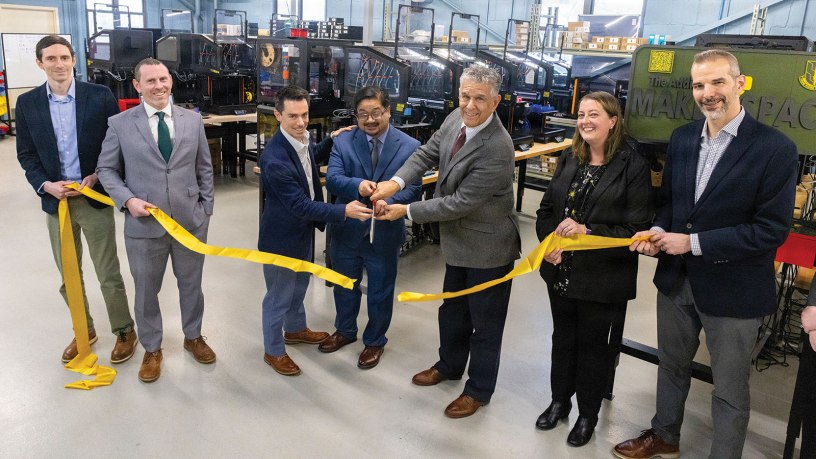
PICATINNY ARSENAL, N.J. – The U.S. Army took a significant step forward in additive manufacturing and rapid prototyping with the grand opening of the Additive Makerspace in a ribbon-cutting ceremony on March 19.
Additive manufacturing, or 3D printing, constructs 3D objects layer-by-layer from digital computer aided-design (CAD) models, supporting materials like plastics, metals, ceramics, and composites. It reduces costs and accelerates development by enabling complex, customized designs that are difficult or impossible for traditional manufacturing.
The new Additive Makerspace facility will provide U.S. Army Combat Capabilities Development Command (DEVCOM) Armaments Center engineers with a state-of-the-art makerspace to design, prototype, and manufacture parts, enhancing the Army’s ability to innovate and respond to the needs of the modern warfighter.
The space is facilitated by the Analysis, Materials, and Prototyping Directorate (AMPD), under the Armaments Center’s Munitions Engineering Technical Center (METC).
“The space is here for the Picatinny community to work on prototype design and manufacturing,” said Matthew Clemente, a mechanical engineer with AMPD. “It serves to add additive manufacturing capacity to the community’s projects.”
More than 50 3D printers make up the facility which offers a range of advanced 3D printing technologies and material options, providing engineers the ability to design and produce work through additive manufacturing processes.
AMPD’s mission is to provide manufacturing, engineering analysis, producibility, prototyping and reverse engineering expertise in support of armaments technologies.
“We know this space will be a valuable tool for Armaments Center engineers to utilize these technologies and expertise – so we can drive speed and innovation to the battlefield,” said Thomas Fasano, Senior Scientific Technical Manager of AMPD.
The establishment of this new makerspace reflects a broader trend within the U.S. military to leverage the power of additive manufacturing. Similar innovation labs have been opened at other U.S. Army and Department of Defense locations, including the Maneuver Innovation Lab at Fort Moore, Georgia, and the Airborne Innovation Lab at Fort Bragg.
These facilities empower Civilians and Soldiers to turn their ideas into tangible solutions, fostering a culture of bottom-up innovation.
From forward-deployed units in remote locations to major depots on home soil, the Army is leveraging 3D printing to keep its equipment operational and give Soldiers a critical edge. The ability to rapidly prototype and manufacture components on-demand is a crucial advantage in a contested logistics environment.
The technology is being used to fabricate everything from simple plastic buckles to complex metal vehicle components, demonstrating a transformative impact on military operations.
By bringing these capabilities closer to the point of need, the Army can reduce its reliance on traditional supply chains and increase its operational readiness.
Engineers interested in utilizing the Additive Makerspace facility should contact usarmy.pica.devcom-ac.mesg.additive-makerspace@army.mil.
 That PAO Guy