
By Stephanie Abdullah, Defense Logistics Agency Energy
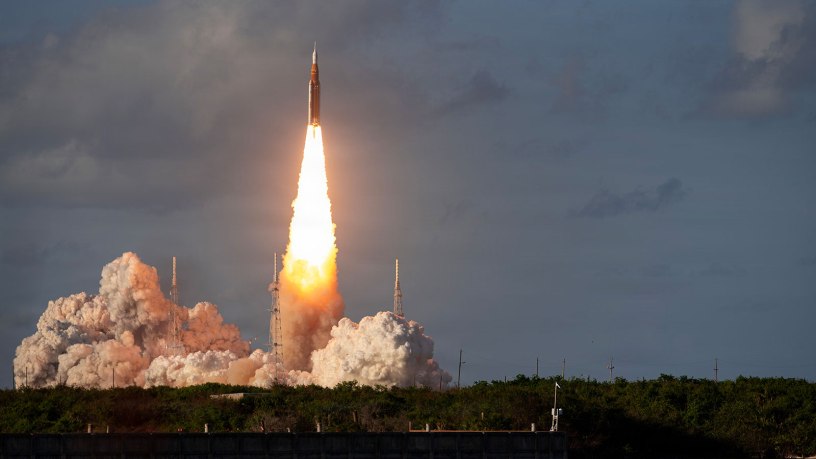
FORT BELVOIR, Va. –When NASA’s Artemis II mission launched on April 1, its success relied on a complex and mission-critical supply chain managed by the Defense Logistics Agency Energy.
DLA Energy provided more than 21,000 pounds of highly specialized propellants essential for the Orion spacecraft’s historic flight sending humans on a journey around the moon for the first time in more than 50 years. The achievement was the result of a multi-layered logistical operation demanding a high degree of precision to ensure the safety of the four-person crew.
“This is a momentous day for our nation,” Douglas G. Smith, director of Aerospace Energy Supplier Operations at DLA Energy, said on the day of the launch. “Providing the essential propellants that will power the Orion spacecraft and its crew is a profound responsibility and a source of immense pride for our entire team.”
DLA Energy’s contribution was the culmination of a process managing volatile, toxic and highly pure fuels where there was no margin for error. The specific propellants included monomethyl hydrazine, dinitrogen tetroxide, and high-purity hydrazine.
“The phrase ‘hand-in-glove’ is the perfect description,” said Shonda Rizo, acting director of Aerospace Energy Customer Operations. “The coordination with NASA is constant, detailed, and operates at multiple levels.”
Rizo described the propellant’s journey as an unbroken chain of custody that began with highly detailed technical requirements from NASA. DLA Energy Aerospace Energy then engaged a niche industrial base and oversaw production, with quality assurance specialists onsite.
“When human lives are at stake, the standard is absolute perfection,” Rizo stated. “Our quality assurance protocols are multi-layered and exhaustive.”
DLA Energy Aerospace Energy, in partnership with the U.S. Air Force and NASA labs, used techniques such as gas chromatography to search for impurities down to the parts-per-million level. They conducted independent verification and stability testing to ensure the fuel was as pure as possible.
This complex process proved its resilience when initial launch preparations were delayed by fuel leaks and technical issues, forcing the rocket back to the vehicle assembly building in February. Smith explained that DLA Energy Aerospace Energy’s response to these issues demonstrated its supply chain is a dynamic capability that can absorb shocks and adapt to the fluid nature of a space launch.
This adaptability is crucial, Smith noted, as it reinforces DLA Energy’s role as a cornerstone of whole-of-government operations.
Looking ahead, he confirmed DLA Energy is already planning for the long-term logistical needs of a sustained human presence on the moon, including supporting the future lunar Gateway space station.
For the DLA Energy Aerospace Energy workforce, they say the mission’s success is deeply personal.
“We all know the names of the astronauts — Reid, Victor, Christina, and Jeremy — and we feel a personal responsibility for their safety,” Rizo said. “It’s a powerful reminder that our work here on the ground can have an impact that is truly out of this world.”
 That PAO Guy