
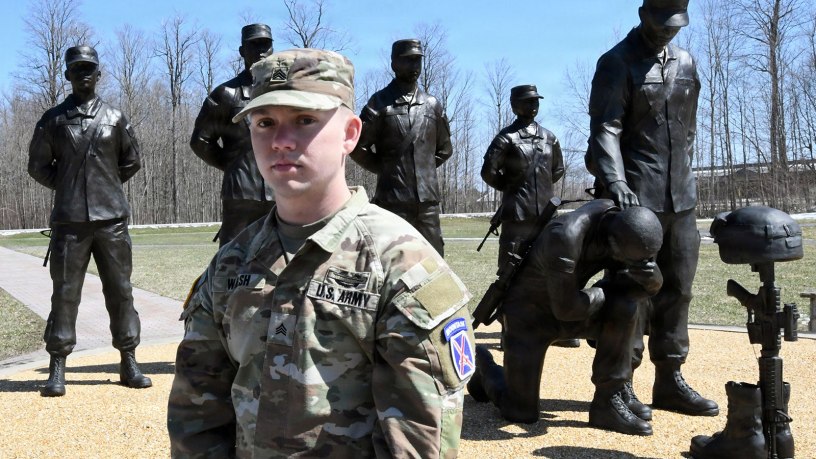
By Michael Strasser, Fort Drum Garrison Public Affairs
FORT DRUM, N.Y. (April 9, 2026) — A 10th Mountain Division (LI) Soldier spent part of his holiday weekend serving as a military escort for the burial of Pvt. Bennett H. Waters, a World War II prisoner of war, on April 4, in Blackshear, Georgia.
The duty was deeply personal for Sgt. Andrew Walsh, with Company A, 2nd Battalion, 87th Infantry Regiment, 2nd Brigade Combat Team. The POW was his great-great uncle, and at his grandmother’s request, Walsh was bringing him home.
“My reaction was happy, for one, because he is coming home after so many years of being a POW/MIA,” Walsh said. “And then I was excited that I could honor my family in such an important way. As a Soldier, it makes me happy to have a fellow Soldier coming home, and honoring his memory, and being able to pay respect to him for the sacrifices that he made for this great nation.”
Walsh escorted the remains from Omaha, Nebraska, to Blackshear, and then joined family members in honoring Waters’ service and sacrifice during the funeral service and burial, with full military honors.
As an infantry noncommissioned officer, Walsh said he never expected to receive an assignment like this and especially one that connected him to a distant relative.
“The only stories that I can remember being passed down was that I had a great-great uncle who served in World War II, and that he was captured by the Japanese,” Walsh said.
He has since learned a few more details about his great-great uncle.
Pvt. Bennett H. Waters, a U.S. Army Air Forces Soldier, served with the 17th Bombardment Squadron, 27th Bombardment Group in the Philippines. He was captured by enemy forces during the Japanese invasion of the islands in April 1942, survived the Bataan Death March, and was sent to the Cabanatuan POW Camp.
According to a letter Waters had sent to his mother, he worked in a Japanese chow hall and was tasked with feeding the pigs in the camp. Waters ate leftover scraps, meant for the animals, so he could maintain his weight and stay healthy. To keep the pigs fed, he gave them coconut meat and water.
Waters was among the roughly 1,600 POWs scheduled for transport during the evacuation from the Philippines in the summer of 1944. The inhumane conditions and overcrowding on board led survivors to call them “Hell Ships.”
According to the Defense POW/MIA Accounting Agency (DPAA), the Japanese government reported that Waters died on Jan. 9, 1945, at the age of 26, when his ship was attacked and sank. After the war ended, the American Graves Registration Command investigated and recovered missing American personnel.
In May 1946, a search and recovery team exhumed a mass grave at Takao, Formosa. They recovered 311 bodies, but the remains could not be identified and were buried in the National Memorial Cemetery of the Pacific in Honolulu. In recent years, several sets of these remains have undergone further study and scientific analysis for positive identification, including Waters.
The DPAA is the agency responsible for the recovery and identification of missing American service members from past conflicts. It combines anthropological analysis, circumstantial evidence and DNA analysis to make identifications. These efforts provide closure for thousands of families and ensure that veterans like Waters are never forgotten.
Walsh grew up in a military family, with his great-great uncle at the start of that tradition, followed by others who served in the Army, Air Force and Navy.
“I wanted to enlist in the Army because I wanted to honor my family by becoming something better than myself,” he said. “What that legacy means to me is to try my best each and every day to honor all of the sacrifices that the generation from World War II and after did before my time of serving.”
When Walsh learned how his relative’s remains were recovered and identified, he said it filled him with pride.
“I think the message it sends to current and future generations is that no matter what happens to your loved ones, the Army will do their very best to reconnect you with them – no matter if it is 20 years, 40 years, or so on,” he said.
Walsh said he is also appreciative of the support and guidance given by his chain of command during this process.
“My battalion and company command teams allowed me the opportunity to be able to do this, and having their support through all of this makes me realize that your command teams will always have your best interest in mind,” he said. “(This) is a great organization to be a part of.”
 That PAO Guy