
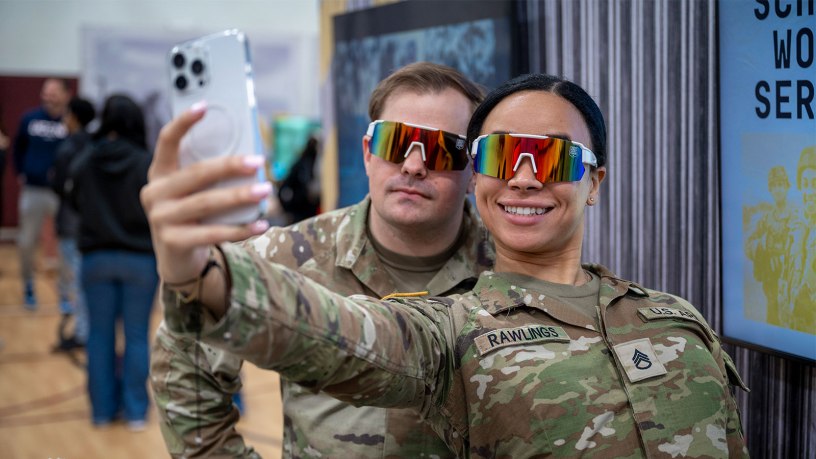
From sharing memes and keeping in touch with our friends to reading news and connecting with people around the globe, social media has become an intertwined part of our daily routine. What was once a platform for sharing enigmatic and melancholic music lyrics as an indicator of our mood (I’m looking at you AIM) is now a platform on which many people build their lifestyle.
As military members, social media can be a constructive place to boost morale, raise recruiting and retention efforts, or share lessons learned for the next generation of leaders in our formations. But it can also be an easy place to get in trouble.
One of our jobs as Public Affairs Officers and Specialists is to provide guidance to service members about the left and right limits of what they can post on social media as a member of the military. But not everyone knows that we’re a resource FOR them.
That’s why I’ve put together this guide. To help you navigate the Do’s and Don’ts of social media. Below, I’ve listed a bunch of resources for you. But, if that’s TLDR, feel free to jump down to the FAQ section, where I answer some of the most common questions I get about posting online as a member of the military.
References
Here are all the different policies, regulations, and instructions that pertain to social media in the military. There’s a lot of information in these documents, much of it doesn’t apply to you as a service member, but if you keep scrolling, I’ve highlighted the key takeaways from each document.
- DOD Instruction 5400.17 “Official use of Social media for Public Affairs Purposes”
- DOD Instruction 8170.01 “Online Information Management and Electronic Messaging”
- The Hatch Act Social Media Guidance
- Federal Employee Ethics Rules
- Army Regulation 360-1 “The Army Public Affairs Program”
- Secretary of the Navy Instruction 5720.44C “Department of the Navy Public Affairs Policy and Regulation”
- Air Force Instruction 35-101 “Public Affairs Operations”
- Social media and the UCMJ (blog by military lawyer Cody Harnish)
Branch Specific Social Media Policies
From the resources above, each service branch has created their own social media policy. Again, a lot of what is in these policies are directed more toward the Public Affairs professionals, but they do cover personal social media use as well.
- Army
- Navy
- Air Force (and Space Force)
- Marine Corps
- Coast Guard
References
DOD Instruction 5400.17″Official Use of Social Media for Public Affairs Purposes”
The area of DODI 5400.17 that you want to pay special attention to is Section 8: Personal Social Media Use by DoD Personnel. It states:
DoD personnel may use unofficial personal social media. In doing so, DoD personnel must adhere to the rules discussed in this instruction, including preventing the unauthorized disclosure of non-public information (or unclassified information that aggregates to reveal classified information) and refraining from any appearance of DoD endorsement or sanction. The following guidance applies to DoD personnel who maintain a personal social media presence.
Key takeaways
- Make sure your personal social media account is clearly identifiable as personal.
- DO NOT use DoD titles, insignia, uniforms, or symbols in a way that could imply DoD sanction or endorsement of the content.
- DO NOT use official email addresses or phone numbers as contact information to establish personal, nonofficial accounts.
- You should use a disclaimer clarifying that your social media communications reflect your personal view and do no necessarily represent your branch of military service or the United States. The use of a disclaimer does not allow DoD personnel to accept compensation that is prohibited by DODI 5400.17 or other applicable regulations.
- DO NOT disclose non-public information to further your private interests or the private interest of others. You MUST adhere to Operations Security (OPSEC) and unit-level directives, including while in forward operation environments. Release of unauthorized content through any means, including social media, may unnecessarily bring harm to individuals, units, and the mission.
- DO NOT conduct official business on personal social media accounts, per Paragraph 3.26.a of DoDI 8170.01 and Section 2911 of Title 44, U.S.C.
- Your personal Social Media accounts MUST NOT be an avenue for friends, followers, or private contacts to gain access to DoD programs or seek action from DoD officials in a manner not available to the general public.
- DO NOT accept compensation for any activity relating to one’s status as a DoD Civilian Employee or Military Service member.
- “DoD personnel are prohibited from using their official position or public office for personal financial gain, for the endorsement of any product, service, or enterprise, or for the private gain of friends, relatives, or persons with whom the employee is affiliated in a nongovernmental capacity. (Section 2635.702 of Title 5, CFR). DoD personnel are also prohibited from using government resources for non-official, personal activities.”
- “The use of one’s official position or public office includes the use of any reference to one’s status, name, image, or likeness as a DoD civilian employee or Service member. This includes the use of official titles, photographs that display a connection to one’s status as a DoD civilian employee or Service member (e.g., a photograph while in uniform or while wearing an identifying device such as a lanyard or lapel pin); and the personal use of DoD protected symbols or other imagery.”
- “DoD personnel are prohibited from using their official position to either affirmatively endorse a non-federal entity, product, service, or enterprise, or by taking action that implies DoD endorsement through the unauthorized use of one’s official position or public office.”
- “Private gain includes the receipt of compensation from a third party, to include revenue from advertising, sponsorships or sponsorship agreements, affiliate marketing agreements, or promotion of commercial ventures on personal social media accounts. This does not preclude DoD personnel from engaging in compensated outside employment when permitted by applicable ethics and other regulations.”
- “DoD personnel are prohibited from using their official position or public office for personal financial gain, for the endorsement of any product, service, or enterprise, or for the private gain of friends, relatives, or persons with whom the employee is affiliated in a nongovernmental capacity. (Section 2635.702 of Title 5, CFR). DoD personnel are also prohibited from using government resources for non-official, personal activities.”
- DO NOT engage in prohibited Political Activity
DOD Instruction 8170.01 “Online Information Management and Electronic Messaging”
Key Takeaways
- DoD personnel may not use personal, nonofficial accounts, to conduct official DoD communications (policy in Paragraph 1.2.f.). Exceptions must meet the combined three conditions:
- Emergencies and other critical mission needs.
- When official communication capabilities are unavailable, impractical, or unreliable.
- It is in the interests of DoD or other USG missions.
- Personal, nonofficial accounts may not be used to conduct official DoD communications for personal convenience or preferences. For example, the desire to only use a personal smartphone and not use one provided by DoD; or the preference for a commercially-provided webmail service, for example the Gmail client, over the Defense Enterprise E-Mail Outlook client are prohibited.
- DoD personnel may use personal, nonofficial accounts to participate in activities such as professional networking, development, and collaboration related to, but not directly associated with, official mission activities as DoD personnel.
- In accordance with United States Office of Government Ethics Legal Advisory 15-03, when conducting personal, nonofficial communication, DoD personnel must:
- Avoid the distribution and discussion of nonpublic information or the appearance of official sanction.
- Not disclose nonpublic information, or unclassified information that aggregates to reveal sensitive or classified information.
- DoD personnel should use non-mission related contact information, such as personal telephone numbers or postal and e-mail addresses, to establish personal, nonofficial accounts, when such information is required.
- Comply with records management procedures described Paragraph 3.32.
- DoD personnel who are acting in a private capacity have the First Amendment right to further release or share publicly-released unclassified information through non-DoD forums or social media provided that no laws or regulations are violated. DoD personnel will not post comments or material that denigrates another military or civilian member of the DoD team. Some of the applicable laws and regulations are:
- Chapter 47 of Title 10, U.S.C.
- Joint Ethics Regulation, notably the provision that preparation activities are not conducted during normal duty hours or using DoD facilities, property, or personnel except as authorized (See DoD 5500.07-R).
- (3) DoDD 1350.2
- (4) DoDD 1020.02E, notably the provision that equal opportunity is critical to mission accomplishment, unit cohesiveness and military readiness and that all are afforded equal opportunity in an environment free from harassment, including sexual harassment, and unlawful discrimination on the basis of race, color, national origin, religion, sex (including gender identity) or sexual orientation.
Frequently Asked Questions
Q: Can I have a personal social media account while serving in the military?
A: Yes! DoD personnel may establish accounts for personal, non-official use.
Q: Can I wear my uniform in content I create on my personal social media accounts?
A: It depends on the intent of your content and your social media account. If it’s simply a personal account that you use to keep in touch with friends and family, then YES, you can post photos and videos of you in uniform so long as the content meets the requirements outlined in regulation. If your social media account is monetized or you’re attempting to grow a following beyond your friends, family, and coworkers, then NO, you cannot create content in uniform as this could be perceived as using your uniform for personal gain.
Q: Can I monetize my social media accounts?
A: Yes. However, you cannot monetize any content in which you use DoD titles, insignia, uniforms, or symbols in a way that could imply DoD sanction or endorsement of the content (DODI 5400.17 Para. 3.1.c). And yes, wearing your uniform can imply DoD endorsement of your content, even with a disclaimer.
Q: Can I create and post content to my personal page while on duty?
A: It depends. If your social media account is monetized or you’re attempting to grow a following, then NO, DoD ethics rules clearly state service members CANNOT engage in outside employment, including creating monetized social media content, when it interferes with official duties. If your personal social media is just for friends, families, and coworkers, then yes, you could create content while at work. But you still shouldn’t because, well, shouldn’t you be working?
Q: Can I use government equipment, such as laptops or cameras, to create content for my personal page?
A: No. Federal employees are generally prohibited from using government equipment for anything other than official business.
Best Practices to stay safe on social media
- Personal accounts must be clearly identifiable as personal.
- Avoid use of DoD titles, insignia, uniforms or symbols in a way that could imply DoD sanction or endorsement of the content.
- Use a non-endorsement disclaimer when posting content featuring DoD titles, insignia, uniforms, symbols, or otherwise identifying yourself as a service member.
- DON’T POST ABOUT POLITICS while in a duty status or in uniform. Per DoDI 5400.17, para. 6.1.d.(5)(a), service members are prohibited from engaging in political activity on their personal social media while in the federal workplace or while on-duty, including teleworking. This also includes liking and sharing content from political accounts.
- DO NOT comment, post, or link to material that violates the UCMJ or service regulations. Examples of this include showing contempt for public officials, releasing sensitive information, or posting unprofessional material that is prejudicial to good order and discipline under the UCMJ.
- DO NOT share classified information.
- ALWAYS keep Operational Security (OPSEC) in mind.
- AVOID discussing areas of expertise where you have no firsthand, direct experience or knowledge.
- CLEARLY differentiate between your opinions and official information.
- DO NOT use your military affiliation, official title, or position to promote, endorse, or benefit any profit-making group or agency, or non-profit groups based solely on religious or political affiliations. This includes appearing in, or preparing statements for inclusion in, advertisements designed for use by electric or print media.
- YOU MAY use a photo of yourself in uniform as a profile picture SO LONG AS you clearly identify the page as being unofficial.
- WHEN IN DOUBT, ask your public affairs office for guidance.
 That PAO Guy