
By Lt. Col. Kristin Porter, 807th Theater Medical Command
FORT GREGG-ADAMS, Va. — The Army Reserve Culinary Arts Team demonstrated technical skill, adaptability, and competitive excellence during this year’s Joint Culinary Training Exercise, Feb. 27 to March 4, earning medals across every category and securing a third-place overall finish among top military teams.
Behind that success was Chief Warrant Officer 4 Colby Beard, 807th Theater Medical Command, a seasoned culinary professional and longtime competitor who served as the team’s advisor while also stepping onto the international stage himself.
Beard, a food service technician (MOS 922A), has been involved in military culinary competitions since 2009. Over the years, he has served as a competitor, team captain, manager and now advisor, mentoring the next generation of Army Reserve culinarians while continuing to refine his own craft.
“I was overseeing the team and mentoring and coaching and training them,” Beard said. “We had a full team this year and medaled in every category.”
Training for Excellence
As team advisor, Beard played a critical role in preparing soldiers for competition. Unlike active-duty teams that often train together for months, Army Reserve teams are built from across the country and must quickly develop cohesion and skill.
Despite those challenges, the team conducted five dedicated training days prior to the competition, an opportunity Beard says made a significant difference.
“We were able to carve out funding to get those additional training days for junior soldiers,” he said. “That really helped the performance of the team.”
The team consisted of both junior and senior competitors, following American Culinary Federation standards. Junior soldiers, many with little to no professional culinary background, trained alongside more experienced noncommissioned officers.
Beard and his leadership team worked closely with competitors on menu development, knife skills, and execution, ensuring they were prepared to meet strict competition standards.
Once the competition begins, however, coaching stops.
“When they actually go to compete, you’re hands off,” Beard said.
From Advisor to International Competitor
Although advisors typically do not compete, Beard was called upon just days before the event to represent the United States in the prestigious International Culinary Challenge after a team member became unavailable.
The competition paired Beard with Sgt. Maj. Michael E. Bogle from Fort Hood, combining pastry and savory expertise to compete against elite military teams from France, Germany, the United Kingdom, and beyond.
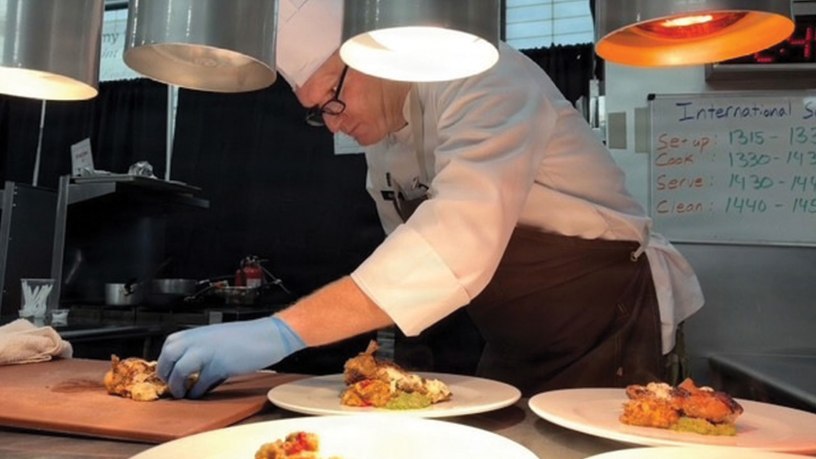
Beard competed in both cold and hot food categories, earning a bronze medal for his cold platter and a silver medal for his live cooking challenge.
His cold platter featured a technically demanding beet and roasted pepper terrine layered with goat cheese and encased in aspic, a classical French preparation requiring precision and presentation.
For the live cooking portion, Beard prepared a marinated chicken stuffed with queso fresco and queso-style cheese, served with black bean sauce, corn spoon bread, cilantro quinoa and sautéed vegetables, fabricating everything from scratch and completing it within a 60-minute time limit.
Competing on a Global Stage
The Joint Culinary Training Exercise brings together teams from across the Department of Defense, including the Army, Navy, Air Force and Coast Guard, as well as international military partners.
The Army Reserve team competed against active-duty installations such as Fort Bragg, Fort Stewart and others, as well as U.S. Army teams from Europe and Korea.
Despite the decentralized nature of the Reserve, Beard believes that structure can be an advantage.
“We’re used to building teams on the fly,” he said. “We went in and executed well and were able to medal in every category.”
Beyond Competition: Real-World Impact
While the competition highlights culinary excellence, Beard emphasized that the skills developed extend far beyond the kitchen.
He noted that creativity, adaptability and problem-solving, all essential in competition, directly translate to field feeding operations, where soldiers must work with limited resources and unpredictable conditions.
“You always have residual rations in the field,” Beard said. “The skills you learn here help you think outside the box and enhance meals for soldiers.”
From transforming leftover rations into new dishes to maintaining quality under pressure, those capabilities directly impact soldier morale and readiness.
Looking Ahead
Despite strong performance, Beard sees opportunities to further develop culinary training within the Army Reserve, particularly in medical units, where food service capabilities have been reduced in recent years.
He is currently working to expand training opportunities for Nutrition Care Specialists (MOS 68M) and improve culinary readiness across commands.
At the same time, the success of this year’s team reinforces the value of investment in culinary programs.
“The capability of what Reserve Soldiers bring to the table is significant,” Beard said.
With continued mentorship, training and competition experience, Army Reserve culinarians are proving they can compete — and succeed — at the highest levels.
 That PAO Guy