
By Alisha Tyer, Naval Surface Warfare Center Carderock Division
BETHESDA, Md. – The Orion capsule, carrying the crew of NASA’s Artemis II, returned to Earth on April 10, completing a mission that once again relied on complex recovery operations at sea – work supported by decades of testing at Naval Surface Warfare Center, Carderock Division.
The mission, which launched April 1 and concluded with a splashdown on April 10, demonstrated recovery procedures that were developed and refined through years of collaboration between NASA and the Navy. For Carderock engineers, it was a visible reminder that work conducted more than a decade ago continues to shape how those operations unfold today.
For some engineers, that connection spans years. Lauren “Tink” Hanyok, who continues to support the effort, was early in her career when she helped promote initial Orion testing at Carderock. That experience shaped her technical focus and professional path. It also reflects the kind of cross-disciplinary work that defines Carderock’s role in broader scientific and engineering efforts.
Carderock’s involvement in capsule recovery testing traces back to the early 2000s, when engineers began supporting efforts to understand how next-generation spacecraft would behave in open water. While spacecraft are designed for spaceflight, their missions ultimately end in the ocean, where naval engineering expertise becomes essential.
That intersection of aerospace and maritime engineering defined Carderock’s role in the development of NASA’s Orion spacecraft.
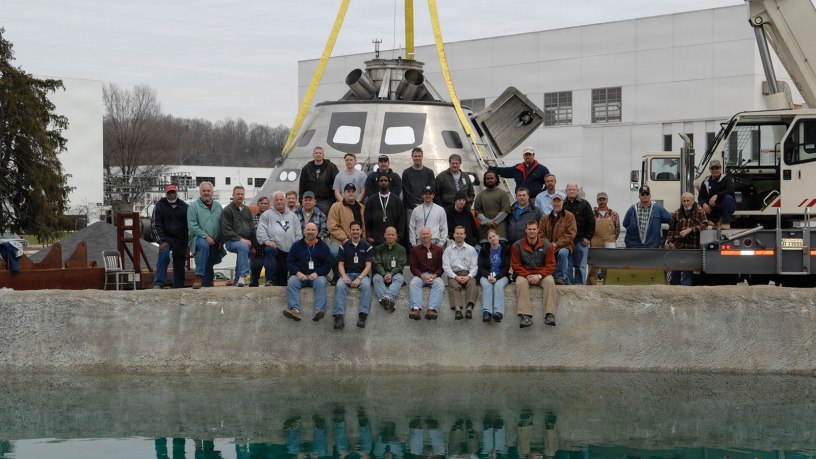
In 2009, Carderock engineers, working alongside NASA, designed, fabricated and tested multiple Orion capsule models to evaluate recovery operations in realistic ocean conditions. These included full-scale boilerplate test articles, scale models and tow tank experiments that examined stability, seakeeping and crew recovery procedures, as previously reported in the April 2009 issue of Carderock Wavelengths. The effort demonstrated how Carderock’s capabilities could be applied to complex challenges beyond traditional naval platforms.
More than a decade later, that work took on renewed relevance during NASA’s Artemis I mission, the first integrated test of its deep space exploration systems, and Artemis II’s successful splashdown with the full crew reiterated the critical value of that early hydrodynamic testing partnership with Carderock. A 2022 NAVSEA article highlighted how Carderock’s earlier testing efforts informed Orion’s splashdown and recovery operations.
“We built two full-scale models for NASA,” said Mark Melendez, a Carderock mechanical engineer, in a 2022 Navy article. “The first one was the big, metallic, full-scale boilerplate called the PORT… It was built to replicate the hydrodynamic behavior of the Orion Command Module.”
The testing addressed a critical question: how astronauts and recovery teams would operate in real ocean environments following splashdown.
“NASA wanted to know what kind of motions to expect from the capsule bobbing up and down in the ocean,” Melendez said in the same article. “Due to our test and evaluation experience, they came to us to help build this full-scale model.”
Engineers evaluated how the capsule responded to waves, how it could be stabilized or righted if overturned, and how recovery personnel could safely approach and extract crew members. The work also examined how sea conditions would affect astronauts awaiting recovery, sometimes for extended periods.
“NASA wanted to see how this capsule interacted with the waves in various sea states and try to get indices on the safety of the astronauts as the capsule bobbed on the ocean’s surface,” said Richard Banko, the project’s principal designer and manager, in the 2022 article.
These efforts required a level of reliability and testing capability that was not readily available elsewhere.
“They wanted a very high-fidelity test, so we had to model not only the external structure, but also the internal structure to see how water moved around on the inside,” Banko said in the same article.
The results informed recovery procedures that remain relevant today.
“Because of Carderock’s involvement in Orion’s development, NASA was able to determine the safest way to recover the capsule,” said Hanyok. “With a capsule roughly three times larger than Apollo, guesswork wasn’t an option. It required testing that could only be done at a place like Carderock.”
For those involved, the mission represents the culmination of years of engineering and collaboration.
“Just being involved with NASA has been incredible,” Melendez said. “Every engineer dreams of working with NASA, so to see this whole thing come full circle and to know I worked on it and made a significant contribution has been unreal.”
Banko emphasized the lasting value of the work.
“I am glad to see these assets are still in use and have provided valuable information and training for America’s space program,” he said in a 2022 Navy article.
For Hanyok, the impact extends beyond a single project.
“This experience showed me how work at Carderock can extend far beyond the Navy and contribute directly to national-level missions,” she said.
For engineers who contributed to the effort, the recent mission was more than a technical milestone. It was a moment of validation.
“It’s been nearly 17 years since we designed and built those models at Carderock. To see NASA and the Navy still using them to practice recovery operations and then getting to watch it all come together during the actual mission is something to be proud of,” Melendez said.
That continuity reflects a broader reality: while spacecraft technology continues to evolve, the challenges of ocean recovery remain constant.
From early testing efforts to today’s Artemis missions, Carderock’s role has been consistent, providing the technical expertise needed to bridge the gap between space flight and the maritime environment. The work also contributes to broader advancements in engineering and applied science.
As future missions push farther into deep space, that expertise will continue to be essential to ensure that no matter how far Orion travels, it can return home safely.
 That PAO Guy