
By Christopher Jones, Naval Hospital Twentynine Palms
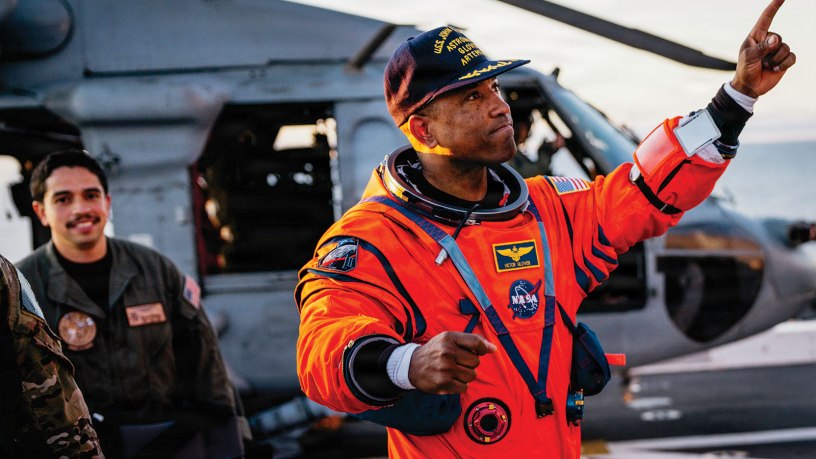
SAN DIEGO (April 15, 2026) — As NASA’s Artemis II crew returned to Earth following their historic mission around the moon, a team of Navy Medicine professionals stood ready in the Pacific Ocean to receive them—prepared for anything from a routine recovery to a life-threatening emergency.
Among them was Hospital Corpsman 1st Class Brian Romero, a Gilbert, Ariz. native and search and rescue medical technician (SMT) assigned to Navy Medicine Readiness and Training Unit (NMRTU) China Lake. Romero was part of Navy Medicine’s Expeditionary Resuscitative Surgical System (ERSS) and En-Route Care System (ERCS) teams embarked aboard the San Antonio-class amphibious transport dock USS John P. Murtha (LPD 26), the primary recovery platform for the Orion spacecraft following its splashdown in the Pacific Ocean on April 10.
Selected to support the mission back when he was fresh out of paramedic school, Romero said his initial focus was on applying his newly developed skills—but the magnitude of the mission became much clearer as the moment approached.
“I was more excited to use my new skills, and it really didn’t hit me how important it was to be part of something much bigger than myself until the day of the mission,” Romero said.
Romero served as part of ERCS-11, one of several Navy Medicine teams embarked for the mission. The ERCS is a two-person team that provides critical care during patient transport via air, surface, or ground, while the ERSS is a seven-person mobile surgical team capable of delivering life-saving trauma care in austere environments.
Navy Medicine personnel supporting the mission were drawn from commands across the Pacific, including Navy Medicine Readiness and Training Command (NMRTC) San Diego, NMRTC Camp Pendleton, U.S. NMRTC Guam, and NMRTU China Lake, which supports NMRTC Twentynine Palms.
Romero said the success of the mission highlighted the versatility of search and rescue medical technicians, who are trained as both pre-hospital medical providers and rescue specialists capable of operating in dynamic environments.
“I was part of the ERCS. There were four SMTs from HSC-23 (Helicopter Sea Combat Squadron 23) who did a flawless job in the actual recovery of the astronauts from the capsule,” Romero said. “It’s pretty amazing to see that SMTs can be utilized in so many ways, and so many of us were involved in this important mission. SMTs are specialized pre-hospital medical professionals and are prepared for missions like this because we are trained rescue technicians as well, with a helicopter crew in our toolbox.”
On the day of recovery, Romero and his team prepared for both nominal and off-nominal scenarios as the Orion capsule descended toward the Pacific Ocean.
“In the morning we prepared our stations for an off-nominal reentry,” he said. “It wasn’t until around noon that the tension and suspense really built. We were hoping for the best, but extremely prepared for the worst. Time went by slowly, and it wasn’t until the capsule was recovered aboard the ship that we could stand down and actually take in the moment.”
As a search and rescue medical technician, Romero’s role focused on providing en route care for both the astronauts and recovery personnel during one of the most critical phases of the mission.
“We are the en route care team for both the astronauts and the recovery team,” Romero said. “Reentry into Earth’s atmosphere is a very critical time for the astronauts and the Orion capsule, so we really didn’t know what to expect at our level. We were also utilized to support the ward corpsmen and nurses in the medical evaluation as soon as they boarded the ship.”
Medical teams trained extensively for the physiological effects of spaceflight, particularly the challenges associated with returning to Earth’s gravity after extended time in a microgravity environment.
“The biggest concern was that after being in zero gravity for so long, their equilibrium would be off, so we trained to mitigate any risks associated,” Romero said.
Romero was among the first medical personnel to interact with the astronauts after they exited the capsule.
“It was surreal,” he said. “I was expecting all of them to be feeling sick, but they all looked great. It was really amazing to see how grateful and humble they were after making history.”
He said one of the most fulfilling aspects of the mission was seeing the recovery effort come together as a unified operation.
“The most rewarding part was being able to be part of a much bigger team,” Romero said. “Everyone played an important role, and we all had one mission—to safely recover the astronauts and support the recovery team as best as we could.”
That teamwork, Romero said, reflected the broader strength and flexibility of Navy Medicine personnel operating far beyond traditional clinical settings.
“I think it was a perfect opportunity to show that the Navy Medicine team is like a Swiss Army knife—great at their jobs, but also very versatile and adaptable,” Romero said. “It’s a well-trained team capable of achieving any task.”
Reflecting on the mission as a hospital corpsman, Romero said the operation also highlighted the wide range of specialties corpsmen hold that support a recovery of this scale.
“You can’t go on missions like this without hospital corpsmen,” Romero said. “It was amazing to see all the dive IDCs (independent duty corpsmen), SMTs, surgical techs, lab, X-ray, and quad-zero personnel working together as a unit to accomplish this mission.”
For Romero, the mission marked another milestone in a fast-paced operational career. Less than a year earlier, he participated in the successful rescue of an ejected F-16 pilot near China Lake, Calif.—demonstrating the wide-ranging mission set Navy SMTs may encounter.
“I think it’s amazing to be part of history, and I’m grateful to the Navy and leadership for offering this opportunity—not only to myself, but to other junior Sailors,” Romero said. “When facing a mission like this, I find it most important to just do my job competently and help those around me—that’s what gives me the most fulfillment.”
He said his experience working in a clinical environment at Branch Health Clinic China Lake, which supports Naval Hospital Twentynine Palms, played a critical role in sustaining the medical skills needed for the mission.
“Working at an MTF (military treatment facility) keeps me on my toes, making sure I’m getting exposed to those patients and staying up to date with the newest protocols,” Romero explained.
Romero also credited his home commands—NMRTU China Lake and Air Test and Evaluation Squadron Three One (VX-31)—and their leadership for the opportunity to support the mission.
“Over at VX-31 we’re constantly flying, practicing that en route care piece, so our skills never die,” Romero said. “Without NMRTU China Lake and without VX-31, I wouldn’t have been able to get here. Those commands—my OICs (officers-in-command)—have been able to give me the opportunity to get trained, be here for this mission, and be a part of history, so I’m really grateful for that.”
The successful recovery of the Artemis II crew highlights the critical role Navy Medicine plays in supporting operational missions. For Romero and other SMTs, the mission remains the same: be ready to provide care in any environment, under any conditions—even when that mission involves recovering astronauts returning from space.
 That PAO Guy