
By Lt. Erin Wiley, Explosive Ordnance Disposal Group One
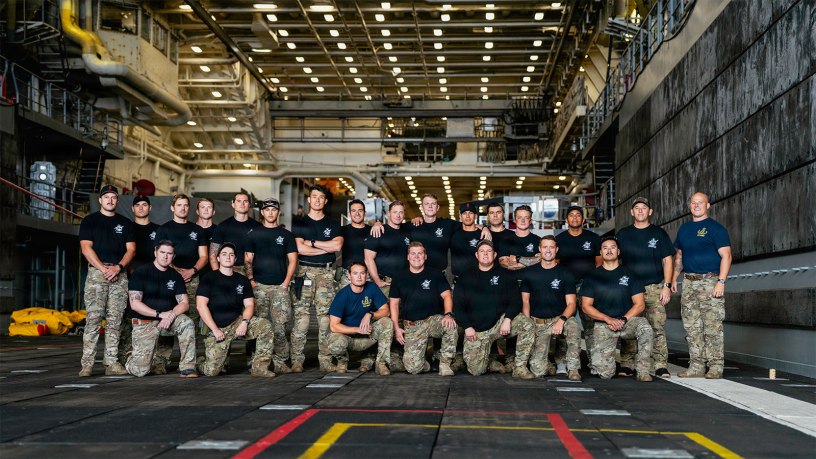
SAN DIEGO — A small team of U.S. Navy divers, assigned to units under Explosive Ordnance Disposal Group (EODGRU) 1, recovered the Artemis II crew and Orion space craft upon their return to Earth and splashdown in the Pacific Ocean following a historic 10-day lunar mission April 10, 2026.
As the recovery master diver for the mission, Master Chief Navy Diver Ryan Crider, assigned to EODGRU 1, oversaw and coordinated the movement of equipment and divers and led communication between all involved assets to safely recover the astronauts and spacecraft. His experience in the effort began before the launch of Artemis I in 2022.
All Navy divers must complete basic Navy dive school, but for the Artemis II mission, teams of divers visited the Neutral Buoyancy Lab at NASA’s Johnson Space Center in Houston and participated in a series of underway recovery tests for specialized training. Drilling different scenarios while using recovery tools and equipment, sometimes with the astronauts themselves in attendance, provided a twofold benefit: it bolstered both diver skillsets and astronaut rapport with the recovery team.
“As the hatch door opened, you could tell that it was like old friends greeting each other after a long trip,” said Crider, from Mililani, Hawaii. “There was nothing but love, appreciation and respect between the Navy and NASA in that moment.”
The recovery began April 10 with a sonic boom as Orion reentered the atmosphere before splashing down in the Pacific Ocean off the coast of San Diego. Divers moved quickly toward the spacecraft on small boats to begin operations. After conducting safety checks for hazardous gases on the capsule’s exterior, the team commenced recovery procedures.
As the lead in-water recovery diver, Navy Diver 1st Class Chase Marini, assigned to Explosive Ordnance Disposal Mobile Unit 3, was responsible for the deployment and attachment of recovery platforms to Orion. This included an inflatable raft known as the front porch and a stabilization collar used to keep Orion steady during the medical assessment and extraction of the crew.
Once the platforms were successfully deployed, Marini, from El Dorado Hills, Calif., assisted the first-contact medical team with the safe exit of the astronauts from the spacecraft onto the front porch.
“Both the training for and execution of this historic event has been an incredible experience,” said Marini. “I’ll never forget the time we shared with the Integrity crew as we sat on the front porch prior to their lift back to the ship on helicopters. We were excited to welcome them back to Earth and be a part of their journey home.”
After the astronauts were safely transported by helicopter to amphibious transport dock USS John P. Murtha (LPD 26), divers shifted focus to preparing the Orion capsule for safe recovery into the ship’s well deck. As sea and daylight conditions changed, the team worked into the evening, applying their expertise in rigging and salvage until Orion was ultimately returned to the ship in the early morning hours.
“Despite initially calm seas and clear skies, we encountered some unexpected currents, and we had to change our plan accordingly,” said Chief Navy Diver August Dhayer. “The ocean always holds a vote, so we reacted quickly. Precise coordination and communication became critical as we towed the space craft back to the Murtha. ”
Dhayer, from Norwalk, Calif., managed the 10-person team of divers and medical personnel who made first contact with the Artemis II crew.
“Navy divers serve in a variety of roles across the fleet, so selection for this mission came down to qualifications and timing,” said Marini. “While the world watched this recovery, I hope it saw years of preparation by dedicated professionals and experienced recovery teams.”
The partnership between the Department of War and NASA in human spaceflight recovery operations dates back to 1959. Early missions relied on Navy underwater demolition teams and aircraft carriers, establishing a legacy that continues through modern recovery efforts.
“Navy divers have been instrumental in developing the tactics and procedures required for the safe recovery of both astronauts and crew modules,” said Shawn Murray, NASA Artemis master diver and retired Navy master diver. “Their critical continuity of service in support of NASA and human space flight undoubtedly contributed to the overall success of the Artemis II recovery.”
Although Crider will retire before future Artemis III and IV missions, he expressed confidence in the continued strength of the Navy-NASA partnership.
“We have set the standard for what comes next, and I know these teams will continue to succeed,” said Crider. “This experience has been the highlight of my career. To the next generation: train hard, give it your all, and stay ready.”
U.S. Navy divers assigned to EODGRU 1 supported NASA’s Artemis II mission, retrieving the crew and spacecraft following their return to Earth and splashdown in the Pacific Ocean. NASA’s Artemis II mission sent four astronauts on a flight around the moon in the Orion space capsule, marking the first time humans journeyed to deep space in over 50 years.
 That PAO Guy