
By Andrew Ortuzar, Defense Health Agency
The Defense Health Agency Traumatic Brain Injury Center of Excellence hosted the 2026 Annual Brain Health Symposium March 18, featuring presentations and the latest research across warfighter brain health.
In her opening remarks, Dr. Katie Stout, the center’s division chief, said research presented at the symposium is aimed at advancing military medicine to mitigate brain exposures and “provide long-term protection for service members, both in deployed and garrison environments” to keep warfighters lethal.
Military medical leaders briefed the Warfighter Brain Health Initiative which prioritizes providing high-quality care to all beneficiaries, working across the active duty, National Guard and Reserve components, and combatant commands to deliver integrated joint warfighting capabilities, and enhanced battlefield brain health assessment and treatment capabilities
Looking ahead to improved warfighter brain health
Opening the symposium, Kathy Lee, director of Warfighter Brain Health Policy in the office of the deputy assistant secretary of war for health affairs, defined warfighter brain health as the “physical, psychological, and cognitive status that affects a warfighter’s capacity to function adaptively in any operational environment and impacts readiness, operational capability, and the goal to achieve, overmatch, or superior lethality.”
Lee outlined key developments in the Department of War’s Warfighter Brain Health initiative:
- Accelerated cognitive assessments throughout the lifecycle of the warfighter
- Working towards a better understanding of long-term and late effects of TBI and blast exposures
- A refresh of Warfighter Brain Health Initiative, 2.0, expected in fall 2026
According to Lee, revising the initiative is “necessary to be agile and adaptive to evolving threats and operational environments.”
Lee said the focus of Warfighter Brain Health 2.0 will consolidate lines of effort to further focusing on an agile fighting force, maximize readiness and lethality by optimizing brain health and performance, recognizing and mitigating brain health risk, and protecting and treating warfighters.
“How do we do this?” Lee explained it takes engaging “communities of interest.”
“To continue to set conditions for success, we need engagement from multiple communities — such as the safety community, the acquisition community (weapons, information technology), training, the intelligence community, are obviously critical,” she said, adding the partnerships will need “intelligence information to provide emerging threat sources and environments that can negatively affect brain health and performance.”
Working with these communities “through policy, data streams, education and communication, as well as research,” are all vital for the initiative’s goals, she added.
Before the refreshed initiative launches, Lee said, “stakeholder feedback from Warfighter Brain Health 1.0 is absolutely critical” and will include soliciting input from service members with various experiences.
“We want to make sure we’re meeting the mark based on feedback with different levels of how long somebody’s been in the military,” Lee said, stressing the importance of including service members who newly joined as well as mid and late-career warfighters.
Lee explained “they may be deciding if they’re going to stay in the military and didn’t have a program like this in the very beginning when they entered into the force,” she said. “We’re trying to make sure that we are addressing the needs throughout a warfighter’s career.”
TBI screening for battlefield readiness
Lt. Col. (Dr.) Bradley Dengler, director of the Military Traumatic Brain Injury Initiative at Uniformed Services University, presented research based on data collected from over 17 years of conflict showing 68% of service members with mild TBI were evacuated from the battlefield.
Dengler said many widely accepted methods for TBI screening in operational environments required technology-dependent testing that prompted an evacuation from the battlefield. Evacuation “of people back in major ground warfare was a luxury in OIR (Operation Inherent Resolve) and OEF (Operation Enduring Freedom) but going forward (it’s) not going to be anymore,” he stressed.
“We looked at how fast these tests can be done,” Dengler said. He explained while some tests may be highly accurate, they are not practical for far-forward environments if they are time-consuming to complete and rely on computers for data analysis.
To find a better solution, Dengler’s team assembled a steering committee of TBI experts to evaluate the available methods for making real-time, return-to-duty decisions at the point of injury. Dengler emphasized tests need to be objective to prevent individuals from memorizing answers or embellishing poor performance.
The committee’s preliminary findings favor several rapid screening methods, with some assessments derived from sports medicine and field sobriety tests. For use in far-forward environments, the recommendations favor visual exams with minimal or no technology required, including:
- Convergence eye test:An object is moved toward the nose to measure the eyes’ threshold for focus.
- Smooth pursuit eye test:The eyes track a moving object, such as a pen or finger.
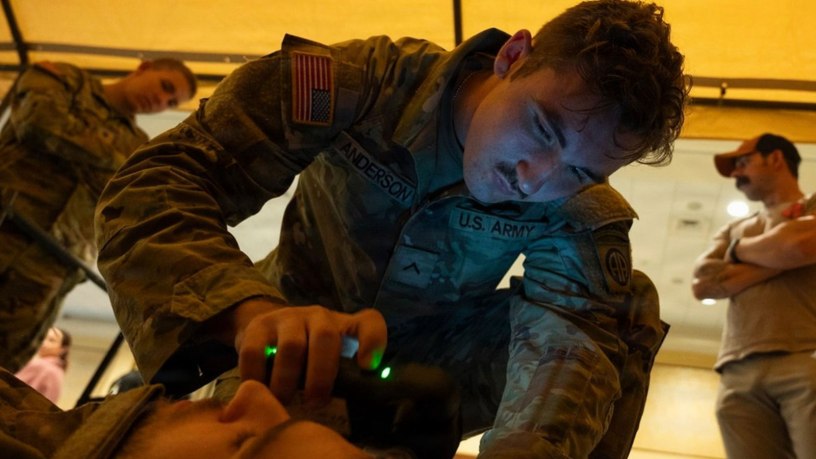
- Pupillometry:A portable device is used to scan and test the pupil’s response to light.
Dengler spoke to the potential for smart-phone technology integration into far-forward TBI screening as an overall goal but emphasized more data is needed and methods requiring no technology can be more reliably used in operational environments.
Overview:
Additional presentations covered topics including:
- “Military Traumatic Brain Injury, Sleep Disorders & the Glymphatic System,” presented by Cmdr. J. Kent Werner: outlining the interplay of TBI-related sleep disturbances, brain chemistry, and long-term symptoms
- “A Patient-Centered Approach to Understanding Traumatic Brain Injury Outcomes for Warfighters Through a Trauma-Informed Research Design,” presented by Ida Babakhanyan: connecting post traumatic stress disorder to long-term TBI recovery data, and advancing holistic brain health recommendations to improve outcomes
- “The Impact of Family Involvement on Traumatic Brain Injury Care,” presented by Susan Gallardo**:** exploring the central and critical role of family and caregivers in TBI recovery, and the importance of empowering family involvement in a treatment setting
- “Physical Activity and Exercise in the Role of Mild Traumatic Brain Injury Management,” presented by Andrew J. Darr: detailing how physical activity and exercise can positively impact TBI symptoms in unique populations of service members
At the foundation of the DOW’s joint, integrated effort to understand more about the brain and enhance treating brain injuries, is reducing risks of injury for keep warfighters in the fight, said Lee.
“We must ramp up our knowledge base so we can maximize brain protection strategies for service members and further advance our health care delivery system in a way that allows earlier intervention to keep them healthy and ready and able to enjoy a high quality of life post military service.”
 That PAO Guy