
By Michael Strasser, Fort Drum Garrison Public Affairs
Two forensic canines recently led Fort Drum archaeologists on a trail of centuries-old scents during a first-of-its-kind initiative for the Cultural Resources Program.
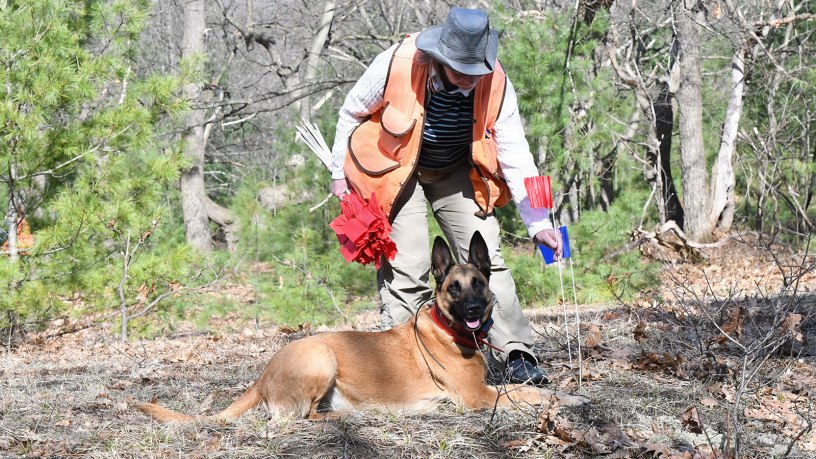
Ronda Bowser and Colette Falco, from the Institute for Canine Forensics, and their historical human remains detection (HHRD) dogs, Badger and Kaze, assisted the Cultural Resources team in examining ancestral burial sites on post, April 20-24.
Their work resulted in positive alerts at all but one site. Notable locations included an area in Range 14 where ground-penetrating radar had previously suggested a community cemetery, and a suspected burial site dating back roughly 2,000 years.
The Cultural Resources Section had made those areas off-limits years ago, and this new testing helped validate their previous archaeological surveys. Dr. Laurie Rush, Fort Drum Cultural Resources program manager, said the weeklong testing provided the highest level of certainty possible without shovel testing.
“We can never be conclusive without potentially disturbing the remains underground,” she said. “And we definitely don’t want to do that. So, we’ll never have all the answers we want, but this is contributing information and it also makes us reassured of the decisions we’ve made in the past to protect these sites.”
Rush learned about HHRD teams during a Society for American Archaeology meeting where she learned how they can locate old or ancient human graves by detecting the distinct chemical scent of decomposition. They are trained to detect odors from deep underground with a high rate of success, while differentiating between human and animal remains.
“Our dogs don’t find bodies, they find odor,” Bowser said. “In active decomposition, the strongest concentration of odor is directly with the source. But with 2,000-year-old burials, it’s been dispersed. Our dogs are telling us where the highest concentration of odor is in the area we allow them to search.”
The dogs must sort through commingled odors that have interacted with soil minerals over time as well as secondary structures like trees, which act as scent collectors. Weather also plays a critical role, as odor tends to move toward moisture and heat. In high temperatures, odor plumes may travel straight up, requiring the dog to be directly over the source to detect it.
Bowser said the dogs would “work until doomsday” without handler intervention, so they rely on behavioral nuances to gauge fatigue and effectiveness.
“This is fun for them – they have a blast,” she said. “Both of our dogs are in prime condition, so when they get tired, it’s more mental than physical.”
In fact, the dogs’ work ethic is so high that not working can be perceived as punishment. Bowser said that 80- to 90-percent of their work is in historical detection because of its complexity compared to standard forensic cases. She said, essentially, these dogs thrive on the challenge.
“People who do 50-piece puzzles, they can do that really well if that’s what they always do,” Bowser said. “But then you get a 10,000-piece puzzle, and you don’t have the patience for it. Historical detection is an absolute patience game for the dog. If we only gave them simple puzzles, then all of a sudden the dog doesn’t want to work hard anymore.”
As handlers, Bowser and Falco said their job blends scientific knowledge with real-time interpretation. They must understand odor dynamics, thermodynamics, wind effects and terrain features. However, once in the field, the dog takes the lead.
“The dog is the expert,” she said. “I tell people that we must know all of the science, and then when you get your dog out, you leave the science in the car because the dog is the expert. Then when you put the dog back in the car, you can bring the science out to understand what our dogs are telling us.”
While dogs have been used in forensic cases for more than 50 years, the Institute for Canine Forensics was established in 1997 to train dogs specifically to locate historic remains.
“Really, the whole idea of doing archaeology without digging is only about 20 years old, and you started to see the development of technological tools to enable that,” said Rush. “And so these historic human remains detection dog teams are an amazing resource, and this has been such a unique opportunity to work with them.”
During a site visit on April 22, Rush invited military working dog handlers to observe the HHRD teams. She said the Soldiers were intrigued by the differences in training philosophy, as well as potential post-military careers in professional dog handling.
“They had so many questions, and you could tell right away the young Soldiers were interested in how these dogs worked with their handlers,” Rush said. “There were all sorts of discussions about training, and it was pretty interesting to watch.”
Rush said the weeklong collaboration with the visiting HHRD teams was a valuable initiative for the Cultural Resources Program. The findings validated previous decisions to protect sensitive sites, and underscored a commitment to non-evasive archaeological methods.
“We are really encouraged to try and find other ways to get answers that doesn’t disturb protected sites,” Rush said. And you have these generational changes in archaeology where folks are beginning to understand and appreciate the importance of that. We’ve been extremely fortunate in that, over the years, Fort Drum leadership has always deferred to the side of protection which I think has opened us up to having unique opportunities such as this.”
 That PAO Guy