
By Staff Sgt. Shelby Rapert, 515th Air Mobility Operations Wing
KADENA AIR BASE, Japan — Tactical Combat Casualty Care training prepares service members to respond in life-threatening situations, but for Tech. Sgt. Scott Hartnett, 730th Air Mobility Squadron, heavy aircraft integrated avionics craftsman, that training became real during a weekend trip to Okinawa’s Miyagi Islands when a nearby man collapsed and suffered a severe head injury.
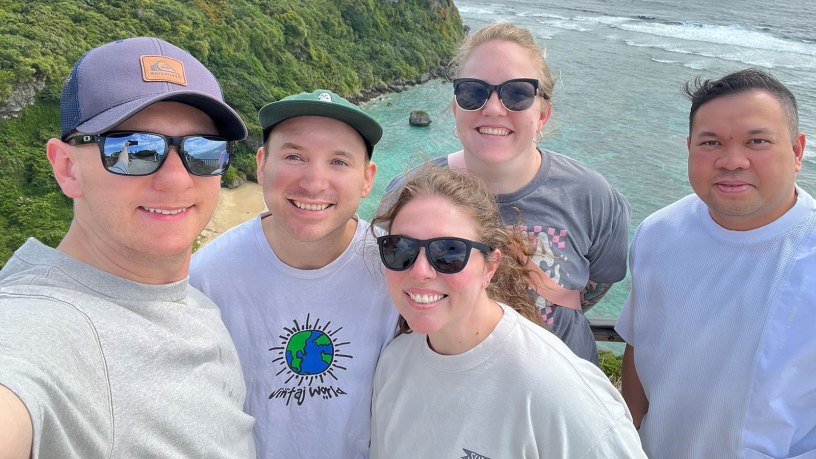
Hartnett and four other Airmen attending Noncommissioned Officer Academy at Kadena Air Base, Japan, had spent the day exploring the Miyagi Islands, stopping at scenic overlooks and making their way along Okinawa’s coastline. Ikei Beach was intended to be one final stop before heading back.
As the group turned to leave, a man nearby stumbled and fell, striking his head on the concrete. Within seconds, blood began pooling beneath him.
While two of his teammates moved to the man’s side, Hartnett scanned the area and found a first aid kit, bringing it back as the others began assessing and providing care. Tech. Sgt. Nathan Blizzard, 36th Maintenance Squadron, ASM section chief, used his shirt to apply pressure to the wound. Master Sgt. Clare Gill, 374th Medical Support Squadron, section chief, stabilized the man’s neck and monitored his condition. Tech. Sgt. Jeremy Guancia, 379th Air Expeditionary Wing, diagnostic imaging technologist, directed the family to call emergency services, and Tech. Sgt. Kylie Eberle, 51st Medical Support Squadron, unit deployment manager, worked to prevent shock.
“It wasn’t something we had to talk through,” Hartnett said. “We all snapped into action since we all knew the priorities and order of what needed to be taken care of.”
All five Airmen had been trained in TCCC, a program designed to teach service members how to assess and treat life-threatening injuries in high-stress environments. The training emphasizes prioritizing care, controlling bleeding, maintaining airways and preventing shock. The readiness training is designed to translate beyond the battlefield.
In a classroom, those steps are practiced and deliberate. On the beach, they became immediate.
“We were in sync,” Hartnett said. “It was amazing teamwork in action.”
The group rotated through maintaining pressure on the wound, checking for responsiveness and keeping the man conscious while they waited for emergency responders. By the time local medical personnel arrived, the bleeding had been controlled and the man had regained consciousness. The Airmen briefed responders on what had been done before stepping back.
For Hartnett’s leadership, the moment reflected the importance of readiness and training.
“Tech. Sgt. Hartnett’s actions reflect the very best of our Airmen,” said Lt. Col. Shawn Cox, 730th Air Mobility Squadron commander. “His ability to remain calm under pressure, take initiative and support his team in a life-threatening situation speaks volumes about his character and training. I couldn’t be prouder of the way he and his fellow Airmen represented the Air Force.”
The five Airmen had only known each other for a few weeks through NCOA, but their response reflected trust, teamwork and shared training.
Afterward, the group was recognized by NCOA leadership and later awarded Air Force Achievement Medals. For Hartnett, though, the recognition is not what stands out most.
“Few people experience saving a life,” he said. “I, for one, will never forget that feeling. I’m sure we will talk about it with each other for years to come.”
What began as a simple weekend trip became a defining moment, one that reflects the core of what it means to be an Airman: ready to respond, ready to lead and ready to act when it matters most.
 That PAO Guy