
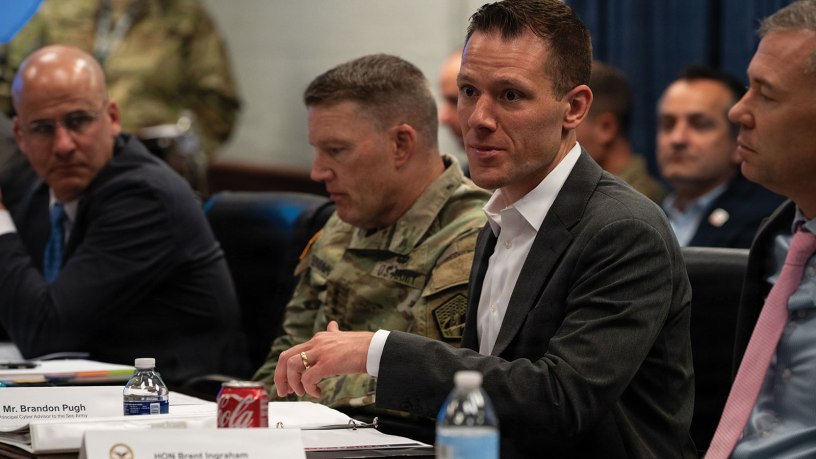
Courtesy Story, Principal Cyber Advisor to the Secretary of the Army
WASHINGTON — On April 27, the Army convened 14 senior cybersecurity executives from leading technology companies at the Pentagon for the second iteration of its artificial intelligence tabletop exercise, an effort designed to accelerate adoption of agentic AI for cyber defense.
The exercise, known as AI TTX 2.0, brought together C-suite leaders from companies including Amazon Web Services, Google, Microsoft, OpenAI, CrowdStrike, Palo Alto Networks and others alongside Army and Department of War leadership. The Office of the Principal Cyber Advisor hosted the half-day event, with design and moderation support from the Special Competitive Studies Project, and partnering organizations including U.S. Cyber Command, U.S. Army Cyber Command and the Army Cyber Institute at West Point.
“We have to move faster to deliver the best capabilities to the warfighter,” said Secretary of the Army Dan Driscoll. “One of the hacks to do that is through better, more effective collaboration with industry.”
The exercise centered on a hypothetical scenario set in a future Indo-Pacific crisis, in which an adversary leveraged AI to launch continuous, adapting cyberattacks against Army networks faster than human defenders could respond. Participants were asked to identify scalable, existing AI-driven capabilities that could give Army cyber defenders a decisive advantage.
Brandon Pugh, principal cyber advisor to the secretary of the Army, said the exercise reflects a shift in how the Army engages with industry.
“We are not here to develop new requirements from scratch,” Pugh said. “We are here to identify scalable, adaptable and existing AI-driven capabilities that can give our cyber defenders a decisive advantage today.”
The scenario challenged participants to address two critical problems: developing agentic AI tools that improve cyber defense across the Army’s digital terrain, and overcoming vulnerabilities created by heterogeneous networks, legacy systems and uneven modernization.
Lt. Gen. Christopher Eubank, commanding general of Army Cyber Command, said the discussion revealed important insights about the human-machine balance.
“Speed wins, scale decides, and you have to determine the difference in speed — human speed, machine speed and organizational speed — and then leverage AI to do the things that it should be doing at speed,” Eubank said.
AI TTX 2.0 builds on the inaugural AI TTX hosted by Driscoll in September 2025, which convened approximately 15 CEOs representing more than $15 trillion in enterprise value. That exercise launched Project ARIA — the Army Rapid Implementation of Artificial Intelligence — which established three lines of effort: a model armory delivering AI capabilities to the tactical edge, agentic tools to automate the planning, programming, budgeting and execution process, and AI-driven supply chain management.
Unlike the first exercise, AI TTX 2.0 focused specifically on cyber defense and included examination of policy gaps that may impede enterprise-wide AI adoption. According to Eubank, he took away 19 items for reflection and improvement — none of which were specific products.
The Army intends to leverage rapid prototyping authorities resident at Army Cyber Command and the secretary of the Army’s acquisition initiatives like FUZE to pilot promising capabilities within 30 to 90 days, with the goal of fielding solutions to operational units shortly thereafter.
“The Army that masters the integration of data, AI compute and human judgment into every warfighting function will have a decisive advantage,” Driscoll said. “The Army that fails to do so will be outpaced, outmaneuvered and unable to achieve its objectives.”
 That PAO Guy