
By Lyndsey Abbasi, U.S. Army Combat Capabilities Development Command Chemical Biological Center
Aberdeen Proving Ground, MD – For warfighters and first responders operating in hazardous environments, reliable collective protection systems are a lifeline. These systems filter out harmful chemical, biological, and radiological threats from the air in ships, buildings, and field hospitals. A new technology developed by the U.S. Army Combat Capabilities Development Command Chemical Biological Center (DEVCOM CBC), the Residual Life Indicator, is revolutionizing how the Army ensures collective protection systems’ operational readiness, increasing warfighter lethality and our Nation’s ability to fight and win.
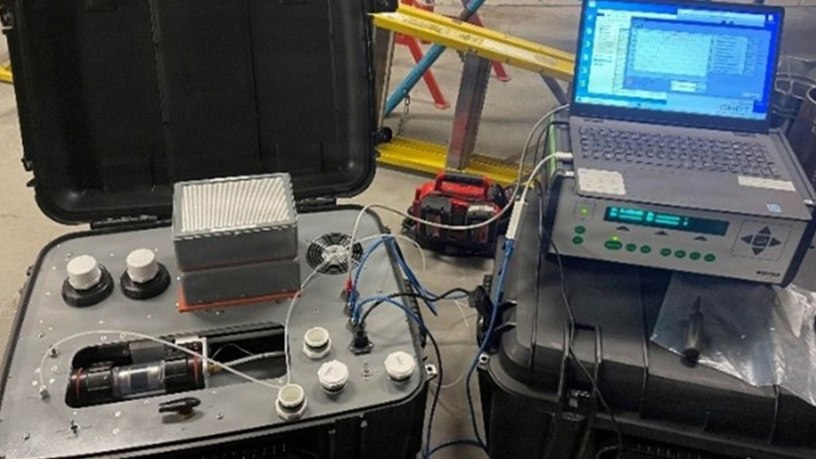
The Residual Life Indicator, or RLI, allows for accurate, on-site assessment of an M98 filter’s remaining life without taking it out of service. Previously, this critical test required the removal of the filter and shipping it to a specialized lab for destructive testing with live chemical agents. This was a costly and logistically complex process that left the protection system temporarily vulnerable. By eliminating this downtime, the RLI ensures collective protection systems provide continuous, uninterrupted protection.
Years of rigorous testing on Navy destroyers and in fixed installations have proven the RLI’s accuracy, with readings consistently matching traditional testing methods. This data-driven approach allows leaders to make informed decisions and optimize filter replacement schedules based on actual conditions rather than fixed timelines.
Working with industry partner HDT Global, DEVCOM CBC chemical engineer, Zachary Litsch, led the effort to successfully transition the RLI from the Defense Threat Reduction Agency’s Joint Science and Technology Office to a Program of Record within the Capability Program Executive Chemical, Biological, Radiological and Nuclear Defense, Joint Project Manager CBRN Protection.
“This technology directly enhances the safety and readiness of our forces while driving down costs, and it stands as a textbook example of our division’s commitment to providing innovative sustainment solutions for the modern warfighter,” said Jorge Christian, chief of DEVCOM CBC’s Engineering Sustainment and Operational Support Division.
The RLI is already making a global impact, with systems actively deployed in the U.S. European Command, U.S. Northern Command, U.S. Indo-Pacific Command, and the U.S. Central Command Areas of Responsibility. Preparations are underway for additional installations in fiscal year 2027 to help refine filter changeout schedules and evaluate new carbon filter technologies.
 That PAO Guy