
By Spc. Thomas Madrzak, U.S. Army V Corps
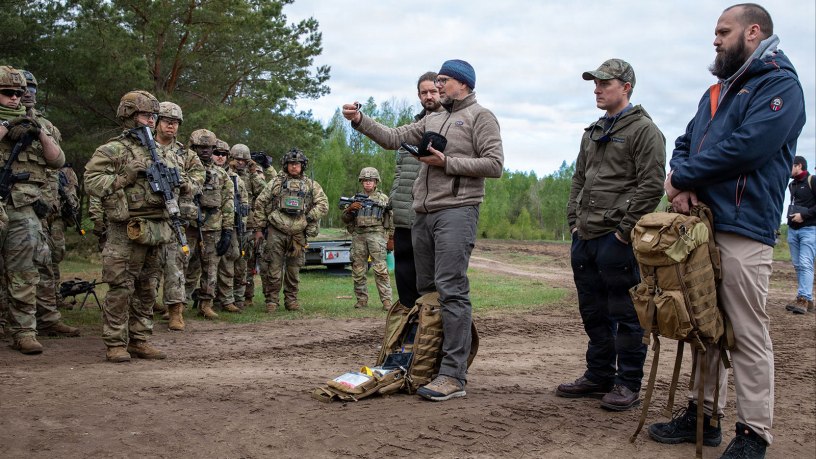
BEMOWO PISKIE, Poland — The 68th Theater Medical Command brought U.S. Soldiers, evaluators, partner nation observers, and industry partners together at Bemowo Piskie Training Area, Poland, May 9-11, 2026, for the Autonomous Triage and Treatment Challenge, an event designed to test emerging medical technologies that could help medics make faster, better-informed decisions on the battlefield.
The challenge focused on one of combat medic’s most difficult tasks: how to sort, monitor and treat casualties when time is of the essence, resources are limited and operations continue under pressure. Instead of evaluating new tools in a laboratory or hospital setting, organizers placed them in the field, where Soldiers would actually be expected to use them.
This setting made the event more than a technology demonstration, it became a practical test of whether emerging systems could perform in the same kind of environment where battlefield medicine is often highly critical and challenging.
U.S. Army Reserve Capt. James Yu, assigned to the 75th Innovation Command’s Medical and Biotechnology Detachment, served as one of the evaluators during the event.
He explains that the challenge reflects the reality of future large-scale combat operations, where medical personnel may be forced to manage more casualties with fewer resources and less time.
“In these scenarios, information is truly the key—the key to enabling the care of more people under such strenuous circumstances…We’re taking the product out of the lab setting and putting it into a field environment,” Yu said.
These circumstances often happen in less-than-ideal locations, sometimes close to enemy fire. This makes boots on the ground testing all the more important. This allowed Yu and his team to test the technology in a setting where it will be most used, which Yu noted was ideal.
Testing like this matters because many technologies perform well under ideal conditions, but field evaluation reveals whether they can still deliver when weather, terrain and operational friction begin to affect performance.
Maj. Garrett Kuipers, Autonomous Triage and Treatment Planner, assigned to the 68th Theater Medical Command, said the event was built around direct Soldier involvement and feedback.
“The idea has been, instead of writing requirements or just deciding on pieces of equipment in a more sterile environment, is to get them out in the hands of the Soldiers and get that direct feedback from them,” Kuipers said.
Soldiers working through realistic medical scenarios helped planners understand whether the systems provided useful information. Understanding whether they interfered with care and would be trusted in the field, Kuipers continued. That type of feedback is essential to selecting equipment that is both effective and practical for operational use.
The event, from the industry side, also gave vendors an opportunity to test emerging technology against real battlefield requirements.
Vendor Casey Boutwell, said his company’s device is designed to monitor tissue oxygen in a ruggedized, field-ready format, helping move a medical capability typically associated with hospital settings farther forward on the battlefield.
Boutwell said events like this are important because they bring innovators into direct contact with operational users and allow technology to be assessed against the Army’s real-world needs. That’s why the 68th Theater Medical Command hosted such an important event, it highlights the importance of innovation in an ever-changing battlefield.
Of the path forward Boutwell said, “If we’re going to have a positive effect on survivability, focusing on accelerating the triage process, identifying those soldiers who need care sooner and faster and better, seems to be the path forward.”
The medics tested multiple biomedical sensors equipped with predictive artificial intelligence (AI) software in order to assist with the triage and treatment decisions for simulated casualties. All of the devices were made to be portable and easily accessible by using an application synched to a device already available to medical personnel, allowing a quicker triage process.
In a hostile environment, faster triage and more accurate patient monitoring can help medics prioritize care, preserve resources and improve survivability.
The Autonomous Triage and Treatment Challenge demonstrated that the future of battlefield medicine will depend not only on advanced devices, but on how quickly the Army can test, refine and adopt tools that help medics make critical decisions where they are needed most.
At Bemowo Piskie Training Area, that work happened in real time. Where technology, training and operational needs came together.
Kuipers said, “We’re very excited to help … advance a lot of this technology, specifically to close a lot of those Eastern Flank Deterrence Initiative gaps that have been identified in the medical space, to move as fast as possible to find those solutions.”

