
By Col. Gregory Harland, Space Launch Delta 4
PATRICK SPACE FORCE BASE, Fla. — Space Launch Delta 45 Airmen and Guardians at Patrick Space Force Base played a key role in the rapid rescue of 11 Bahamian adults who survived the ditching of a Beechcraft King Air twin-engine turboprop aircraft in the Atlantic Ocean on May 12, 2026. The operation showcased seamless collaboration among U.S. military services, federal agencies and local partners. It highlighted how Space Force infrastructure and training for domestic emergencies save lives.
U.S. Space Force Col. Brian L. Chatman, commander of Space Launch Delta 45, praised the Delta’s contributions. “This rescue demonstrates the vital role our space infrastructure plays in saving lives and the power of seamless integration across military and civilian partners,” Chatman said. “SLD 45 Airmen and Guardians stand ready every day to support not only national security launches but also real-world emergencies that protect American and international lives.”
An emergency locator transmitter aboard the aircraft activated after engine failure during a flight from Marsh Harbour, Bahamas, to Freeport. The signal reached the international Cospas-Sarsat system, which relies on critical space-based assets. U.S. Space Force satellites, including those supported by launches from Cape Canaveral Space Force Station, helped relay the distress alert swiftly. Miami Air Route Traffic Control Center received the initial notification and alerted the U.S. Coast Guard.
The U.S. Coast Guard reached out to the SLD 45 Command Post for support. SLD 45’s Command Post, Public Affairs team, aircraft operations and Patrick Space Force Base tower operators responded immediately. They coordinated with the 920th Rescue Wing, whose crews were already airborne on a routine training mission east of the base.
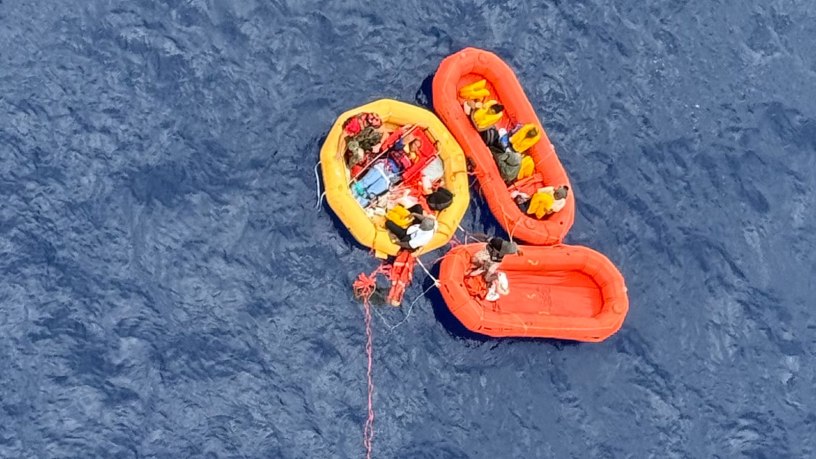
The 920th Rescue Wing’s HC-130J Combat King II aircraft, commanded by U.S. Air Force Maj. Elizabeth Piowaty, diverted to the scene about 60 to 80 miles east of Cape Canaveral. The crew located the survivors in a life raft within minutes, dropped rescue kits with additional rafts, water and supplies, and provided real-time reconnaissance.
U.S. Air Force Lt. Col. Matt Johnson’s HH-60W Jolly Green II helicopter crew, carrying pararescuemen led by U.S. Air Force Capt. Rory Whipple, joined the effort. Pararescuemen swam to the raft, assessed the 11 adults, all with minor injuries typical of a water ditching, and hoisted them aboard one by one. The new Jolly Green II’s increased capacity proved vital for safely transporting the full group. The helicopter then flew the survivors to Melbourne Orlando International Airport, where the City of Melbourne Fire Department provided initial triage. Brevard County Fire Rescue and Coastal Health Systems ambulances transported them to Health First Holmes Regional Medical Center and Orlando Health Melbourne Hospital. All were reported in stable condition.
The 920th Rescue Wing trains daily for these types of missions. Its crews transitioned quickly from a training flight to real-world rescue operations. The “Reserve Advantage” keeps the wing ready at a moment’s notice to conduct civil search and rescue alongside its combat missions.
Coast Guard officials praised the rapid response. A C-27 Spartan from Air Station Clearwater also supported the search. Melbourne Orlando International Airport and the Brevard County Emergency Operations Center coordinated ground efforts, while the Department of Homeland Security and Melbourne Orlando Airport Authority police assisted the Bahamian nationals. NOAA’s U.S. Mission Control Center for Cospas-Sarsat and other partners ensured complete accountability.
This mission underscores SLD 45’s long history at America’s busiest spaceport. SLD 45 manages launches that deliver satellites enabling navigation, communication and search-and-rescue capabilities worldwide. Recent successes include the GOES-R series, with GOES-16 launching Nov. 19, 2016, from Cape Canaveral, and GPS III missions, such as those via Falcon Heavy in April 2026, which bolster positioning accuracy for rescue operations.
SLD 45 leaders emphasized that military personnel do more than prepare for armed conflict. They stand ready for domestic emergencies from aircraft accidents at sea to floods and tornadoes, working in unison with civic authorities. This rescue, one of hundreds annually throughout the United States, demonstrates how the U.S. military and partners help Americans and international visitors in their time of need.
Interoperability proved decisive. Real-time coordination between SLD 45 assets, the 920th Rescue Wing, Coast Guard, local first responders and space infrastructure turned a potential tragedy into a success. Survivors spent about five hours in the raft before rescue. Their will to survive, combined with lashed rafts and clear communication, aided the effort.
Officials at Patrick Space Force Base expressed pride in the joint team. The operation reflects the dedication of Airmen, Guardians, Coast Guardsmen and civilians who marshal the nation’s search-and-rescue tools to bring people home safely. Such stories affirm the value of investment in space capabilities and trained forces that protect lives every day.

