
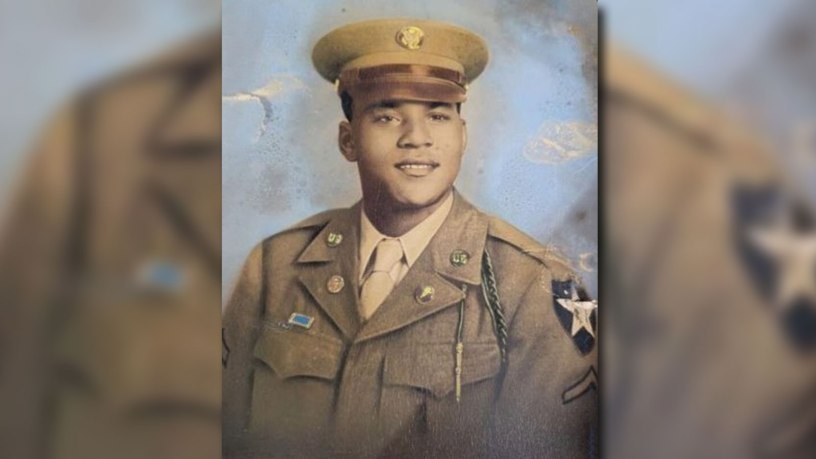
By Daniela Vestal, U.S. Army Human Resources Command
FORT KNOX, Ky. – The remains of U.S. Army Cpl. Orestus M. Stewart, 20, killed during the Korean War, will be interred May 23, in Spring Hill Cemetery in Magnolia Springs, Texas. Services and interment will be coordinated by Coleman Funeral Home.
In the summer of 1950, Stewart was a member of Medical Company, 9th Infantry Regiment, 2nd Infantry Division. He was reportedly killed in action on Aug. 11 in the vicinity of Kyong-ju, Republic of Korea (South Korea) when his unit was ordered to seize control of Yonil Airfield in the eastern sector of the Pusan Perimeter. His remains were not recovered following the battle and on Jan. 16, 1956, Stewart was declared nonrecoverable.
The Defense POW/MIA Accounting Agency accounted for Stewart on Nov. 26, 2023.
For more information on DPAA’s efforts to locate and identify Stewart, please visit: https://www.dpaa.mil/News-Stories/ID-Announcements/Article/4357805/soldier-accounted-for-from-korean-war-stewart-o/
U.S. Army Human Resources Command’s Past Conflict Repatriations Branch plays a vital role in the process of identifying, locating and contacting subsequent generation family members of Soldiers missing or killed in action during WWII and the Korean War to positively identify previously undiscovered or unknown remains.
Media interested in covering and/or obtaining more information about the funeral and interment should contact Coleman Funeral Home, 409-384-3711.
DPAA Service Member Profile for Cpl. Orestus M. Stewart
On Nov. 26, 2025, the Defense POW/MIA Accounting Agency identified the remains of U.S. Army Cpl. Orestus Marion Stewart, missing from the Korean War.
Stewart entered the Army from Texas and was a member of the Medical Company, 9th Infantry Regiment, 2nd Infantry Division. On Aug. 10, 1950, he was part of a task force directed to defend the city of P’ohang-dong, and Yonil Airfield, South Korea, from an impending attack by the North Korean People’s army. Much of the task force reached Yonil shortly before midnight; however, during the early hours of the following day, NKPA forces ambushed part of the group. It was during this fighting on Aug. 11, 1950, near Pohang, South Korea that Stewart was killed. Conditions at the time of Stewart’s loss prevented the recovery of his remains. In April 1954, Army personnel and South Korean citizens recovered a set of remains, later designated X-5495 Tanggok, from a shallow grave near Pugni-dong, South Korea. The Central Identification Unit in Kokura, Japan, compared X-5495 to all unresolved U.S. casualties from the general area of recovery, but the remains could not be identified. They were transported to the National Memorial Cemetery of the Pacific in Honolulu, where they were interred as an Unknown. On Nov. 21, 2022, as part of DPAA’s Korean War Disinterment Project, X-5495 was disinterred and sent to the DPAA Laboratory for analysis. There, based on the laboratory analysis and total circumstantial evidence available, the previously unidentified set of remains was found to be that of Stewart.
He is memorialized on the Courts of the Missing at the National Memorial Cemetery of the Pacific. His name is also inscribed on the Korean War Veterans Memorial Wall in Washington, DC, which was updated in 2022 to include the names of the fallen.
 That PAO Guy