
By Jennifer DeHaan, DEVCOM Ground Vehicle Systems Center
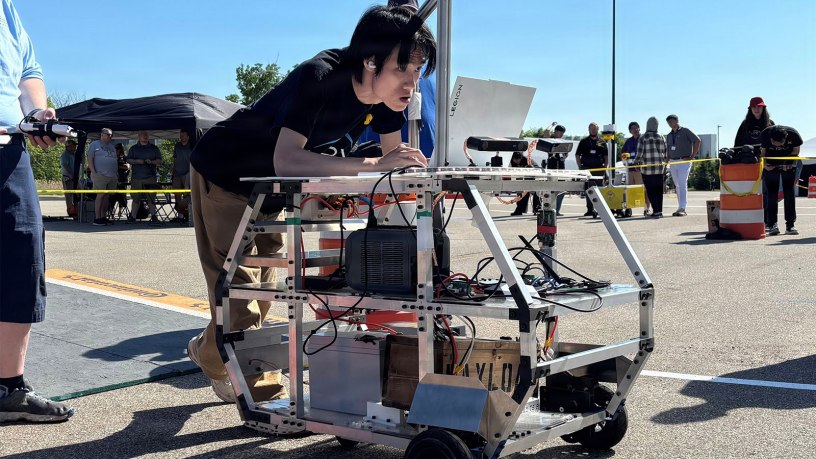
ROCHESTER, Mich. – The future of autonomous systems and cutting-edge robotics was on full display last weekend, as university student teams from all over the world joined scientists and engineers from the U.S. Army Ground Vehicle Systems Center at Oakland University for the 33rd annual Intelligent Ground Vehicle Competition.
For more than three decades, this international contest has challenged students to design, build, and test autonomous vehicles, pitting their custom robotics against real-world constraints and rigorous performance standards.The competition serves as an important venue for exposing future engineers to the challenges and opportunities associated with autonomous ground systems.
The technologies demonstrated at IGVC align closely with the Army’s growing focus on autonomy, as autonomous and semi-autonomous vehicles extend reach, reduce Soldier risk and accelerate operational tempo. The competition also highlights advances in robotics that support both the Army’s adoption of autonomy and the integration of innovative industry solutions into the Army’s autonomy environment.
Each year, this unique competition brings together academia, government and metro Detroit’s automotive industry. This year’s event featured 33 teams from six different countries.
Bernard Theisen, GVSC Ground Vehicle Robotics chief technology officer, has been a central figure at IGVC for more than 25 years. After many years as a judge and now serving as a co-chair, he said GVSC plays a major role in developing the constraints of the competition.
“We help inform the rules based on what the military needs are and help shape the challenges,” Theisen said. The competition spanned four days, during which teams presented and tested their vehicles in a series of events that included a highly technical Design Challenge, an Autonomous Navigation (AutoNav) course, and Self-Drive performance challenges.
Prizes were awarded for the top teams in each category, as well as best performance by a rookie team, and best overall combined score by a team.
Jonathan King, one of several recent graduates on the Tennessee Tech University team who worked on the entry for their senior project, said everyone was simply hoping to qualify.
Theirs was the only vehicle to successfully complete the full AutoNav course, and it even crossed the finish line twice. The first time the vehicle reached the final obstacle, King said it started to veer, and everyone held their breath.
“I was amazed at the recovery,” King said. “It hit that edge on the ramp, and I thought, ‘Oh no, this is going to be it!’ Then it thankfully recovered. It was amazing.”
Tennessee Tech went on to receive several awards, including this year’s top honor for best overall performance. Other schools that received recognition include Michigan-based Lawrence Technical University and Karabuk University out of Turkey.
In addition to providing recognition and prize money, IGVC is also an avenue to promote the Science, Mathematics, and Research for Transformation (https://www.smartscholarship.org/smart) Scholarship.
Eduardo Cerame, a mechanical engineer with GVSC and former SMART recipient, said the Department of War funded program is a great educational and workforce opportunity for students going into a science, technology, engineering or mathematics field.
“It’s a scholarship-for-service, so every year of funding you receive, you then work for a lab for that many years,” Cerame said. “You can then choose to stay on. That’s the goal.”
The SMART program focuses on students pursuing disciplines that are critical to national security function of the DoW and is available as undergraduate, master’s, and doctoral scholarships.
For many participants, the IGVC experience extends beyond the competition field and acts as a pipeline for the future workforce, offering hands-on skill building that translates directly into industry jobs. Combined with the networking opportunities to provide resumes to potential employers like GVSC and pathways like the SMART scholarship, the event ensures that the next generation of engineers is fully equipped to tackle the nation’s most pressing technological challenges.
 That PAO Guy