
By Staff Sgt. Anthony Jones, Oklahoma National Guard
OKLAHOMA CITY — A groundbreaking new artificial intelligence tool developed by an Oklahoma Army National Guard Soldier is set to transform how the state processes military awards, potentially saving administrative staff more than 61,000 hours of paperwork while allowing them to focus more on supporting Soldiers and mission readiness.
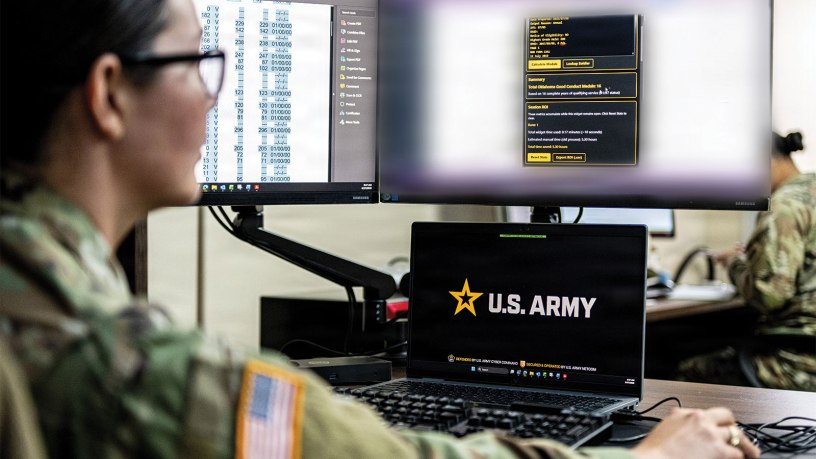
Staff Sgt. Herbert Hailey, an information technology specialist assigned to the Oklahoma Army National Guard Recruiting and Retention Battalion, developed the tool after being approached by his battalion’s personnel officer with a request to streamline the process of identifying Guardsmen eligible for time-in-service awards.
The traditional awards process requires administrative personnel to manually review each Soldier’s NGB-23A retirement points record, evaluate service history and calculate years of qualifying service.
Drawing on skills gained during a specialized Oklahoma Army National Guard-hosted artificial intelligence and data training course with training provided by Skillquest, Hailey used advanced prompting within the Army Vantage platform to develop an AI-powered widget capable of automating much of that work.
At launch, the widget processes data to determine eligibility for the Oklahoma Good Conduct Medal, with plans to expand its capabilities to include the Army Reserve Components Achievement Medal, Army Good Conduct Medal and Oklahoma Long Service Ribbon.
“Our priority is taking care of Soldiers,” said Sgt. Lorelei Hubbard, an administrative noncommissioned officer in the OKARNG Recruiting and Retention Battalion. “But manual record scrubs for awards like the Oklahoma Good Conduct Medal can take hours per Soldier. This widget represents a massive leap forward in our administrative capabilities. Ultimately, it ensures our Soldiers receive the accurate, hard-earned recognition they deserve.”
Hailey said his development of the awards widget is not just about streamlining processes.
“It’s about creating better quality of life for our staff members while positively impacting our service population’s readiness. It’s all linked, it’s an ecosystem and I’m just the guy trying to retire the ‘struggle bus’ one prompt at a time,” Hailey said.
The tool reads the digital contents of a Soldier’s NGB-23A, identifies qualifying years of service and determines eligibility for awards.
The administrative savings are already significant. Within the OKARNG’s Recruiting and Retention Battalion alone, submitting all RRB-assigned Soldiers for a single award would normally require approximately 483 hours of administrative labor.
When scaled across the Oklahoma National Guard, the tool is projected to save more than 20,400 hours for a single award cycle. Once expanded to process additional time-in-service awards, projected savings could exceed 61,000 hours across the force.
By eliminating thousands of hours of manual administrative work, the innovation allows personnel professionals to spend less time processing paperwork and more time supporting Soldiers, units and mission readiness.
“Staff Sgt. Hailey’s initiative demonstrates the kind of innovation that keeps the Oklahoma National Guard moving forward,” said Maj. Gen. Thomas H. Mancino, adjutant general for Oklahoma. “By identifying a challenge and developing a practical solution, he’s helping save valuable time across the force. Guardsmen at every level are finding new ways to solve problems, improve efficiency and allow our Soldiers and Airmen to focus on what matters most: remaining ready to support our state and federal missions.”
 That PAO Guy