
By Timothy Koster, Connecticut National Guard Public Affairs Office
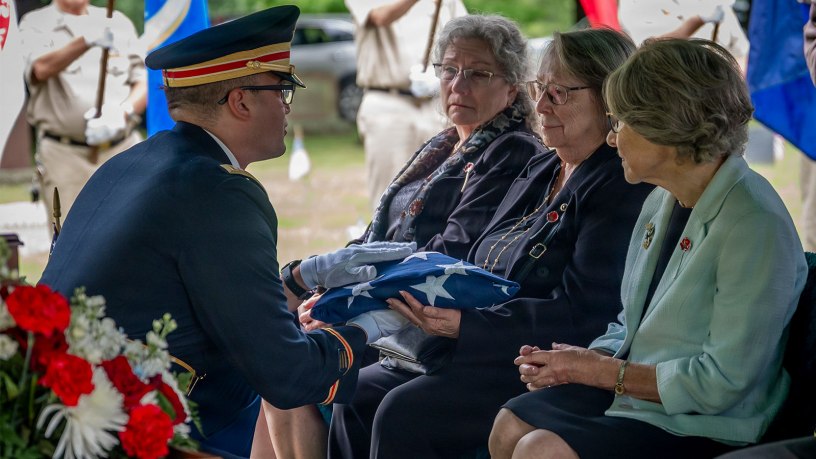
The Connecticut National Guard provided military funeral honors for the cremains of U.S. Army Air Forces Tech. Sgt. Donald A. Dorman, as they were laid to rest at Oak Hill Cemetery in Southington, Conn. June 23, 2026.
Dorman, a Southington native, was assigned to the 429th Bombardment Squadron, 2d Bombardment Group, 15th Air Force, during World War II, where he served as the upper turret gunner aboard a B-17G “Flying Fortress”.
On March 22, 1945, Dorman and ten other airmen were conducting a bombing mission against oil refineries in Ruhland, Germany, when his plane was hit by enemy anti-aircraft fire, forcing the pilot to fly toward allied Soviet-held territory to conduct an emergency landing. As the aircraft was making its way over Poland, the bomber was engaged by multiple German fighter planes and critically damaged.
Of the 10 crewmembers, eight, including Dorman, went missing. The two survivors were captured by German forces and later returned to U.S. custody. Their reports indicated that they weren’t sure how many of the plane’s crew members were able to bail out of the plane before it crashed, but those who did, remained under heavy enemy fire as they parachuted to the ground.
Following the war, the American Graves Registration Command searched for the remains of U.S. personnel missing in action from the European Theater. However, resources to search in Soviet-held territory were extremely limited and Dorman’s remains were not found.
But the search wasn’t over. Between 2008 and 2012, the Defense POW/MIA Accounting Agency, the successor to the AGRC, conducted three field investigations into the loss of Dorman’s plane. What they uncovered was evidence that an aircraft matching the description of a B-17 “Flying Fortress” had crashed near Glinica, Poland.
The DPAA conducted additional investigations in 2017 and 2018. Then, between the years of 2019 and 2024, the organization conducted five excavations at the crash site, and discovered possible human remains. The remains were transferred to a DPAA laboratory for analysis which, in conjunction with circumstantial evidence, and previous recoveries, the research team was able to conclude that the remains belonged to Dorman.
Now, 81 years after he died, Dorman returned home. A memorial service was held in his honor at the First Congregational Church in his hometown before he was laid to rest in his family plot at the Oak Hill Cemetery, near his mother.
The ceremony was open to the public and brought together veterans, uniformed service members, and citizens of Southington, who wished to pay their respects to this fallen American hero.
In addition to providing military funeral honors, the Connecticut Army National Guard also conducted a two-ship UH-60 Blackhawk flyover of the graveside ceremony.

