
By Brooke Nevins, U.S. Army Space and Missile Defense Command
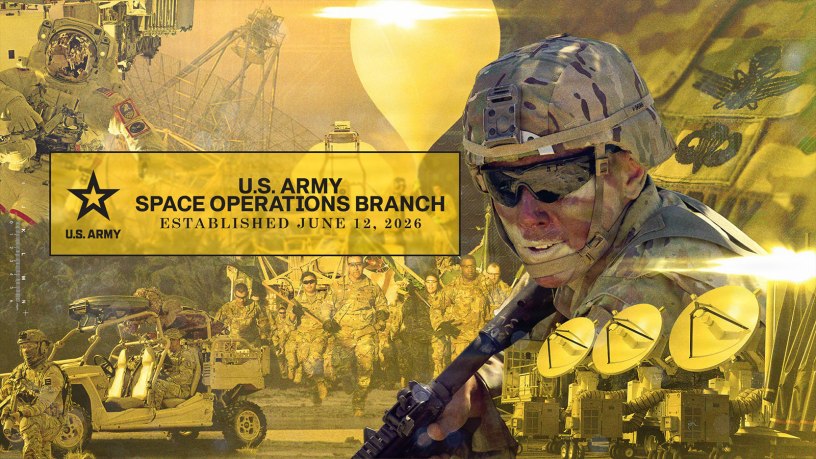
The Army established its new Space Operations Branch on June 12, marking a historic milestone in its continuous transformation to meet the challenges of modern, multidomain warfare.
The new branch consolidates the career paths of the Army’s space professionals, uniting Functional Area 40A Space Operations Officers and the newly created 40D enlisted Tactical Space Operations Specialists into a single, permanent force. These professionals provide vital close-space support the Army needs to plan, communicate, navigate, engage the enemy, provide missile warning, and protect forces.
“The Army is the largest user of space capabilities in the joint force, and space integration is absolutely critical to multidomain operations at every echelon,” said Lt. Gen. John L. Rafferty, commanding general of U.S. Army Space and Missile Defense Command. “Establishing the Space Operations Branch is an important step in the Army’s continuous transformation. It provides the Army with the professional structure to deliver space-based effects directly to our Soldiers and units at the tactical edge enabling commanders to fight and win in a contested, multidomain environment.”
While FA40 Space Operations Officers have served the Army since 1999, they previously lacked an enlisted counterpart. The Army leveraged enlisted personnel from the Air Defense Artillery, Signal, and Military Intelligence branches to execute space missions on a temporary basis.
“For too long, enlisted Soldiers with specialized space training and experience rotated through critical space assignments, eventually returning to their basic branches,” Rafferty said. “The rotational system served the U.S. Army well in the past but will not meet the demands of the future, which requires a professional and sustainable approach to training, career progression and leader development for Army Space Soldiers. This historic step ensures we build a highly-trained corps of space professionals to keep pace with the expanding force structure in our space brigade, multidomain task forces and theater strike effects groups.”
Establishing the Space Operations Branch relieves operational pressure on those donor branches. This transition allows ADA, Signal, and MI to decrease non-mission-essential billets and redistribute Soldiers to critical vacancies, ultimately optimizing readiness across the wider Army. Effective Oct. 1, 2026, the 40D MOS creates a permanent career path in space operations for active duty, National Guard, and Reserve component Soldiers in the ranks of specialist to sergeant major.
“Land power requires warfighting expertise in all domains,” said Gen. Christoper LaNeve, vice chief of staff of the Army. “What makes me proud is that our Army is not just building a capability, we’re growing professionals at every echelon. That’s what the 40D MOS is about – Soldiers delivering the foundational excellence our Joint Force depends on.”
The Space and Missile Defense Center of Excellence trains and educates space operations professionals across the Joint Force, enabling transformation in contact for resilient space systems and dedicated counterspace capabilities.
“The establishment of the new Army Space Branch is a critical step forward in strengthening the profession,” said Col. Felix Torres, commandant, Space and Missile Defense Center of Excellence. “It will standardize and streamline the critical knowledge, training, and education required for our 40A and 40D cohorts, ensuring our space professionals remain elite, agile, and prepared for multidomain operations. Space is no longer a benign environment and enabler, but a battlefield,” he added.
Russia, China and other adversaries intend to compete with the United States in space. These increasing threats necessitate a strategic approach to recruit, train, and retain top talent.
As the Army grows its space force structure across the globe, the branch designation brings the 2024 Army Space Vision to fruition.
“For 27 years, Army space officers have been working to normalize Army space operations, and that’s what this branch designation now does for the Army,” said Brig. Gen. Don Brooks, USASMDC deputy commanding general. “It normalizes our two pillars – integration of joint, coalition and commercial space capabilities; and interdiction of adversary space capabilities – into concepts of operations, schemes of movement and maneuver, and fires. It gives us a rallying point: that we all now belong to a branch.”
 That PAO Guy