
By Senior Airman Jack Rodgers, 4th Combat Camera Squadron
As NASA prepares to send astronauts farther into space than any American crew has traveled in more than 50 years, Airmen from the 4th Combat Camera Squadron are preparing for the mission’s final chapter: recovery.
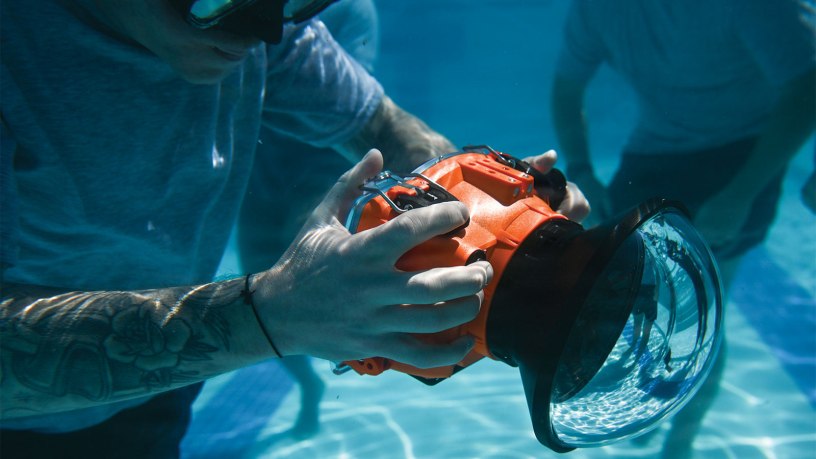
Twenty Airmen from the 4th Combat Camera Squadron participated in underwater camera housing training May 15–17, developing a specialized capability that will help support future NASA Human Space Flight Support (HSFS) missions, including astronaut recovery operations associated with the Artemis program.
The training equipped Combat Camera Airmen with the skills necessary to operate professional camera systems in and around water while documenting some of the Department of Defense’s most complex maritime operations.
For most photographers, water is an obstacle. For Combat Camera Airmen, it is simply another environment where the mission must be captured.
“The mission doesn’t stop because the environment gets difficult,” said Tech. Sgt. Christopher Muncy, one of the course instructors. “From pararescue and SERE training to aircraft recovery operations and maritime rescue missions, there’s a real operational need for Combat Camera to function in those environments.”
As the Air Force Reserve’s only fully mission-qualified aircrew photographer unit, the 4th Combat Camera Squadron routinely documents missions from the air, on the ground, and in austere environments around the world.
Increasingly, that includes operations conducted in and around water.
The connection between Combat Camera and astronaut recovery operations is not new. In 2021, then-Staff Sgt. Muncy documented Pararescue Jumpers and Combat Rescue Officers from the 48th Rescue Squadron as they practiced retrieving astronauts from a SpaceX capsule mock-up during the Rescue Force Qualification Course at Cape Canaveral Air Force Station, Florida. The training prepared rescue forces to safely recover astronauts following splashdown operations and provided critical imagery used to document recovery procedures.
“When astronauts splash down, recovery procedures have to be executed safely and precisely,” Muncy said. “Combat Camera documents those procedures for training, analysis, and historical purposes. That imagery becomes incredibly important for future operations and mission reviews.”
The three-day course began in a controlled pool environment at Joint Base Charleston in partnership with the 628th Force Support Squadron. The clear water allowed Airmen to focus on mastering the fundamentals of underwater photography before transitioning to the unpredictable conditions of open water.
Participants learned how to assemble and inspect underwater camera housings, conduct leak checks, manage buoyancy, maintain equipment control while submerged, and adjust camera settings to compensate for the unique challenges posed by underwater photography.
“The pool environment was helpful because the water was clear and you could actually see what you were shooting,” said Tech. Sgt. Jennifer Healy. “But even then, you quickly realize you have to position yourself differently, take additional shots, and constantly think about focus and composition.”
For many participants, the training represented an entirely new skill set.
“I was excited going into the training because it’s a skill set I knew I needed to practice,” said Senior Airman Mark Colmenares. “What surprised me most was how natural taking photos underwater felt once you had the right equipment and setup. We have some incredible equipment that really allows us to do our job effectively.”
While the pool provided a controlled learning environment, the next phase of training introduced the realities of maritime operations.
On May 16, Airmen moved to Paradise Beach, where they conducted live-water photography exercises designed to replicate the environmental conditions they may encounter during astronaut recovery, search-and-rescue operations, or other maritime missions.
Working in pairs, Airmen photographed live subjects while contending with waves, shifting light, suspended sand, changing visibility, and constantly moving subjects.
“Environmental conditions like waves, sand, water movement, and changing visibility completely changed how I approached photographing subjects,” Healy said. “It forced you to slow down and become much more deliberate with every shot.”
Unlike traditional photography, underwater imagery requires photographers to make critical decisions before entering the water.
“It’s very different shooting underwater because you’re more limited in what you can adjust once you’re in the water,” Colmenares said. “You really have to understand your camera settings beforehand, trust the equipment, and take multiple shots to make sure you’re getting clarity and focus.”
The ocean environment reinforced one of the most important lessons of the course: preparation is essential.
“It was eye-opening to realize how difficult it can be when you can’t easily access your settings once you’re in the water,” Healy said. “You have to understand which settings will work universally before you enter the environment, because once you’re in the water, your options become limited.”
For Combat Camera Airmen, the training is about much more than photography. It is about ensuring visual documentation remains available regardless of weather, terrain, or operating environment.
“There are a number of Air Force units that operate in or near the water,” Muncy said. “But beyond open-water operations, this training also prepares us to shoot in severe weather and inclement conditions. Without waterproof housing systems, our equipment can fail—and if the equipment fails, the mission fails.”
The capability has applications far beyond NASA support. Combat Camera Airmen may be called upon to document aircraft recovery operations, hurricane response efforts, pararescue missions, maritime exercises, personnel recovery operations, and special operations activities conducted in coastal or open-water environments.
“We have the equipment, the capability, and now the skill set to support missions across a wide range of environments and domains,” Muncy said.
The final day of training focused on imagery review and professional critique. Airmen analyzed photographs captured throughout the course, discussing focus, composition, lighting, and the unique technical challenges associated with shallow-water photography.
By the end of the training, participants had gained a new appreciation for both the complexity and value of underwater imagery.
“Seeing the quality of the imagery at the end was incredibly rewarding,” Healy said. “It showed us that this capability really works, and it gives Combat Camera one more tool we can bring to the fight.”
As NASA continues preparations for future Artemis missions and the return of astronauts from deep space, Combat Camera Airmen are ensuring they are ready to document every phase of the mission—from training and rehearsal to splashdown and recovery.
Because when history returns home, someone has to capture it.

