
By Ann Brandstadter, Walter Reed National Military Medical Center
When a traumatic eye injury threatened a Military Health System beneficiary’s sight, a surgical team at Walter Reed National Military Medical Center stepped in and restored the patient’s vision.
The patient sustained an injury while playing competitive sports that resulted in a nasal orbital bone fracture and an orbital floor fracture. Almost immediately after the injury, the patient experienced debilitating double vision and severe pain. Orbital tissue became entrapped within the fracture, a critical condition that, if left untreated, could have led to permanent double vision.
As the patient’s symptoms worsened, the difficulty in finding the right specialists locally led the patient’s providers to coordinate with Walter Reed eye specialists. The patient immediately traveled to the medical center in Bethesda, Maryland for care.
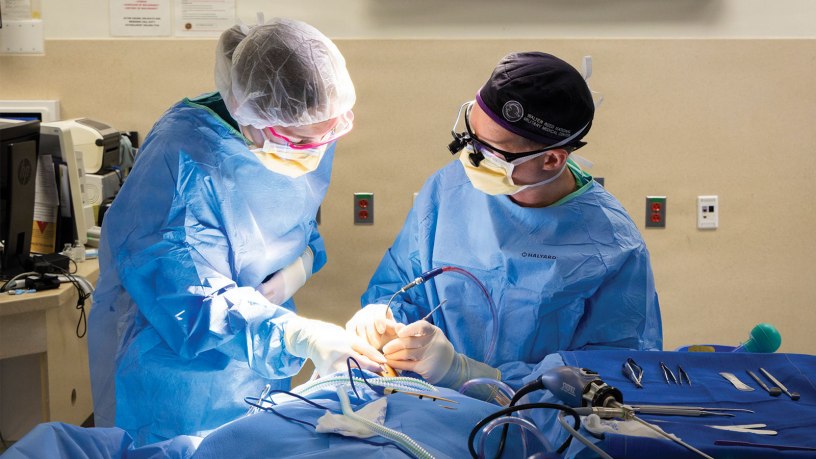
Doctors at Walter Reed, who assessed the patient’s nasal and orbital floor fractures, said the surgery would require a highly coordinated approach. U.S. Army Maj. (Dr.) Jonathan Buttram, an oculoplastic/orbital surgeon, and U.S. Army Lt. Col. (Dr.) Jeffrey Teixeira, a facial plastic surgeon, combined their expertise in the operating room.
“We are both trained to do this, and we often tag team to help each other out,” Teixeira, who is also an ear, nose and throat specialist, explained.
Working together, the surgical team performed the highly advanced, minimally invasive procedure without leaving a single external scar on the patient’s face. They worked entirely inside the eyelids, released the entrapped tissue and restored it to the orbit.
To repair the shattered orbital floor, the team bypassed traditional titanium hardware and installed a bio-absorbable, biodegradable plate. This specialized implant prevents tissue from migrating into the sinuses and is designed to safely dissolve within six to nine months. The absorbable material won’t interfere with MRI scans, medical imaging or security screenings.
The patient explained that since the surgery was more complex than they originally thought, it took a lot to get to that point.
After the successful procedure, Buttram stated, “The goal for this is healing, limiting the patient’s pain, and eliminating the double vision.”
At an outpatient surgery appointment the next day, the patient reported significant improvements in vision. Also, the patient was expected to resume normal activities within four to six weeks.
“I’m grateful I have resources like Walter Reed to get the care that I need,” the patient shared.
To learn more about Walter Reed surgeons who treat orbital disorders and fractures, go to https://walterreed.tricare.mil/Health-Services/Vision/Ophthalmology.

