
By Sgt. 1st Class Rodney Roldan, 79th Theater Sustainment Command
CAMP SHELBY, Miss. — As Soldiers participating in Operation Sentinel Justice train across the expansive ranges and forests of Camp Shelby, a unique partnership between the U.S. Army Reserve, The Nature Conservancy, and the Camp Shelby Environmental Office is ensuring that military readiness and environmental stewardship advance side-by-side.
The collaboration focuses on protecting one of the Southeast’s most important and imperiled species—the gopher tortoise. Through careful planning, habitat management, scientific conservation efforts, and Soldier education, partners are working to preserve the species while maintaining the training environments necessary to prepare Army Reserve forces for future missions.
“The military has a responsibility to be a good steward of the land entrusted to us,” said Col. Shawn Prinkey, lead exercise planner for Operation Sentinel Justice with the 200th Military Police Command. “Throughout Operation Sentinel Justice, our Soldiers have been educated on the significance of protected species such as the gopher tortoise and the habitats they depend on. We’ve incorporated environmental awareness into our planning processes, established protective measures around identified burrows, and coordinated closely with Camp Shelby environmental personnel and conservation partners to ensure training objectives are achieved without impacting local wildlife. This collaboration demonstrates that readiness and conservation can successfully coexist.”
The gopher tortoise is the only tortoise species native to the United States east of the Mississippi River and serves a critical role in maintaining healthy ecosystems across the Southeast. While the animal itself is important, conservationists emphasize that its greatest contribution comes from what lies beneath the ground.
“The gopher tortoise is a keystone species,” said Christopher R. Potin, natural resources manager for the Camp Shelby Environmental Office. “If you’ve seen an arch built, the last piece they put in is the keystone that kind of holds everything together. The gopher tortoise is that part of the arch of this ecosystem.”
Gopher tortoises dig extensive underground burrows that can stretch more than 25 feet long and reach depths of eight feet or more. According to environmental specialists, more than 350 species have been documented using these burrows for shelter, protection from extreme temperatures, storms, fires, and predators.
“If the tortoise goes, the burrow goes, and therefore homes for 350 other species go as well,” Potin explained. “That’s why they’re considered a keystone species.”
For Sidney Godfrey, a wildlife biologist with The Nature Conservancy, protecting the species is about preserving an entire ecosystem while helping military installations remain capable of conducting realistic training.
“A lot of military bases are on lands where there are rare and threatened wildlife species,” Godfrey said. “We help the National Guard here with the gopher tortoise and the black pine snake, which are species protected under the Endangered Species Act.”
The Endangered Species Act, administered by the U.S. Fish and Wildlife Service, provides legal protections for species facing the risk of extinction. Camp Shelby’s environmental team and The Nature Conservancy work together to ensure those protections are balanced with the installation’s military mission.
One of the most significant conservation initiatives currently underway is the gopher tortoise “Head Start” program.
The program begins with the careful collection of tortoise eggs from the wild. Once collected, the eggs are transported to controlled incubation facilities where conservationists monitor their development and increase their chances of survival.
“Part of what we do here is collect eggs from the wild and incubate them in artificial incubators,” Godfrey said. “The hatchlings that come out will be raised until they’re large enough, and then we’ll release them back into the wild. It’s a program called Head Start.”
The incubation process typically lasts between two and two-and-a-half months. During that time, biologists conduct routine evaluations to identify viable eggs and prevent mold from spreading to healthy embryos.
“When we first bring the eggs in from the field, we do what’s called candling,” Godfrey explained. “We hold a light underneath the egg and look for signs of development. If there’s a viable embryo, you’ll often see a gas pocket or a color contrast inside the egg.”
The process requires patience and precision.
“Just because an egg doesn’t show development immediately doesn’t mean it isn’t viable,” Godfrey said. “We have to monitor them carefully and give them time.”
Once hatchlings emerge, daily care becomes critical to their survival.
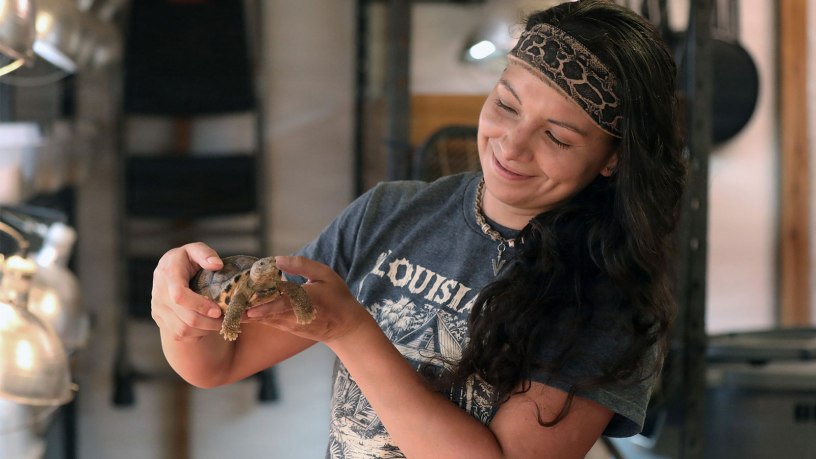
Amy Moseley, a Biological Science Field Technician with The Nature Conservancy, spends countless hours ensuring each young tortoise receives the attention it needs.
“I look them over for any health issues,” Moseley said. “You make sure they’re thriving, clean them if necessary, and make sure they have fresh food and water every day.”
The work can be demanding, but Moseley says the rewards make it worthwhile.
“It is one of the most fulfilling things,” she said. “Every year you have fresh hatchlings to take care of, and then you watch them grow. You dig them out of the ground as eggs, and then you have this.”
Beyond captive rearing efforts, environmental teams also focus on restoring and maintaining habitat conditions that support long-term tortoise recovery.
One of the most important tools is prescribed fire.
The longleaf pine ecosystem evolved with frequent natural fires caused by lightning strikes. Without periodic burns, dense vegetation can overwhelm the open habitat gopher tortoises require for feeding and nesting.
“Lack of fire was one of the big reasons these populations declined,” Godfrey said. “Naturally, fires used to occur every couple of years. We do that now in a controlled way, and it helps maintain the habitat.”
Potin said Camp Shelby’s environmental management strategy extends beyond a single species.
“We do an ecosystem management approach,” he said. “We don’t just manage for tortoises. We manage for the longleaf pine ecosystem. When you do that, you’re managing for the birds, the snakes, the tortoises, and all the species that depend on it.”
That same habitat management also benefits military training.
“We’re here to ensure the military can train and train well while still managing the resources,” Potin said. “If it’s good for a tortoise and good for pine snakes and other species, it’s usually good for Soldiers too. They can move through those areas more easily, conduct land navigation, establish bivouac sites, and accomplish training objectives.”
Operation Sentinel Justice planners began coordinating with environmental specialists months before Soldiers arrived at Camp Shelby.
“During the initial planning phases, we did a lot of preplanning with the units,” Potin said. “We talked about what they needed to consider, what was out there, where the no-go areas were, and how we could help make the transition into the training environment smoother.”
Environmental personnel identified sensitive habitats and marked many tortoise burrows with highly visible signs and posts. They also established protective buffer zones and worked directly with Soldiers in the field.
“We’ve been helping Soldiers find good bivouac areas that are not right on top of gopher tortoise burrows,” Potin said. “Many of our burrows are marked, and we maintain a 25-foot buffer around them.”
Godfrey noted that proactive planning is essential because many training conflicts can be prevented before they occur.
“If we know an exercise is coming during the planning stage, we can go out and identify potential conflicts,” he said. “Maybe it means moving vehicles a short distance away from a sensitive area or avoiding a specific location altogether.”
The ultimate goal, according to conservation experts, is to rebuild healthy tortoise populations across Camp Shelby while preserving military training flexibility for future generations.
“One of the big things we’re trying to do is recover tortoise populations on Camp Shelby,” Godfrey said. “The environmental benefits are important, but we also want Camp Shelby to be able to conduct whatever training is necessary to maintain readiness.”
For the Army Reserve, Operation Sentinel Justice demonstrates that mission success extends beyond tactical objectives. Through cooperation with scientists, environmental managers, and conservation organizations, Soldiers are helping protect a species whose survival supports an entire ecosystem.
As training continues across Camp Shelby’s forests and ranges, the partnership serves as a reminder that readiness and responsible stewardship are not competing priorities—they are complementary missions that ensure both America’s national defense and natural resources remain strong for generations to come.

