
By Elijah Wittum, U.S. Army Corps of Engineers Walla Walla District
KAHLOTUS, Wash. – Beneath the surface of the Snake River, an ever-changing aquatic environment dictates the survival of some of the region’s most iconic wildlife, Pacific salmon and steelhead.
To protect these vulnerable species, personnel with the U.S. Army Corps of Engineers, Walla Walla District are deploying innovative “fish bubblers” to combat rising temperatures. Stable water temperatures are critical to migration success. Even minor temperature increases can have consequences far beyond migration delays for these sensitive species. Warmer water holds less dissolved oxygen, hindering breathing and spiking metabolic rates, forcing fish to deplete vital energy reserves faster.
During the late summer, the sun heats the river’s surface, creating a thermocline –a distinct layer where water temperature changes rapidly. Because this warm surface water partially feeds the fish ladders, the upper portions become much warmer than the tailwater. Detecting these warmer flows, migrating fish often halt in the cooler lower sections, causing migration delays.
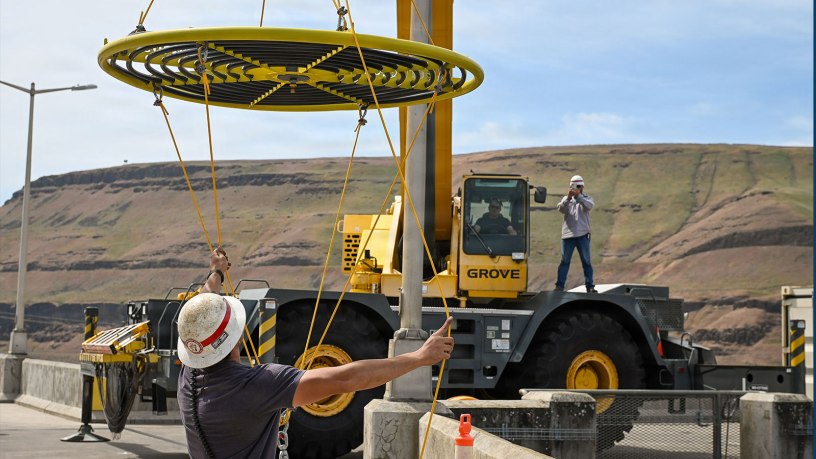
As part of a collaborative interagency effort, the district recently deployed innovative fish bubblers near the ladders at Lower Monumental Dam to cool entering water. Officials plan to implement this technology at several other dams in the coming months, creating a broader network of temperature-controlled passageways.
These bubblers function as a localized climate-control system by releasing compressed air deep underwater. As the bubbles rise, they create an upward current that draws the cooler, denser water from the river’s depths into the fish ladder. This artificial upwelling displaces the solar-heated surface water, engineering a continuous cool flow and removing a major thermal stressor.
Cost effectiveness of innovation
Prior to using fish bubblers, the U.S. Army Corps of Engineers installed permanent deep-water intake chimneys at several sites to draw up cooler water. While those chimneys—installed during a 2016 temperature improvement effort—proved beneficial, they came at a substantial cost to taxpayers. Each chimney cost millions of dollars, whereas the current bubbler option is valued at roughly $15,000 per system.
“The bubbler concept is both simple and extremely cost-effective. Previous successful efforts to cool fish ladders came with a much larger price tag and took years to design and construct,” said Brock Winegar, a hydraulic engineer with the Walla Walla District.
Utilizing bubblers saves upfront costs, allows for faster installation, and enables the district to deploy this technology at more sites across the region. Because the smaller bubblers require less maintenance and labor, they further justify the transition from the older intake chimneys.
Continued monitoring through advanced modeling
Installing a fish bubbler is just the first step.
To ensure optimal performance, engineers routinely measure its effectiveness using computational fluid dynamics (CFD)–an advanced computer modeling method that simulates fluid behavior. This allows our team to analyze and predict how the bubblers will perform in real-world conditions.
While early models anticipate this technology will successfully replace more costly traditional cooling chimneys, assessing those older structures that historically demanded substantial physical resources, including a boat, a crane, and a large field crew.
Today, computational fluid dynamics (CFD) modeling allows engineers to perform these complex evaluations directly from the office with remarkable accuracy. By calibrating digital models with initial field data, the team can simulate different variables to predict the most efficient placement of the bubbler and determine its cooling effects before ever deploying personnel.
Through the seamless integration of cost-effective bubbler technology and precise digital modeling, the U.S. Army Corps of Engineers continues to demonstrates its proactive commitment to the region’s ecological health. Combined with summer water releases that provide increased flows and temperature augmentation, this experimental technology ensures the lower Snake and Columbia rivers remain hospitable corridors–supporting the historic and arduous migrations of Pacific salmon and steelhead.

