
By Petty Officer 1st Class Jennifer Benedict, Naval Hospital Bremerton
BREMERTON, Wash. – Navy Hospital Corpsmen are routinely expected to provide life-saving medical care in high-stress operational and emergency environments – scenarios that demand rapid decision-making, seamless teamwork, and decisive leadership. However, tactical medical and expeditionary skills can degrade over time without routine operational sustainment training.
To combat this skill decay and reinforce operational readiness, Navy Medicine Readiness and Training Command (NMRTC) Bremerton launched the inaugural 2026 Corpsman Cup on Thursday, June 18, 2026. The competitive, scenario-based tactical medical event challenged participants to maintain their edge through a grueling, high-adrenaline course.
“All nine teams were energized for the competition and excited to do the skills they expected to do when they enlisted into the Navy,” said Captain Heather Kirk, NMRTC Bremerton chief nursing officer, who consolidated several independent command training efforts into the culminating event.
A Race Against the Clock and Skill Decay
The competition kicked off in the morning, with teams stepping off in staggered 20-minute intervals. Each team tackled a continuous medical evolution that packed heavy physical exertion and clinical precision into a 1.66-mile course.
Battling both the clock and physical fatigue, competitors were pushed to their limits across five intense tactical stations designed to evaluate core Tactical Combat Casualty Care (TCCC) capabilities:
- Airway management & Chest Decompression: Stabilizing immediate life-threatening respiratory injuries.
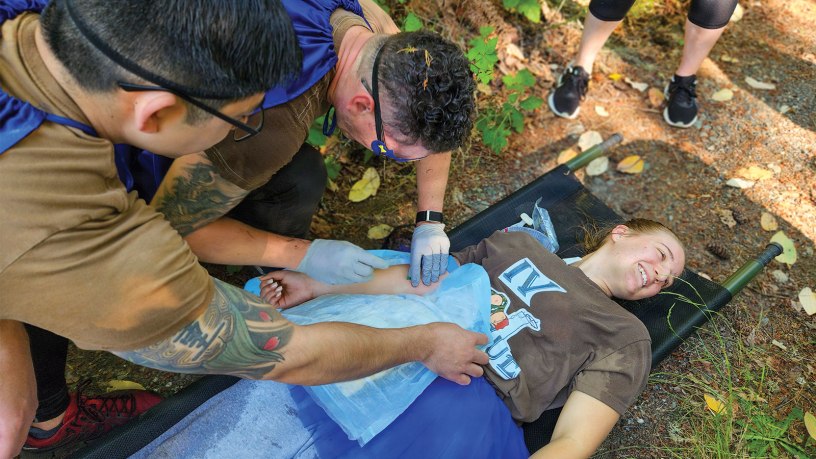
- Intravenous (IV) Access: Rapidly establishing fluid lines under simulated combat stress.
- Casualty Movement & Medical Reporting: Transporting patients safely while executing precise medical communications.
- Common Field Weapon Identification: Testing vital cross-functional familiarization with tactical equipment found in expeditionary environments
- Care Under Fire: Surviving an ambush site where competitors had to rapidly place a tourniquet on a casualty while being actively attacked with water guns.
“The stations were created to mirror trauma skills that are commonly utilized on the battlefield,” Kirk elaborated. “We added in a water-gun ambush scenario to mimic some of the pressures that corpsmen may encounter in a field environment.”
All Hands-on Deck for Readiness
While the event centered on the heritage of the Hospital Corps, who recognized their 128th birthday the day before June 17th, its operational readiness is an all-hand effort. The team rosters reflected a diverse cross-section of the command.
Participation was not limited to corpsmen; teams featured sailors from religious ministries, Supply Corps ratings like Logistics Specialists (LS), and even Medical Service Corps officers from Navy Medicine Readiness and Training Unit (NMRTU) Everett to compete, which Kirk noted was especially motivating to observe as they adapted to the scenarios.
The diverse turnout underscored the event’s ultimate goals: building serious esprit de corps, proving collaborative operational readiness, and kicking off the summer season with a high-impact demonstration of Navy Medicine’s capabilities.

