
By Petty Officer 1st Class Nathan Beard, Naval Medical Forces Atlantic
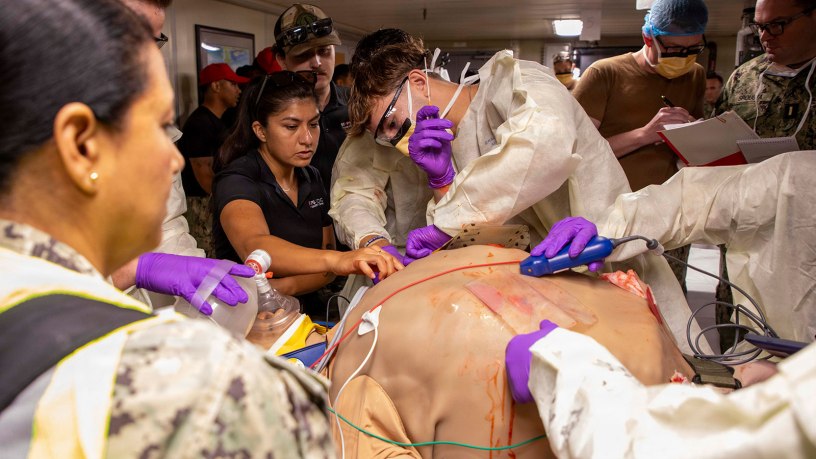
NORFOLK — In a significant milestone for naval medical capabilities, Navy Medicine conducts its first Operational Readiness Evaluation (ORE), marking two historic milestones, the first ORE of an Expeditionary Medical Unit (EMU) and the first afloat ORE for any Navy expeditionary medical team. This critical exercise is designed to test and validate the integration of advanced medical capabilities aboard maritime platforms, marking a crucial step in supporting the Navy’s shift toward Distributed Maritime Operations (DMO).
As the strategic landscape evolves, the Navy is focused on providing robust medical support in contested environments. The EMU ORE aims to thoroughly assess how medical personnel, equipment, and training can be integrated within the physical and logistical constraints of a shipboard environment.
“What I witnessed today was nothing short of incredible. Our people are motivated, dedicated, and ready to fight, no matter where we are. This event proved our warfighting advantage and will help us save lives on the battlefield,” said Rear Adm. Matthew Case, acting Navy Surgeon General and acting chief, U.S. Navy Bureau of Medicine and Surgery,
The evaluation will test the unit’s Role II medical capabilities, which include advanced trauma management, damage control surgery, and patient holding. Medical professionals, ranging from specialized surgeons to junior corpsmen, will face realistic simulated scenarios that test the entire continuum of care. Teams will be evaluated on everything from initial casualty reception and triage to complex surgical interventions and preparing patients for medical evacuation to higher echelons of care.
“As a Role 2 enhanced platform we have damage control resuscitation and damage control surgery,” said Commander Christian Esquivel. “We also bring Intensive Care Unit capability, ward capability, mental health capability, blood, labs, radiology, we bring it all to the fight, and I think we are a very unique asset in that respect.”
The primary objective of this inaugural evaluation is to identify strengths, pinpoint limitations, and define future requirements. Evaluators are closely monitoring metrics related to surgical team effectiveness, clinical adaptability, and standard operating procedures. The data and observations captured during the ORE are critical in shaping the future of expeditionary medical support.
“Throughout our visit, Navy Medicine Sailors have demonstrated their commitment to their fellow shipmates through their knowledge, skills, and adaptability. They are ready for the future fight and are maintaining a critical advantage – health and readiness,” said Case.
As Navy Medicine continues to adapt to modern maritime challenges, the successful validation of the EMU Afloat concept will ensure that medical forces remain agile, responsive, and fully prepared to provide life-saving care wherever the fleet operates.
 That PAO Guy