
By Staff Sgt. Christian Conrad, 53rd Wing
TYNDALL AIR FORCE BASE, Fla. — Get fit—courtesy of the 53rd Weapons Evaluation Group:
First, find a roughly one-ton drone somewhere in the Utah desert.
Then dig it out of a crater.
Then get three other people to help you heave it onto a trailer.
For personnel supporting 53rd WEG testing at the Utah Test and Training Range, recovering a subscale aerial target after a test event can be an operation unto itself.
The aircraft can come to rest in difficult terrain, sometimes partially buried or upside down. When recoverable, however, teams can repair the targets and return them to service for future test missions.
Easier said than done.
“Recovering a drone would take hours,” said 1st Lt. Allison Roush. 53rd Test Support Squadron special devices engineer. “Without machinery or equipment, it was difficult for a four-person team to move something that heavy onto the back of a standard trailer.”
Recovering the aircraft manually also increased the likelihood of causing additional damage to the asset during retrieval.
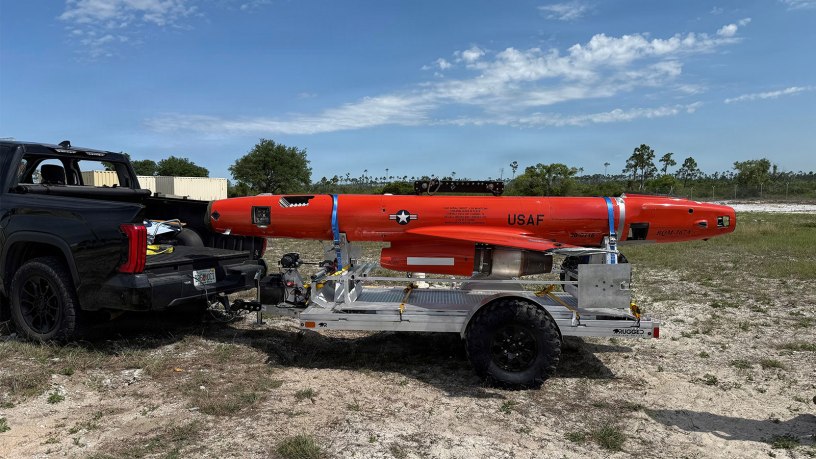
Engineers from the 53rd Test Support Squadron at Tyndall Air Force Base, Florida, recently set out to make the process faster, safer and less physically demanding.
“Our engineering team eliminated the need for personnel to lift any heavy equipment in the scorching desert heat and instead focused on speed and ease of use,” said Darin Williams, 53rd TSS modelmaker leader. Their solution centers on a winch and a purpose-built sled.
Recovery personnel attach the winch to the downed drone and pull it onto the sled, which travels beneath the aircraft as the system draws both onto the trailer. Rather than requiring personnel to lift or drag the fuselage directly, the system does the heavy work while the sled helps protect the aircraft from further damage.
“The design preserves the asset while minimizing manual labor for the team,” Williams said.
But no two recoveries necessarily look the same.
A target may come to rest upside down. Components may separate during impact. Others may become buried in sand. Whatever condition recovery personnel encounter, the trailer has to accommodate it.
“It was critical to account for all recovery scenarios to ensure the recovery team was prepared for anything,” said Senior Airman Kianna Kielb, 53rd TSS avionics journeyman.
That meant designing enough pulling power to dislodge an aircraft from the terrain while accommodating different orientations and configurations once it was free.
Eventually, engineers had a finished recovery trailer. What they didn’t have was the Utah desert. So, they made their own.
“After fabrication was complete, we borrowed a drone from another unit and used our forklift to drop it in a ditch to simulate the austere environment at the Utah Test and Training Range,” said Staff Sgt. Jared Boswell, 53rd TSS aircraft structural maintenance craftsman.
Then the flight came outside to watch.
Four volunteers approached the drone and someone started the clock.
The winch pulled, the sled cut through the mud, and the approximately one-ton aircraft began making its way out of the ditch and onto the trailer.
Less than 20 minutes later, the drone sat undamaged on the trailer.
“After that, we knew it was ready to deliver to the customer,” said Senior Airman Daniel Dehart, 53rd TSS metals technology journeyman.
What once could take hours in the desert took four volunteers less than 20 minutes in a muddy Florida ditch.
Now, the recovery trailer is ready to do it for real.

