
By Spc. Emmanuel Gibson, 130th Public Affairs Detachment
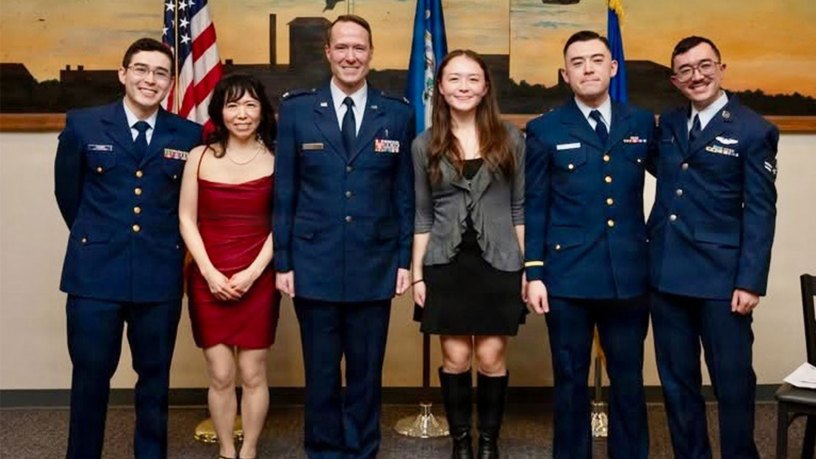
When U.S. Air Force Col. Eric Wismar entered military service, he was the first in his immediate family to wear the uniform. A generation later, all four of his children have pursued military service and a federal service-academy path – three through the U.S. Coast Guard Academy and one through the U.S. Air Force Academy Preparatory School. The result is rare, but the deeper connection among their stories is not a shared resume. It is a shared understanding of service.
In the Lutheran tradition, vocation means more than a career. It is a calling lived out in the ordinary roles of family, church, work and citizenship. In those places, people use the abilities and opportunities they have been given to care for others. For the Wismars, that understanding provides a golden thread between generations of pastoral ministry and a new generation of military service: the uniform is different, but the neighbor to be served remains at the center.
Eric’s own path did not unfold in a straight line. After college, he spent three years as an elementary school teacher, then moved to Tokyo, where he taught English for another three years and met his wife, Miharu. While in Japan, he felt called to pursue ministry. That call led him to Concordia Seminary in St. Louis, Missouri, and continued a long family tradition of Lutheran pastors.
“I’m the first one to serve in my family,” Eric said. “However, I’m actually 15th-generation Lutheran clergy.”
During his third year of seminary, Eric entered the Air Force Reserve Chaplain Candidate Program intending to commission as an active-duty chaplain. After graduating and being ordained, however, he accepted a pastoral call to Lutheran Church of the Good Shepherd in New Fairfield, Connecticut. The call to congregation and the call to uniform would eventually come together.
After serving as an Individual Mobilization Augmentee at Hanscom Air Force Base, Eric joined the Connecticut National Guard in 2008. Eric and Miharu’s decision to make their home in Connecticut grew from the community they found through the church and from the opportunity for Eric to gain the experience needed to serve as an Air Force chaplain. He now serves as the Connecticut National Guard’s full-time support chaplain.
For generations, the Wismar family’s public service had been expressed chiefly through ministry. Eric’s service added another setting in which to care for people, especially service members and families facing the demands of military life. His children would carry that pattern forward, although each would make the choice in a different way.
Jorge, the eldest of the four siblings, was the first child to enter a uniformed service. He attended the U.S. Coast Guard Academy and, after graduating, served aboard U.S. Coast Guard Cutter Willow. He later worked at the Coast Guard Research and Development Center in New London, where his assignments included operational missions, project management and emerging maritime technology.
“It feels good to be involved in a mission set,” Jorge said. “Once you’re trained up at your unit and you understand what your role is, it feels good no matter what you’re doing.”
Jorge’s experience also gave the academy an identifiable face for his younger siblings. His example made the demands and purpose of Coast Guard service easier for them to see.
“The choice to go to the academy was a few things,” Kai said. “It was primarily my older brother being there, having good things to say about it.”
Kai entered the Coast Guard Academy directly out of high school, studied civil engineering, and graduated and commissioned as an ensign in 2024. He now serves at Sector Southeastern New England in Woods Hole, Massachusetts, as a response and logistics officer. He coordinates search-and-rescue cases, stands watch in the command center, and supports law-enforcement operations.
Family influence opened the possibility, but the mission gave Kai a reason of his own. What first caught his attention was not rank or recognition, but the chance to help a person in danger.
“Beyond that, it was the mission and it being more humanitarian focused,” Kai said. “I think search and rescue was really what stuck out to me as a high schooler. What I thought of wasn’t really law enforcement. It wasn’t really going out on patrols and on the cutters. It was more so the search and rescue aspect.”
Their younger brother Luke took a different route. Rather than commissioning first, he enlisted in the Connecticut Air National Guard directly out of high school and served as a C-130 flight engineer with the 103rd Airlift Wing. On operational missions overseas, he managed and troubleshot the aircraft systems that kept his crew in the air. By age 21, he had accumulated approximately 500 flight hours, completed 20 combat missions and deployed to Djibouti. While deployed, he applied to the U.S. Air Force Academy through the Leaders Encouraging Airman Development Program and accepted an appointment to the academy’s Preparatory School class of 2027. One common influence was Civil Air Patrol, the Air Force auxiliary program that introduces cadets to aviation, military customs and leadership. Jorge joined as a teenager, and Eric became involved as a senior member and later served as a chaplain here as well. The program made military service familiar to the Wismar children, while leaving each of them to discern an individual path.
Mia, the youngest, has now begun her own path at the U.S. Coast Guard Academy. After graduating from high school, she completed Swab Summer, the academy’s cadet indoctrination program. With Mia’s arrival and Luke’s acceptance to the Air Force Academy Preparatory School, all four Wismar children had entered, completed or been accepted to a federal service-academy route. Yet their paths – operational, technical, humanitarian and still unfolding – remain distinctly their own.
The family’s story is not only about the people in uniform. Vocation begins at home, where service is often quiet and largely unseen. As Eric and each of the children took on military responsibilities, Miharu and the entire family shared the strain of missed weekends, extended travel and separations.
“I’m thankful to Miharu, as I think all of us who serve are thankful to our families, because it is a sacrifice,” Eric said. “It’s a sacrifice for the service member, but sometimes even more for the family.”
Eric has seen the cost of service at close range. His work as a chaplain places him beside service members in some of their hardest moments. During a deployment to Honduras in 2017, he witnessed a fatal aircraft incident and helped care for people in its aftermath. Now that his own children serve, the risks he once carried as a chaplain are also risks he understands as a father.
“It reinforces that each day is a gift of God,” Eric said. “You never know what’s going to happen.”
What began with generations of Lutheran pastors, and one first-generation military member has become a family legacy spanning the church, the National Guard, the Coast Guard and the service academies. Its meaning does not rest only in the remarkable fact that four siblings chose these paths. It rests in what those paths are for: serving the particular people placed in front of them – a congregation, a crew, a mariner in distress, a fellow service member or a family waiting at home.
“Service is about protecting others,” Kai said. “And knowing who you’re fighting for.”

