
By Maddy Gonzalez, Fort Benning Public Affairs Office
FORT BENNING, Ga. — Maneuver Battle Lab Soldiers and capability developers gathered at McKenna Field Landing Site July 27 to Aug. 7 to assess modern tethered unmanned aircraft systems (Te-UAS) designed to give maneuver units the ability to overcome terrain limitations and conduct persistent reconnaissance, surveillance and extended communications.
Designed and executed by the MBL in collaboration with the Air Robotics, Dismounted Requirements Branch, Requirements Division, Maneuver Future Capability Directorate (MFCD) and Product Lead Strategic Spectrum Warfare (PL SSW), the assessment put two commercial Te-UAS capability surrogates through static, on-the-move and emergency scenarios.
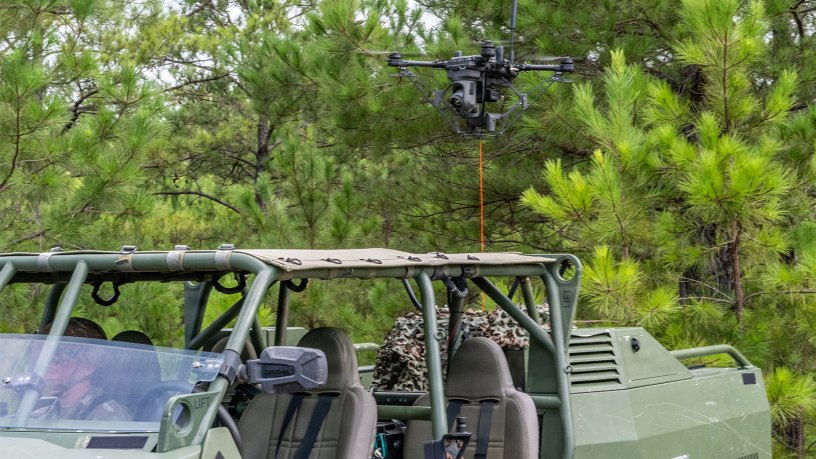
During the trial, the tethered drones climbed to operationally relevant altitudes. The MBL timed ascent and retraction speeds and assessed the system’s “follow-mode” as the Te-UAS tracked above an Infantry Squad Vehicle-Utility (ISV-U) maneuvering through the training area. Moving between designated target reference points, operators bounced communications over terrain obstacles, bypassed signal jamming and spotted targets from safe distances.
“The Maneuver Battle Lab’s mission is experimentation,” said Tollie Strode Jr., government oversight lead for the assessment and Unmanned Systems Team chief at the MBL. “We take technology to the field, employ it in an operational context, look under the hood, kick the tires and report what we find to inform programmatic decisions.”
Unlike traditional free-flying drones that are limited by internal power supplies and require battery swaps, the Te-UAS receives continuous power and exchanges data through its physical tether, allowing it to remain airborne and provide capability to the force indefinitely.
“This is a great opportunity for long-endurance mission sets,” said Capt. Sarah Runion, MBL Live Experimentation Branch executive officer and assessment participant. “Tethered UAS bring a lot of pros to the force: we don’t have to worry about battery life or anything like that, which you see on other drones. It can go through different levels of height, and it can follow you along on whatever platform you deem it on.”
Another feature under evaluation was the system’s simple operational design, which allows users to deploy the Te-UAS rapidly without extensive specialized training.
“In a matter of minutes, I was able to get [the drone] launched up in the air … and then it’s a quick, easy one-step button to bring it back down,” said Runion. “This has been a user-friendly experience.”
Mark Pagliaro, a PL SSW contractor and program officer, compared the setup to a portable, elevated sensor suite for a maneuver unit.
“It’s similar to a very high tower,” Pagliaro said. “Having a sensor up that high in their [area of operations] is going to influence [the maneuver unit] and allow them to extend ranges and see targets farther.”
Pagliaro added that the simple deployment is “pretty much hands-off,” freeing the user to focus on incoming camera feeds and data rather than piloting the aircraft.
Following the field iterations, the MBL compiles Soldier feedback, technical performance data and operational footprint details into a comprehensive final report. This package provides vital data for leaders to determine whether the Army should purchase the technology.
“When we develop a clear concept of operation and employment, it gives us credibility behind the numbers and information we provide to decision-makers,” Strode said. “It answers the ‘so what?’ and provides the essential analytical underpinning to determine if this technology should transition into a permanent Army program of record.”
 That PAO Guy