
By Joseph Siemandel, Joint Force Headquarters – Washington National Guard
After more than six weeks supporting Department of Natural Resources, Washington National Guard aviation and hand crews concluded their wildfire fighting support mission, Sept. 4, marking the end of an extensive response that brought together soldiers, airmen and Washington State Guard members to support communities and civilian agencies.
“This response demonstrated the strength of our joint force and our ability to adapt as conditions and mission requirements changed across the state,” said Col. Carrie Wentzel, director of joint operations, Washington National Guard. “From aviation and hand crews to liaison and community support, our soldiers, airmen and State Guard members worked as one team alongside our civilian partners to protect lives, property, and communities. Their professionalism and flexibility allowed us to deliver the right capability at the right time throughout this extended response.”
Beginning on July 18, when they got the call to mobilize, Washington Army National Guard aviation teams supported the firefighting efforts with 44 days of sustained aerial firefighting operations. During that time, crews flew 474.7 hours, completed 2,044 water bucket drops, and delivered 1,943,269 gallons of water. Crews supported six fires across central and eastern Washington; Sinlahekin, Little Giant, Three Queens, Modrite, Bradeen Hill, and Autumn Lane fires.
“Sustaining aviation operations for 44 days in some of the most demanding conditions our crews encounter required tremendous discipline, coordination, and trust across the entire team,” said Lt. Col. Adam Hanisch, state aviation officer, Washington Army National Guard.
Operating from Deer Park and later Pangborn Memorial Airport in East Wenatchee, aircrews navigated high altitudes, strong winds, heavy smoke, extreme heat, and congested airspace while coordinating with firefighters and other aircraft working around active fire areas. The aviation mission involved far more than the aircrews visible during water drops. Crew chiefs, flight engineers, fuelers, maintainers, flight operations personnel, administrators, and military liaisons worked throughout the activation to keep aircraft and crews ready for each mission.
“Our aircrews performed exceptionally, but every flight and every bucket drop depended on the maintainers, fuelers, crew chiefs, flight operations personnel, and support teams working behind the scenes. I am incredibly proud of how they safely delivered nearly 2 million gallons of water while remaining ready to adapt wherever our partners needed them,” said Hanisch.
A CH-47 Chinook crew from the Montana Army National Guard worked alongside Washington Guardsmen during the response to provide additional capabilities.
“The Montana Army National Guard’s support was a tremendous addition to the mission, their crew integrated seamlessly with our team and brought additional heavy-lift capability when Washington needed it,” said Hanisch. This summer also included the first operational use of a Washington Army National Guard UH-72 Lakota as a helicopter command platform during firefighting operations on the Sinlahekin Fire.
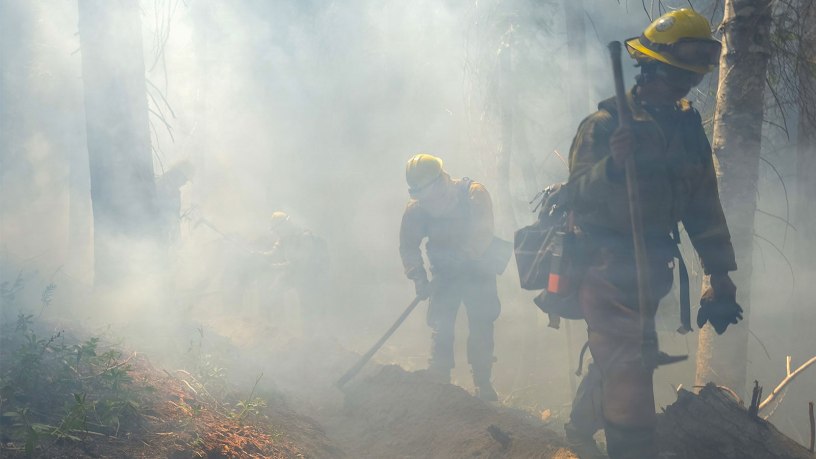
On the ground, two rotations of Washington National Guard hand crews supported firefighting operations on the Little Giant Fire near Leavenworth.
Ten National Guard hand crews completed 28 days on the fire line, conducting more than 34 miles of line clearing and mop-up operations, and constructing more than 13,800 feet of hand line and laying or recovering thousands of meters of hose.
Their work helped strengthen fire lines, extinguish hot spots, and provide additional capacity to professional wildland firefighters working to contain one of Washington’s largest fires of the season. Throughout the response, Washington National Guard soldiers and airmen worked shoulder-to-shoulder with local, state, federal, military, and international partners.
“It was really invigorating. It tested me in different ways that I hadn’t anticipated. I got to get involved with a different group of people that I wouldn’t normally be able to see,” said Tech Sgt. Shauna Bonham, a traditional guard cybersecurity intelligence airman from the 256th Intelligence Squadron, 194th Wing.
The wildfire activation also included Washington National Guard support following the Spokane Complex fires. Soldiers and airmen staffed traffic control and entry points in support of the Spokane Police Department and Spokane County Sheriff’s Office. As conditions improved, Guard members transitioned to other community-support missions, including assisting with the distribution of American Red Cross disaster relief kits.
Washington State Guard members also served as military liaison officers throughout the activation, helping coordinate requests and maintain communication among incident commanders, local jurisdictions, state agencies, and Guard leadership.
The combined aviation, hand-crew, liaison, and community-support missions demonstrated the Guard’s ability to mobilize quickly, adapt as conditions changed, and provide specialized capabilities requested by civil authorities.
“Our ability to respond effectively to increasingly complex emergencies depends on sustained readiness, resilient partnerships, and a force capable of adapting quickly to the needs of the state,” said Maj. Gen. Gent Welsh, the adjutant general, Washington National Guard. “I am incredibly grateful to the soldiers, airmen, and State Guard members who answered the call, the families and employers who supported them, and the local, state, Tribal, and federal partners who worked alongside us. Their collective effort strengthened Washington’s response and reinforced why we must continue investing in the people, partnerships, and capabilities that keep us ready to serve our communities whenever the state needs us.”
 That PAO Guy