
By Capt. Jordan Beagle, U.S. Army Southern European Task Force, Africa
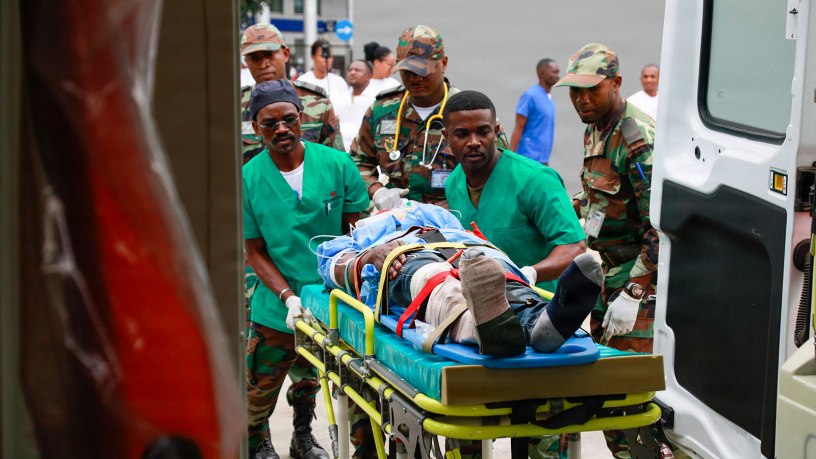
LUANDA, Angola — Angolan Armed Forces (FAA) and U.S. Army Reserve medical professionals with the 915th Forward Resuscitative Surgical Detachment, 313th Hospital Center, 2nd Medical Brigade, conducted a trauma activation simulation Sept. 7 as part of the Angola Medical Readiness Exercise, testing expeditionary medical readiness and strengthening U.S.-Angolan interoperability in trauma response.
The exercise, planned by the Angolan Armed Forces medical team with U.S. Army Southern European Task Force, Africa (SETAF-AF), involved 10 Soldiers from the 915th FRSD. “What we practiced here was the full continuum of care,” said U.S. Army Staff Sgt. Nicholas Koo, MEDREX noncommissioned officer in charge. “From pre‑hospital treatment, evacuation, emergency room care, resuscitation, stabilization, post‑anesthesia recovery, and even medevac planning, each step was exercised in sequence.”
The trauma activation unfolded in three iterations:
- First iteration: Angolan Armed Forces personnel initiated care at the point of injury, evacuated the patient to the emergency room of the Hospital Militar Principal and handed over care to the 915th FRSD for resuscitation and surgical decision making.
- Second iteration: The roles were reversed, with the 915th FRSD beginning treatment and Angolan personnel completing the scenario.
- Final iteration: Both teams worked concurrently, coordinating care under the direction of a lead doctor in a structured approach that mirrored real-world trauma management.
“This exercise is very beneficial,” said Angolan Armed Forces Lt. Cmdr. Joaquim Quibuco, a surgeon with the Angolan Navy. “We are exchanging experiences in medicine. We are ready to learn from the U.S. team, and we are also conveying our experience to the U.S. team.”
For the 915th FRSD, the simulation provided a realistic test of expeditionary surgical operations. The detachment is designed to function as a small, mobile surgical team capable of operating in tents or buildings of opportunity with limited blood supply, equipment and power. The FRSD can split into two teams, each able to provide forward resuscitative surgery in field conditions, a capability that distinguishes it from hospital‑based medical units.
“Our mission is different from hospital training,” said U.S. Army Lt. Col. Matthew Koopmann, MEDREX officer in charge and a general and vascular surgeon with the 915th FRSD. “We train to deliver surgery in austere environments with limited resources, so exercises like this are critical to validate our readiness.”
Following the exercise, both teams discussed lessons learned and noted that while interpreters supported communication the language differences posed challenges. Participants agreed that repeated practice and future iterations will continue to strengthen coordination and reduce barriers. Quibuco emphasized that the collaboration extends beyond professional exchange. “It’s not only about military exchange; it’s also about making friendships,” he said. “We hope this cooperation doesn’t stop here. We look forward to seeing more exercises.”
Through MEDREX, SETAF‑AF and the Angolan Armed Forces continue to advance regional health security objectives, modernize trauma care and reinforce U.S. Africa Command’s commitment to interoperability and partnership.
 That PAO Guy