
By Capt. Rachel Deppen, 4th Psychological Operations Group (Airborne)
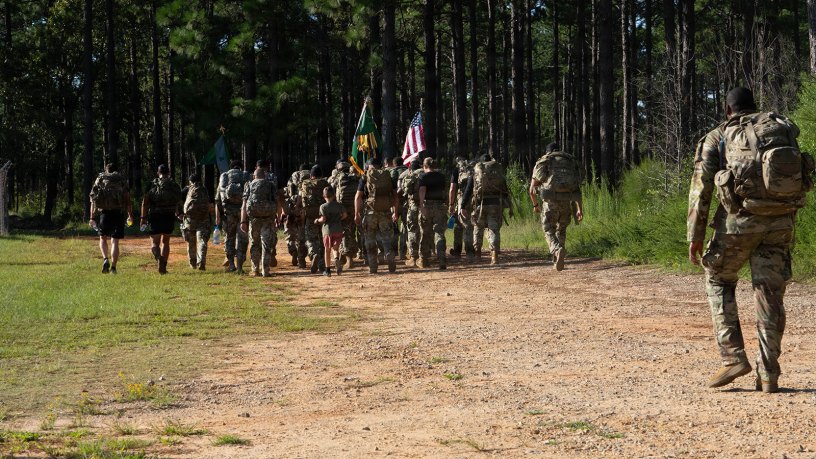
FORT BRAGG, N.C. — Soldiers from across the Psychological Operations Regiment gathered Sept. 10 at the SSG Michael A. Dickinson Mock-Up to commemorate the 25th anniversary of the Sept. 11 terrorist attacks with a 24-hour memorial ruck.
The event brought together Soldiers from across the Regiment to carry the American flag continuously for 24 hours in honor of the nearly 3,000 Americans who lost their lives Sept. 11, 2001, as well as the first responders, military personnel and civilians who answered the call in the aftermath.
The ruck began with the entire regiment moving together with the flag before handing it off to the first scheduled unit. From there, PSYOP formations took designated time blocks, passing the flag from one unit to the next, keeping it continuously moving through the day and night.
“Every generation has a responsibility to remember who we are, who came before us, and who carries us forward,” said Col. Santucci, commander of 4th Psychological Operations Group (Airborne), during the opening ceremony.
Twenty-five years after the attacks, many of the Soldiers participating in the ruck were children when the towers fell, while others were not yet born. For the Regiment, the anniversary provides an opportunity for each generation to learn from those who came before them and understand the service and sacrifice that followed Sept. 11.
The attacks ushered in more than two decades of war and shaped a generation of Soldiers and leaders. Throughout those years, members of the Psychological Operations Regiment deployed, fought and lost teammates.
Santucci emphasized that the memorial ruck honors the nearly 3,000 Americans who lost their lives Sept. 11, as well as the first responders who ran toward danger. For the Psychological Operations Regiment, the commemoration also carries a deeply personal connection to the Soldiers, teammates and families who became part of the Regiment’s history during the 25 years that followed.
The Group Chaplain, Chaplain Vernon Snyder, addressed that broader legacy during the opening prayer, recognizing the first responders and civilians who moved toward danger to help others on Sept. 11.
“Today, God, we express our gratitude for the selfless sacrifice of the firefighters, the paramedics, the police officers, other first responders, and the civilians who chose to run towards smoke and flame so that others might have a chance to make it home that fateful day,” Snyder said.
Snyder also recognized the service members who deployed in the aftermath of the attacks and the sacrifices made during the years of conflict that followed.
The 24-hour ruck gave Soldiers an opportunity to honor both the national significance of Sept. 11 and the experiences of the Psychological Operations Regiment during the quarter century that followed. Each formation carried the same flag before passing it to the next unit, creating a continuous connection between Soldiers throughout the regiment.
The participating units included PSYOP battalions, headquarters elements and 5th Battalion, 1st Special Warfare Training Group.
For Soldiers who were not alive when the attacks occurred, the ruck offered an opportunity to honor a moment they did not personally experience while recognizing the responsibility that comes with wearing the uniform. “It makes me feel patriotic. Even though I wasn’t alive for it, I still must keep them in my mind,” said a Soldier from 5th Battalion, 1st Special Warfare Training Group.
The Soldier, a 37F, also reflected on what wearing the uniform means and the importance of serving others. The experiences of the past 25 years have helped shape resilient Soldiers and adaptive leaders while contributing to the Army’s evolution as a force capable of operating across increasingly complex environments.
For the Psychological Operations Regiment, that evolution is inseparable from the people who carried out the mission, supported their teammates and families, and carried the weight of loss throughout the post-9/11 era. The ruck also served as a reminder that remembrance does not depend solely on personal experience. As the generation with firsthand memories of Sept. 11 becomes smaller, the responsibility to preserve that history increasingly belongs to those who came after.
The flag was scheduled to return to the Dickinson Mock-Up the morning of Sept. 11, where the Regiment reunited for a closing ceremony.
The 24-hour movement of the flag represented a legacy passed from one formation to another and from one generation of Soldiers to the next, honoring those who were lost, recognizing those who served and reinforcing the responsibility of today’s Soldiers to carry that legacy forward.
 That PAO Guy