
By Staff Sgt. Luis Solorio, 10th Special Forces Group (Airborne)
FORT CARSON, Colo. — Nearly 16 years after an improvised explosive device detonated beneath his vehicle in Afghanistan, Chief Warrant Officer 2 Corey L. Cook stood before his family, former teammates and fellow Soldiers at Fort Carson, Sept. 15, 2026, to receive the Purple Heart.
For Cook, a Green Beret assigned to the 10th Special Forces Group (Airborne), the medal is not a symbol of recognition or personal achievement. To him, it represents something far more meaningful.
“I’m glad to be alive,” Cook said. “I am glad I’m able to be a father, to be a husband.”
The Purple Heart, awarded to Soldiers wounded or killed by enemy action, commemorates sacrifice. For Cook, it represents gratitude. That gratitude is for the teammates who fought beside him, the training that helped save his life, and the chance to keep serving after surviving one of the defining moments of his military career. Cook, a Minnesota native, spent his childhood on hockey rinks, baseball diamonds, and football fields. Athletics shaped his work ethic, but a friendship during college ultimately changed the course of his life.
A former 82nd Airborne Division Soldier and friend introduced him to the mission of U.S. Army Special Forces. His friend described Green Berets as members of small teams that work alongside partner forces to help nations defend themselves and as experts in their craft, built to protect the nation.
From that moment, Cook had one goal.
“There wasn’t anything about being a Ranger, or a Navy SEAL,” Cook said. “It was always about becoming a Green Beret.”
He enlisted through the Special Forces enlistment program in 2008 and approached every challenge with a simple mindset.
“You have to keep one foot in front of the other and never stop moving forward,” he said.
That mentality carried him through Basic Combat Training, the Special Forces Qualification Course, and eventually to the 1st Special Forces Group (Airborne), where he deployed to Afghanistan as a young engineer sergeant.
Assigned to Bravo Company, 3rd Battalion, 1st SFG (A), Cook and his teammates operated in Helmand Province, Afghanistan, supporting village stability operations in an area where the insurgency maintained dominant political control. The team lived for six months in Mirmandab, a village in southern Afghanistan, without running water and fully integrated with the local community.
Cook spent his days conducting patrols, improving defensive positions, pulling security and supporting resupply missions.
The work was demanding, but Cook never doubted where he belonged or the purpose of his mission.
“My life, my purpose, was the team,” Cook said.
On Dec. 10, 2010, Cook and his teammates were conducting a tactical ground movement and resupply mission when their convoy transitioned to blackout operations. Cook reached for the controls to activate his vehicle’s thermal camera.
Before he could finish, a 120-pound improvised explosive device detonated beneath the front driver’s side of his vehicle.
The blast rolled the vehicle onto its side, ripped the driver’s door completely off, and spread debris across the desert.
Cook remembers only fragments of that moment. The first was wondering why he was lying against the ground inside the overturned vehicle. The second was seeing flames through the windshield. Regardless, his first concern was not himself. It was his teammate.
“Dave, you good?” he recalled asking.
After confirming both were alive, Cook and his teammate immediately checked on their Afghan gunner. Despite facial lacerations, bleeding from his ears from the blast pressure and significant pain, Cook freed himself from the vehicle and helped evacuate the other Soldiers through the gunner’s hatch.
As the team received small-arms fire, Cook and his teammates reestablished security, secured sensitive equipment, and held the scene until medical evacuation arrived.
“The adrenaline is no joke,” Cook said. “You don’t feel pain. You go back on what your training provides.”
Although he escaped without losing any limbs or suffering catastrophic external injuries, the explosion left lasting internal injuries, including concussion-related symptoms, vertigo, and blast-related trauma, requiring evacuation and medical observation.
For 10 days, Cook remained under medical care before returning to his detachment.
More than anything else, he wanted to get back to the team. Cook spoke of a sense of duty and supporting his teammates just as they had supported him. He returned to duty and finished the deployment alongside the Soldiers who had helped save his life.
The deployment demanded that same resilience from the entire detachment.
Nine members of the team, including Cook, survived at least one explosion during the deployment. Nearly every dismounted patrol resulted in firefights, and the tempo of violence eventually became so relentless that the team stopped keeping track of troops in contact.
The team also experienced loss.
Staff Sgt. Jimmy Ide, a dog handler from a sister team, and British Army Lance Cpl. Liam Tasker were killed in action while conducting patrols alongside the detachment.
Despite the violence and loss surrounding the deployment, Cook and his teammates continued the mission. The team’s performance during the tour resulted in four valor awards. At the same time, other team members continued their careers and eventually left the Army with little broader recognition of what they experienced together.
For years afterward, Cook rarely thought about recognition. In fact, he questioned whether his injuries warranted the Purple Heart at all.
Then, nearly 16 years after the explosion, an email informed him the Army had approved the award.
His reaction was less about validation and more about reflection. He recalled thinking about those who received the same award but never returned home.
“I think about everybody else who has received it,” Cook said. “A lot of people are awarded this after they die.”
For Cook, the Purple Heart carries the stories of every Soldier who has worn it, those who survived, those who carry lifelong wounds, and those who made the ultimate sacrifice.
“When people see this award, they should know it comes with a unique story,” Cook said. “It’s not something people strive to earn. It’s awarded because of someone’s sacrifice in service to this nation.”
That perspective continues to shape the way he leads today’s Green Berets.
Over more than 17 years of service, including more than 15 years in Special Forces, Cook has deployed multiple times to Afghanistan and Iraq, trained partner forces across Asia, and completed some of the Army’s most demanding schools and assessments, including Sniper, Jumpmaster, and Military Freefall.
Today, he serves as commander of the Special Forces Advanced Urban Combat Detachment at Fort Carson, where lessons from Helmand Province have shaped how he trains and mentors the next generation of Soldiers.
“Train as hard as you can,” Cook said. “You never know what’s going to happen tomorrow. The harder you train, the more you’ll fall back on that training when it matters.”
On Sept. 15, Cook’s journey from that night in Afghanistan to the present came full circle.
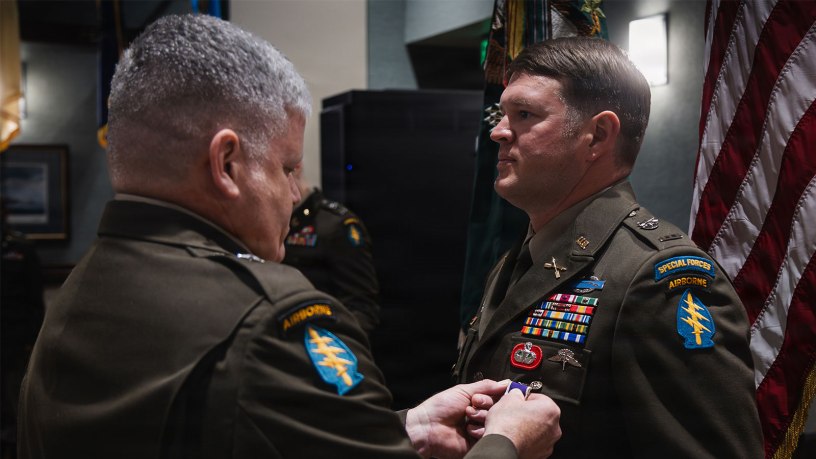
With his family, former teammates, and fellow Soldiers looking on, Brig. Gen. John W. Sannes, deputy commanding general-operations of 1st Special Forces Command (Airborne), pinned the Purple Heart on Cook during an award ceremony at Fort Carson.
For Sannes, the ceremony recognized more than the wounds Cook sustained in 2010. It recognized the years of service that followed.
“In combat, in training, and in the countless moments that define a life of service, Corey has shown steady leadership, quiet courage, and unwavering dedication,” Sannes said.
The recognition came nearly 16 years after the attack, but Cook’s perspective on the medal remained focused on those who served beside him and those whose sacrifices were greater than his own.
The Purple Heart rests not as a reminder of the day an IED nearly claimed his life, but as a testament to resilience, selfless service, and the teammates who ensured he lived to continue serving others.
For Cook, surviving the explosion was only the beginning.
The true legacy has been everything he has been able to do since.
 That PAO Guy