
By Dustin Senger, Blount Island Command
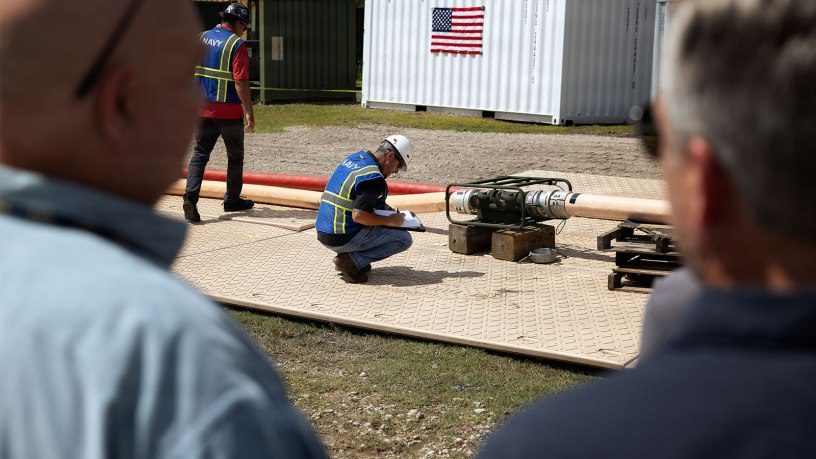
ST. MARYS, Ga. — Steven Insco, a test coordinator supporting Blount Island Command, worked through a verification checklist Sept. 16, then started a pump-and-compressor configuration designed to give military planners another way to move fuel and water to forces ashore.
The equipment ran at several settings as Navy acquisition, engineering and logistics specialists observed and documented its performance. The pump and compressor operated outside the compact container intended to house them, allowing evaluators to focus on the stand-alone pumping configuration.
The Navy calls the new configuration the Amphibious Bulk Liquid Transfer System-J, or ABLTS-J. The “J” refers to Joint Logistics Over-the-Shore. Blount Island Command’s Navy positioning specialists at Marine Corps Support Facility Blount Island in Florida developed it to complement — not replace or supersede — the fielded ABLTS.
ABLTS uses hose lines to transfer bulk fuel or water from a ship to shore. When employed from a maritime prepositioning ship, the system relies on pumping support from the vessel. ABLTS-J would place that pumping capability in a transportable package, giving commanders more flexibility to employ the transfer system from different platforms and locations.
“We’re good — we’ve proved the concept,” said William Fish, director of Blount Island Command’s Navy positioning department. “We know it’ll fit dimensionally. Now we just need to operate it in the container.”
Mike Prouty, principal assistant program manager for the Navy’s Joint Petroleum Over-the-Shore effort, traveled from the Washington Navy Yard to a coastal Georgia industrial yard to observe the test. He said ABLTS-J grew from an engineering change proposal for a stand-alone configuration.
“We’re happy with what we’re seeing — excited by what we’re seeing — but we still have some steps left,” Prouty said.
After Blount Island Command completes the containerized configuration, the program plans to move ABLTS-J to fleet demonstrations in an operational environment.
Prouty’s program falls within PMS 300H, which manages the Navy’s Logistics Over-the-Shore portfolio under the Boats and Craft Program Office of Portfolio Acquisition Executive Maritime. The portfolio brings together capabilities for moving equipment, cargo, personnel and bulk fuel from ships to shore when conventional port infrastructure is unavailable or unsuitable.
For Blount Island Command, the project connects the workforce’s positioning mission with the Navy’s future sustainment requirements, turning familiarity with existing equipment into options for the fleet.
Insco brought a fleet operator’s experience to the evaluation. He retired as a Navy chief petty officer after 20 years as a boatswain’s mate, including small-boat operations in coastal and near-shore environments.
“We’re taking a fielded system traditionally employed from maritime prepositioning ships and giving it a stand-alone pumping option,” Fish said. “We want to make ABLTS operable anywhere in the world, from any barge or remote island.”
Before the field evaluation, participants met at Marine Corps Support Facility Blount Island to review design constraints and timelines, set development priorities, assign engineering and logistics responsibilities and discuss potential updates to Navy training curricula.
With the pumping concept established, the team will modify a compact shipping container to house and operate the pump-and-compressor package while accounting for ventilation, heat, vibration and access to the controls. The design is also intended to limit modifications required in the field.
A Naval Sea Logistics Center representative observed the kickoff and field test to identify requirements for training, repair parts and technical manuals, while a naval architect documented observations to help finalize the system drawings.
The ABLTS-J effort follows a pattern at Blount Island Command.
The command provides equipment, space and expertise for autonomous-navigation testing aboard an Improved Navy Lighterage System causeway ferry. In June, it revised a loading plan aboard USNS Sgt. William R. Button to accommodate a causeway ferry while creating space for additional containers.
Across those projects, the command brought engineers, logisticians and experienced operators together to develop more workable options for the fleet. That problem-solving pattern also helps explain why Fish’s team accepted the ABLTS-J work despite an already demanding workload.
Blount Island Command’s Navy specialists sustain, configure and position maritime logistics equipment and supplies. Their familiarity with how systems are stored, transported, maintained and prepared for forward employment made developing the configuration a natural extension of their daily mission.
“We’re saturated with work, but where else you going to do it?” Fish said. “We’re trying like hell to produce a good product, and in the end we will.”
 That PAO Guy