
By Senior Airman Adam Enbal, 501st Combat Support Wing
ROYAL MILITARY ACADEMY SANDHURST, England — At one of the United Kingdom’s most prestigious military academies, the cadence of marching officer cadets mixed with a less familiar sound — the high-pitched whir of first-person-view drones.
Across the grounds of the Royal Military Academy Sandhurst, drones accelerated through racing gates, carried simulated payloads and disappeared between trees. Behind first person view goggles, pilots remained locked on the live feed, their hands making precise adjustments to guide aircraft they could no longer see. With little room for error, a slight movement on the controls could mean the difference between clearing an obstacle and ending the run.
Military drone operators from around the world came to Sandhurst for the Military International Drone Racing Tournament and British Army Tactical Drone Competition, Sept. 14–18, 2026. Team USA brought together Airmen, Soldiers, Sailors and Marines from across the globe.
Among them was Lt. Col. Kendall “Spartan” Smith, 420th Air Base Squadron commander, whose involvement with drones began in 2015 after borrowing a kit from his brother-in-law. He spent a weekend building it, had it flying within a few days and was hooked. What began as a hobby led to drone racing and eventually found relevance in his work with the Air Force.
“Drones are not the future. They’re here now,” Smith said. “Our job is to take anybody and everyone who’s got an interest, or responsibility, to understand drones and their capabilities and think about ways that we are both offensive with them and defensive.”
The competition gave Smith and the rest of Team USA a chance to apply that experience to unfamiliar challenges.
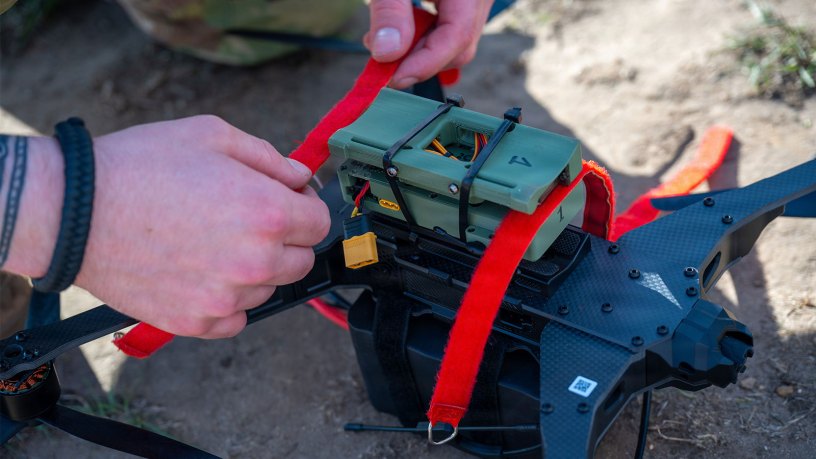
During the simulated payload drop, a pilot flew by FPV while a spotter watched the course and made callouts. Other team members prepared aircraft for another attempt. Smith compared the coordination to his previous experience as a B-52 weapons systems officer, where each crew member has a role in accomplishing the mission.
“It takes a team effort to execute,” Smith said. “It’s about teamwork, integration, oiling that machine and learning how to improve your capabilities as you work together.”
Tech. Sgt. Skye Dalrymple, a 423rd Security Forces Squadron Defender stationed at RAF Alconbury, brought a different background to the team. He began building and flying drones in 2013 and later worked with counter-small unmanned aircraft systems and Air Force innovation efforts.
Dalrymple said drones are often viewed as either toys or attack platforms, while their potential uses extend much further. He pointed to force protection, building inspections, airfield foreign object debris inspections and assessments of hazardous areas as examples.
“It allows you to put a piece of equipment with highly specialized programs and capabilities instead of Airmen in the face of danger.” Dalrymple said.
Working alongside international teams also gave the U.S. participants a chance to see how other militaries are approaching drone operations and bring those lessons back to their own units.
“We have so many of our mission partner forces that are doing this day to day and have such a vast reservoir of knowledge,” Dalrymple said. “Being involved in things like this lets us get that cross-play and really watch how they’re operating, what they’re doing.”
That exchange extended across Team USA, where Airmen worked alongside U.S. Army personnel and representatives from the U.S. Naval Academy, each bringing experience from their respective services. The U.S. Naval Academy was also represented, reflecting its effort to incorporate robotics, autonomous systems and FPV drone operations into the development of future Navy and Marine Corps officers.
“The U.S. Naval Academy is modernizing its curriculum and operational training to prepare future naval leaders for the realities of modern multi-domain warfare,” said Lt. Cmdr. Kara Handley, U.S. Naval Academy public affairs officer.
For Dalrymple, bringing different services together meant finding out that a problem facing one unit may have already been solved somewhere else.
Smith said working alongside members of other services exposed him to tactical applications outside his own experience.
“What is really humbling is to come out here and sit with our young Army infantrymen who this is their day-to-day job,” Smith said. “I’ve been building drones for more than 10 years, and I’ve learned so much already in a short period of doing the tactical side of it.”
That mix of experience was visible across Sandhurst with each team approaching the same technology from a different perspective, giving participants a chance to see where their own experience fits into a much larger effort.
As small drones become an increasingly common part of military operations, the skills developed at Sandhurst have relevance far beyond the competition course. For the members who participated, the next step is applying what they learned to build greater drone knowledge within their units and prepare all service-members for a technology that, as Smith put it, is already here.
 That PAO Guy