
By Staff Sgt. Serena Smith, 129th Rescue Wing
MOFFETT AIR NATIONAL GUARD BASE, Calif. — For more than three decades, the HH-60G Pave Hawk served as a critical part of the Air Force’s combat search and rescue mission, carrying generations of rescue Airmen into some of the world’s most challenging environments to recover those in need.
From combat zones in Afghanistan and Iraq, to California communities devastated by disasters, the Pave Hawk stood ready to answer the call. The aircraft became synonymous with the Air Force rescue mission and its commitment to bringing people home.
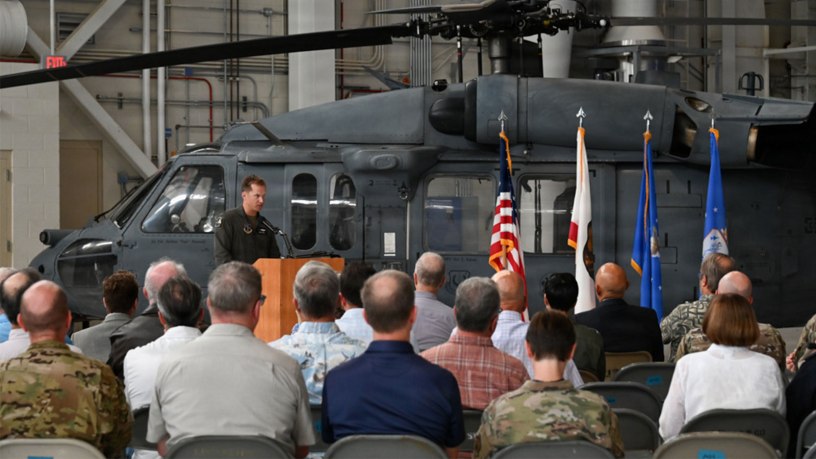
That chapter closed on Sept. 10, as the California Air National Guard’s 129th Rescue Wing marked the retirement of the U.S. Air Force’s final operational HH-60G Pave Hawk with a divestment ceremony and final flight at Moffett Air National Guard Base, near Mountain View, California.
The ceremony commemorated more than the retirement of tail number 27045. It honored a legacy built by the pilots, special mission aviators, pararescuemen, maintainers and support personnel who transformed the Pave Hawk from a helicopter into a symbol of hope and survival. For those Airmen, the aircraft’s legacy is inseparable from the people who kept it flying and the lives its crews worked to save.
“Our motto is ‘these things we do that others may live’, which means that at any time, anywhere, any place, we’re going to send crews and helicopters into harm’s way if necessary to save a life, because it matters,” said U.S. Air Force Senior Master Sgt. Sean Pellaton, flight engineer and senior enlisted leader of the 129th Rescue Squadron.
Since 1977, the 129th is credited with saving 1,190 lives, many of them with the Pave Hawk playing a critical role in the rescue. The aircraft supported many of the wing’s most critical missions, including operations following hurricanes Katrina, Ike, and Harvey.
Overseas, the Pave Hawk carried 129th crews during deployments in Afghanistan, contributing to more than 300 combat saves.
After training and combat losses in Afghanistan and Iraq impacted the rescue fleet, the Air Force converted six U.S. Army UH-60L Black Hawk helicopters to rescue, modified to become HH-60G Pave Hawks. Tail #27045, the last operational Pave Hawk, was one of them.
For air crews, accomplishing that mission required countless hours of training and trust built between crew members and the aircraft.
“When you’re flying the [Pave Hawk], you kind of become one with that machine,” said U.S. Air Force Lt. Col. Benjamin Buchta, HH-60 pilot and commander of the 129th Rescue Squadron. “The Golf feels like home when I sit in it.”
Before every launch was another team of Airmen whose work began long before wheels left the ground.
Maintainers spent long hours inspecting and repairing the Pave Hawk, working to sustain an aging aircraft, where readiness could directly affect whether someone made it home.
“You go through all this training and finally all this training comes to a point when you have to prove yourself that you performed training correctly,” said U.S. Air Force Master Sgt. Brock Woodward, a flight engineer and prior maintainer assigned to the 129th Rescue Squadron.
For many of those Airmen, the HH-60G was the aircraft they learned their profession on, deployed with, and devoted their lives to help save others.
“Rescuing another human being is much more rewarding than any award and [decoration] that you could receive,” said Woodward.
The Pave Hawk’s retirement, however, does not mean the end of the mission it helped define.
“It built the helicopter combat search and rescue community into what it is today,” said Buchta.
The Pave Hawk was the platform and cornerstone for many of the tactics the Air Force uses now, he said.
The HH-60W Jolly Green II carries the Air Force’s next generation of combat rescue capabilities, bringing new technology and increased capabilities to the personnel recovery mission.
The final flight of the HH-60G marked the end of an era that stretched across generations of rescue Airmen. Its legacy can be measured in missions flown and lives saved, but it also lives in the Airmen who crewed its cockpits, worked on its flight line and supported every launch.
They gave the Pave Hawk its purpose.
And while the last HH-60G has flown its final Air Force mission, the legacy those Airmen built will continue wherever rescue crews answer the call to bring someone home.

