
By Peggy Bebb, U.S. Army Corps of Engineers, Jacksonville District
LAKE OKEECHOBEE, Fla. – Much of Lake Okeechobee’s recovery is happening out of sight, beneath the water’s surface. In some areas of the lake, native underwater plants are beginning to return which is an early, but important, sign of improving habitat for fish and wildlife. Chara is already growing, and shoots of tape grass have begun to appear.
Chara and tape grass act like natural filters. They help hold mud and sediment in place, reducing cloudy water and allowing more sunlight to reach below the surface. They also use nutrients that might otherwise fuel excess algae growth. Their leaves and branches create shelter and feeding areas for small fish, insects, snails and other aquatic animals. Those smaller animals, in turn, become food for larger fish and birds.
Along with pondweed, Chara and tape grass help build an underwater habitat that strengthens the lake’s food web, improves habitat quality and helps keep the lake clear, healthy and full of life.
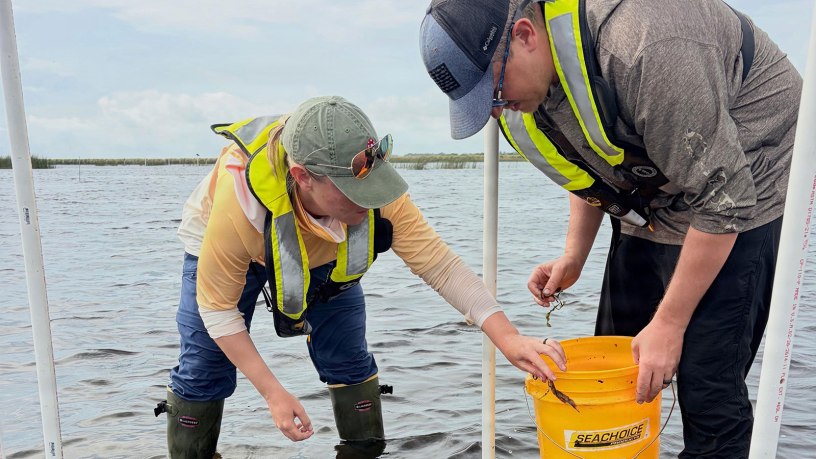
To build on this natural recovery, a small team of Jacksonville District’s Operations Division personnel recently planted native pondweed in 10 protected cages on Lake Okeechobee.
Operations Biologist Lee Martin led the project with assistance from Lead Park Ranger Megan Parsons, Biologist Jessica “Skippy” Martin and a small group of volunteers. The team built and installed 10 protective cages, each about three feet by three feet and five feet tall and planted pondweed inside them.
The cages give young plants time to establish.. The cages protect the plants during that early stage while allowing the team to monitor how well they survive and grow under lake conditions.
“We are seeing encouraging signs of natural submerged aquatic vegetation (SAV) recovery in this area,” Lee Martin said. “This pilot gives us an opportunity to build on that recovery and test whether targeted pondweed plantings can help increase the diversity and extent of native SAV.”
Pondweed was selected because it adds another type of native underwater plant to the recovering area. Different plants provide different forms of cover and food for the wildlife that live in the lake. Together, Chara, tape grass and pondweed can create a stronger and more diverse underwater habitat than any one plant could provide alone.
“Native plants are the foundation of a healthy ecosystem, and adding pondweed alongside the existing Chara and emerging tape grass gives us a greater variety that plants can provide different types of habitat and resources,” Lee Martin said.
That matters because underwater plants do more than grow on the lake bottom. They give wildlife places to hide, feed and reproduce. They help support the small aquatic animals that are food for fish, birds and other wildlife. They also help keep sediment from being stirred up by wind and waves. When less sediment is stirred, the water can remain clearer, allowing sunlight to reach and support more underwater vegetation growth.
The team selected planting locations based on water depth, bottom conditions, exposure and the presence of existing SAV. “The Chara and emerging tape grass were encouraging indicators that the area could support additional submerged vegetation,” Lee Martin said.
The pondweed cages were placed near a bulrush planting completed by the South Florida Water Management District. The two efforts are meant to complement each other. Bulrush grows near the shoreline, while pondweed creates habitat beneath the surface. The bulrush creates a good buffer to protect the new sav from extreme wave action.
“The enclosures will protect the newly planted vegetation while it is becoming established and developing roots and new growth,” Lee Martin said.
The project was a team effort. Lee Martin and Skippy Martin planned the work, developed the cage design and selected planting locations. Skippy Martin operated the boat during fieldwork, while Parsons helped assemble the cages and plant the pondweed. Volunteers cut poles for the cages, and the South Florida Water Management District completed the nearby bulrush planting.
For now, the team will be watching for simple but meaningful signs: pondweed remains healthy, develops roots and produces new growth. An increase in plant coverage inside the cages would be another positive signal.
The long-term goal is for pondweed to grow outside the cages and spread naturally.
“If we eventually see pondweed growing outside the cages, reproducing and becoming established naturally, that will tell us the plants are doing more than surviving under protection,” Lee Martin said. “It would show they may be able to become part of Lake Okeechobee’s recovering plant community.”
This is a small project on a very large lake, and it will take time to see the full results. Still, the 10 planting sites can help the team learn what works, where pondweed performs best and how future planting efforts might be expanded.
“These ten planting sites are really a way to test an approach that could eventually help expand native SAV across a much broader area of the lake,” Lee Martin said.
The hope is that these small, protected plantings will help more native underwater vegetation return over time—creating better habitat for fish and wildlife, complementing the lake’s natural recovery and supporting a healthier Lake Okeechobee.

